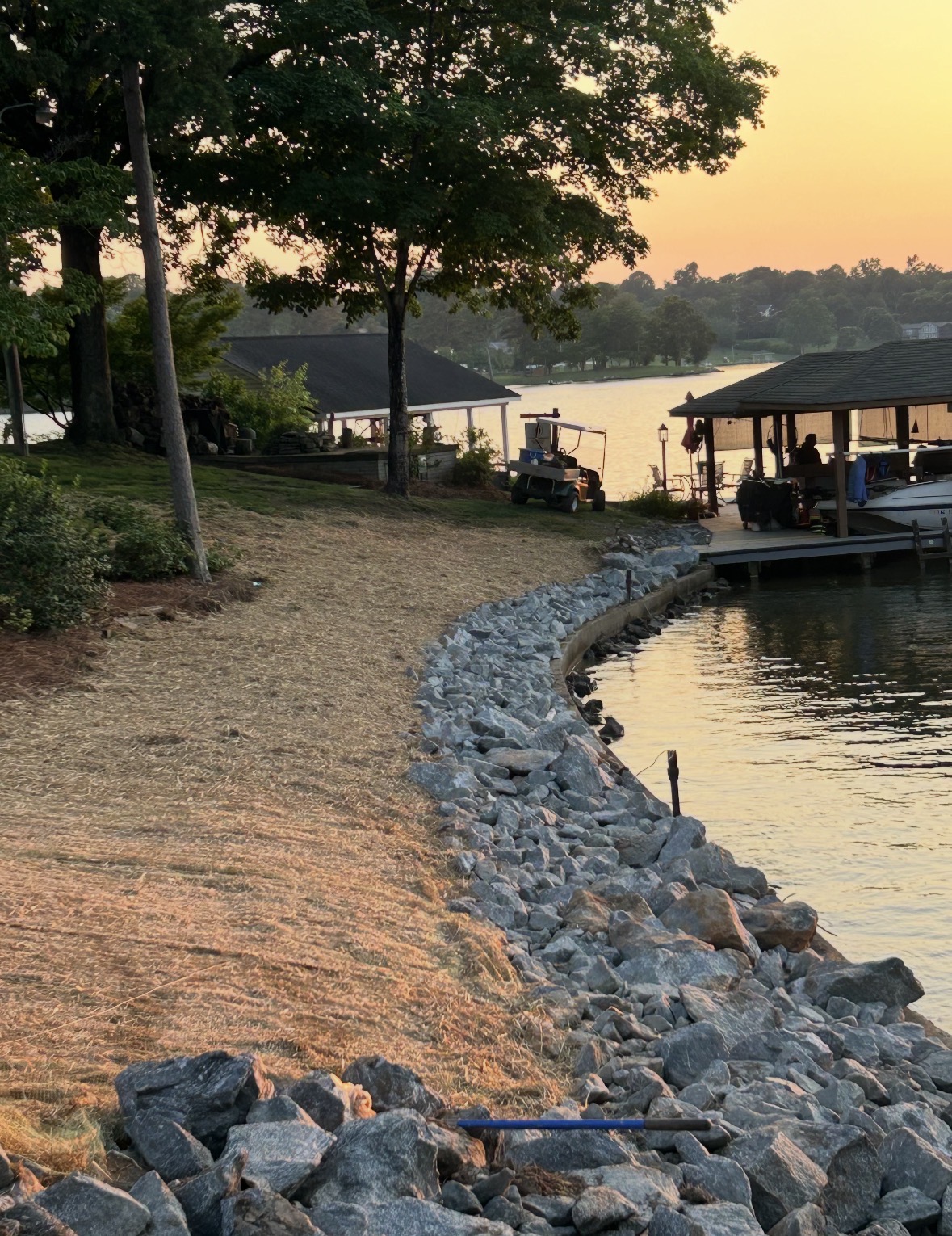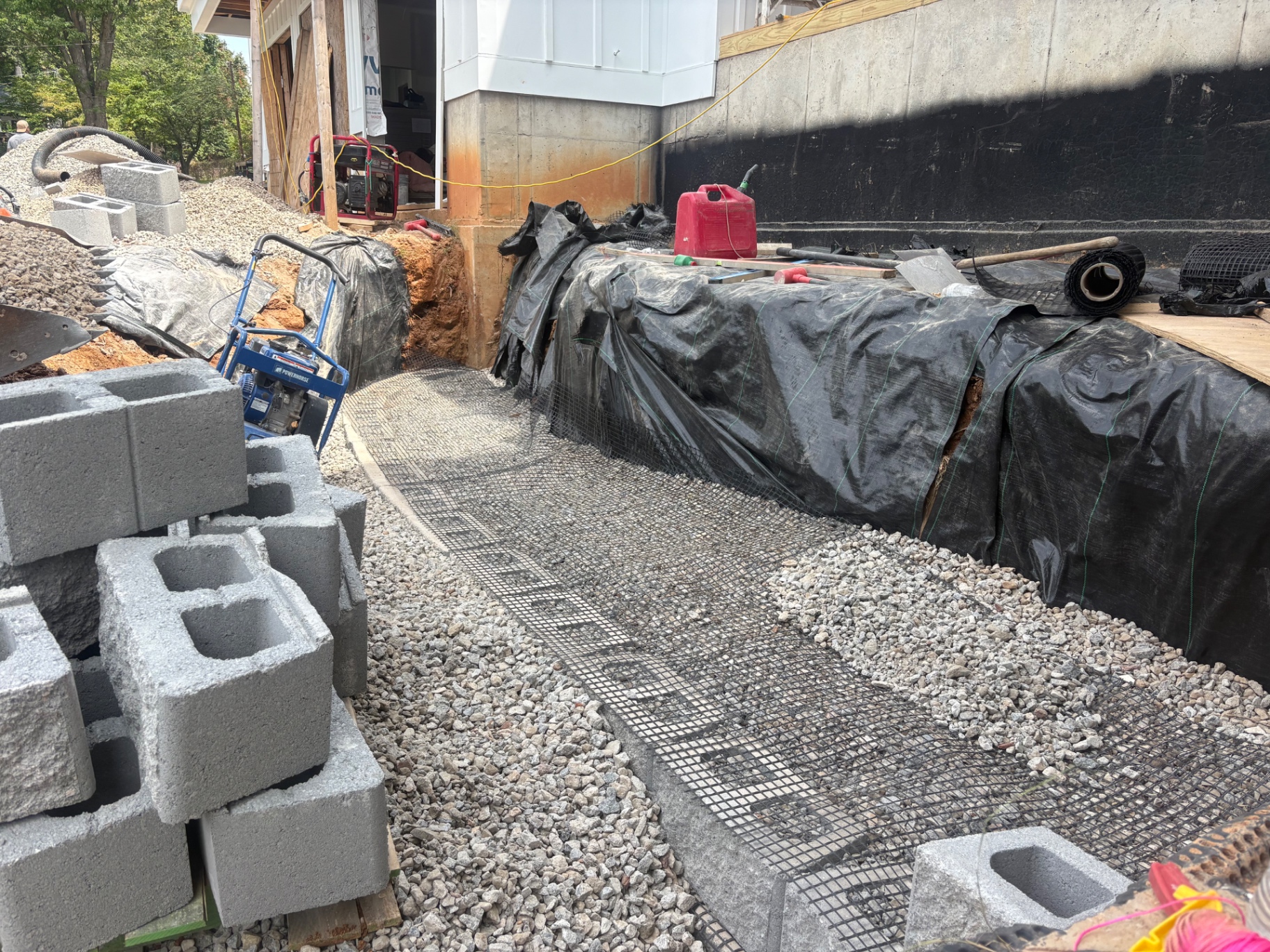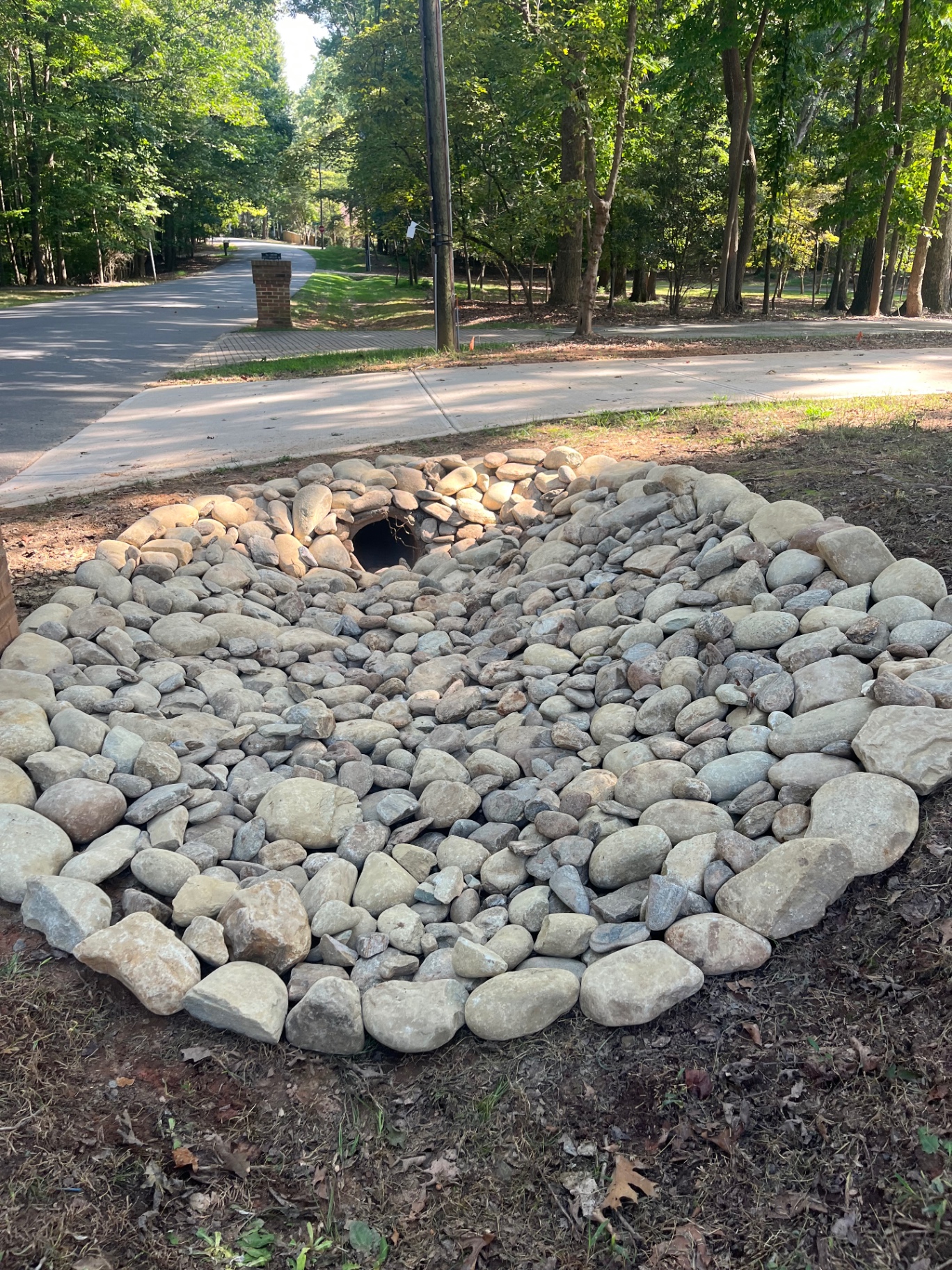
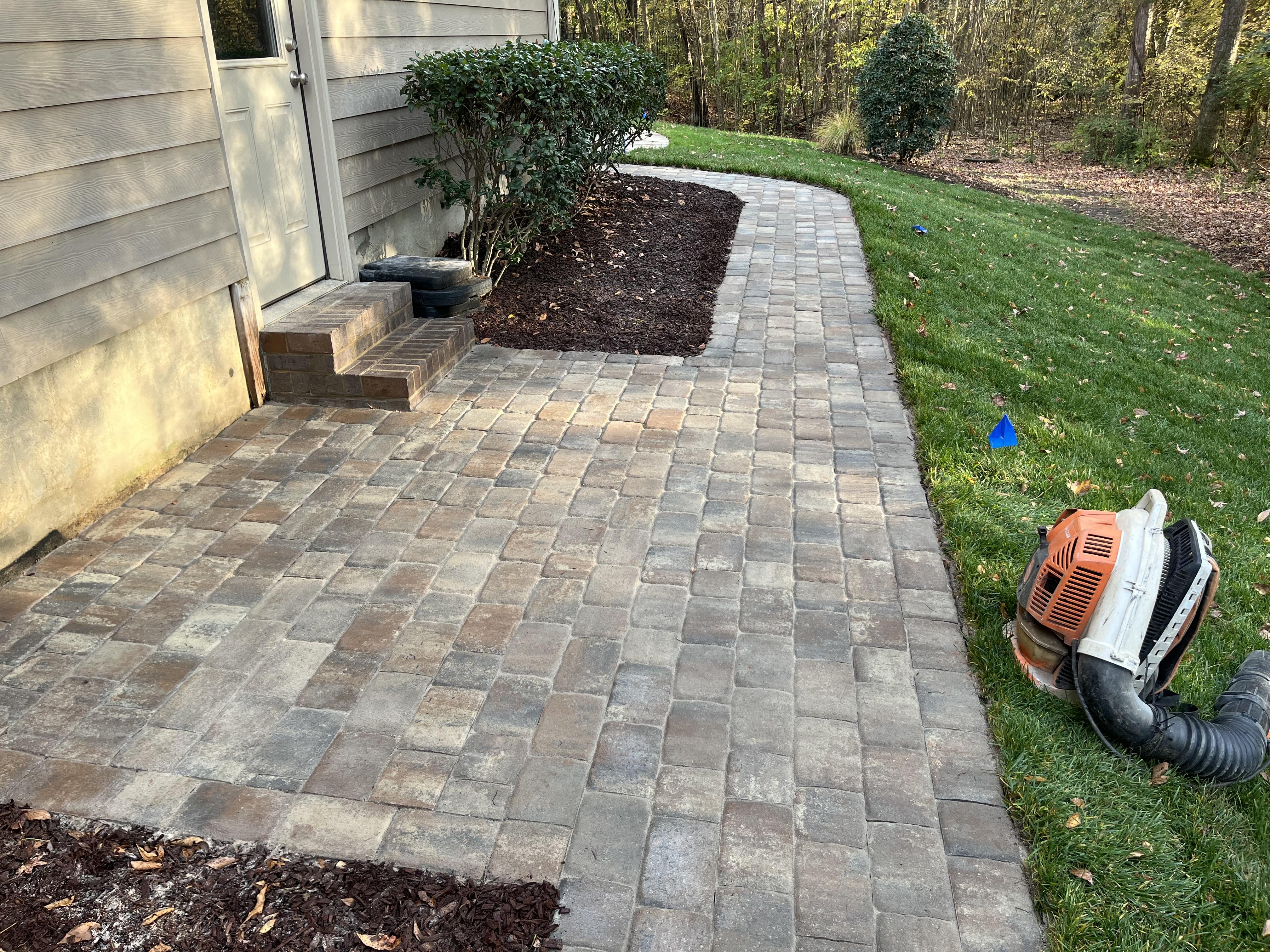
A yard drainage system is a planned path that moves water off the surface and out of the soil to a safe discharge point. Most Lake Norman properties need a combination — grading to shed surface water, collection points such as catch basins or channel drains, solid pipe to carry that water away, and in wetter areas a perforated French drain to intercept water already in the ground. Which combination is right depends on your elevation, soil, water volume, existing utilities and where the water can legally and safely go.
Quick answer
Yard drainage is not one product. It is a system with four parts: a place water is collected, a pipe that carries it, a slope that makes it move, and an outlet that releases it somewhere it cannot cause a new problem.
Surface drainage (grading, swales, catch basins, channel drains) handles water running across the ground. Subsurface drainage (perforated pipe in washed stone wrapped in filter fabric, commonly called a French drain) handles water saturating the soil. Many yards around Lake Norman need both because Piedmont clay drains slowly and holds water near the surface.
The single most important design decision is the outlet. Until you know where water can go — a daylight point on a downslope, a pop-up emitter in a lower lawn area, an approved storm structure — pipe type and trench depth cannot be settled.
Surface drainage: moving water before it soaks in
Surface drainage starts with grade. Ground should fall away from the house and from patios, and it should keep falling all the way to an outlet rather than stopping in a low spot. When a yard holds water after every storm, the first question is whether the ground shape can be corrected before pipe is ever considered.
Where grade alone is not enough, water is collected. A catch basin is a buried box with a grate that captures a low point and connects to pipe. A channel drain (also called a trench drain) is a long, narrow grated channel set flush across a driveway, patio edge or garage apron where a single point inlet would not catch a wide sheet of water.
A swale is a shallow, shaped depression that carries water across the yard on the surface. On properties with room, a swale can move a large volume with little maintenance and no pipe to clog.
Subsurface drainage: intercepting water in the soil
When the ground stays spongy for days, the problem is usually water held in or moving through the soil rather than water sitting on top of it. A French drain addresses that: a trench, filter fabric, washed drainage stone, and perforated pipe laid so groundwater enters the pipe through its holes and is carried away.
Filter fabric is the part homeowners most often skip and most often regret. Its job is to keep fine clay and silt out of the stone and pipe. Without it, the voids between stones fill with sediment and the drain slowly stops working — often years after it was installed, which makes the cause hard to see.
A French drain only works if the water it collects has somewhere to go. In flat lots with no downhill outlet, a French drain that ends in the ground simply relocates the saturation.
Roof water: downspouts and underground piping
Roof runoff is concentrated water, and it is often the largest single contributor to a wet yard. A downspout that discharges at the foundation delivers hundreds of gallons within a few feet of the structure during one storm.
Downspouts are normally tied into solid (non-perforated) pipe and carried well away from the house. Solid pipe is used deliberately here: the goal is to transport the water, not to let it seep back into the soil beside the foundation. The line typically terminates at a daylight outlet on a slope or a pop-up emitter that opens under flow and closes after.
Gutter and downspout capacity matters too. Undersized or overloaded gutters overflow at the corners and create the same wet spots the underground line was meant to prevent.
Choosing pipe: there is no universal answer
Pipe selection depends on what the pipe has to do. Solid pipe transports water from a collection point to an outlet. Perforated pipe collects groundwater along its length. Using the wrong one is a common and expensive mistake — perforated pipe beside a foundation releases the water you were trying to remove.
Beyond solid versus perforated, the choice is about crush resistance, interior smoothness, cleanability and depth of cover. Rigid PVC has a smooth bore and takes a drain snake or jetter well. Quality smooth-interior or dual-wall HDPE performs far better than thin single-wall corrugated pipe and is a reasonable choice in many runs. Single-wall corrugated pipe is inexpensive and flexible but its ridged interior slows flow, traps sediment and is harder to clean.
Depth, traffic loads, fittings, cleanout access and the length of the run all factor in. A short lawn run under no traffic is a different problem from a 120-foot line crossing a driveway.
Slope, sizing and outlets
Pipe has to fall continuously toward the outlet, and it has to be large enough for the flow it will receive. Neither number can be copied from an article. Both come from field conditions: how much roof and hardscape drains to the line, how far the water must travel, how much elevation is actually available between the inlet and the discharge point, and whether other structures or utilities dictate the path.
The available discharge elevation is often the limiting factor. If there is only a small drop between the inlet and the only legal outlet, the design may need larger pipe, a different route, fewer inlets on one line, or a pumped solution rather than more slope than the site can provide.
Discharge must also be safe. Water released onto a bare slope, at a property line or directly onto a neighbor's yard creates erosion and disputes. Outlets should be stabilized, and stormwater rules, easements and shoreline buffers apply in parts of the Lake Norman area.
What Lake Norman conditions change
Piedmont clay is the constant. It sheds water rather than absorbing it, so runoff arrives fast and then sits. A percolation test on a specific spot tells you more about that yard than any general rule about North Carolina soil.
Newer neighborhoods in Mooresville and Denver add a second factor: construction grading and compacted subsoil. Lawns installed over compacted fill behave like a shallow bowl, and the fix is usually corrective grading plus a designed outlet rather than a drain in the lowest corner.
Waterfront and creek-adjacent properties in Cornelius, Davidson and Sherrills Ford add shoreline erosion, buffer rules and fluctuating water levels to the design.
Common installation mistakes
Most failed drainage systems were installed with reasonable materials and an unreasonable plan. These are the recurring causes we find when we open an old system.
- No outlet, or an outlet that is higher than the inlet once the line is actually dug.
- Perforated pipe used to carry downspout water next to the house.
- Washed stone omitted or dirty stone used, so the trench silts in.
- No filter fabric, or fabric wrapped only around the pipe in heavy clay.
- No cleanouts, leaving no way to inspect or flush the line later.
- Fittings that create sharp turns instead of sweeping wyes and long-radius bends.
- Pipe buried too shallow under a drive or parking area and later crushed.
- Utilities not located before digging.
When to call a professional
Call when water reaches the foundation or crawlspace, when soil is washing off a slope, when a previous drain has stopped working, when the only apparent outlet is on someone else's property, or when the line must cross a driveway, septic area, or utility corridor.
A site visit should produce a diagnosis first — where the water comes from, where it collects, and where it can go — and a proposed system second. Any contractor who names a product before walking the elevations is guessing.
Utility locating through NC 811 is required before excavation, and some work may fall under county stormwater, erosion control or buffer rules.
Key takeaways
If you remember nothing else from this guide, remember these points before you buy a drainage system.
- Drainage is a system — collection, conveyance, slope and outlet — not a single product.
- Solid pipe transports water; perforated pipe collects groundwater. They are not interchangeable.
- Pipe type, size and slope are determined by site conditions, not by a general rule.
- The outlet location usually dictates the rest of the design.
- In Lake Norman clay, grading corrections and filter fabric matter as much as the pipe you choose.
Helpful outside reference
For background on why hard surfaces send more water across a yard, see the EPA guidance on urban runoff.
Frequently asked questions
What is the difference between surface and subsurface drainage?
Surface drainage moves water flowing across the ground using grade, swales, catch basins and channel drains. Subsurface drainage removes water held in the soil using perforated pipe in washed stone wrapped with filter fabric. Many yards need both.
Do I need a French drain or better grading?
If water sheets across the yard and collects in a low spot, grading is usually the first correction. If the ground stays saturated and spongy between storms, a subsurface drain may be needed. A site evaluation determines which condition you actually have.
Where can drainage water be discharged?
To a lower point on your own property that can accept the flow without eroding, or to an approved stormwater structure. Discharge should not be directed onto a neighboring property, and easements, shoreline buffers and local rules apply in parts of the Lake Norman area.
How long does a yard drainage system last?
Service life depends on materials, installation and maintenance rather than a fixed number of years. Systems with washed stone, filter fabric, proper slope and accessible cleanouts last far longer than systems without them, because most failures are sediment and crushing rather than the pipe wearing out.
Does a drainage system need maintenance?
Yes. Grates and basins should be cleared of leaves and debris, outlets should be kept open and visible, and lines with cleanouts can be flushed if flow slows. Systems buried with no access point are the hardest and most expensive to service later.
Want this looked at on your property?
We give free, no-pressure on-site estimates across Denver, Mooresville, Cornelius, Davidson, Huntersville and Troutman.