Solid drainage pipe is closed along its length and carries water from a collection point to an outlet. Perforated pipe has holes or slots so groundwater can enter it, and it is used to collect water from saturated soil inside a stone-filled trench. Using the wrong one is one of the most damaging mistakes in residential drainage — perforated pipe near a foundation releases the water the system was installed to remove.
Quick answer
Use solid pipe wherever the goal is to move water: downspout lines, catch basin outlets, channel drain outlets, and the main run to the discharge point.
Use perforated pipe wherever the goal is to gather water out of the ground: a French drain trench, a curtain drain intercepting hillside seepage, or drainage behind a retaining wall.
Most real systems use both. A French drain may collect water with perforated pipe for 40 feet, then transition to solid pipe to carry that water past the patio to a safe outlet.
How each type works
Solid pipe behaves like a closed conduit. Water enters at a defined inlet, travels the pipe, and exits at the outlet. Nothing is meant to leave through the pipe wall, and nothing is meant to enter except at the inlets you designed.
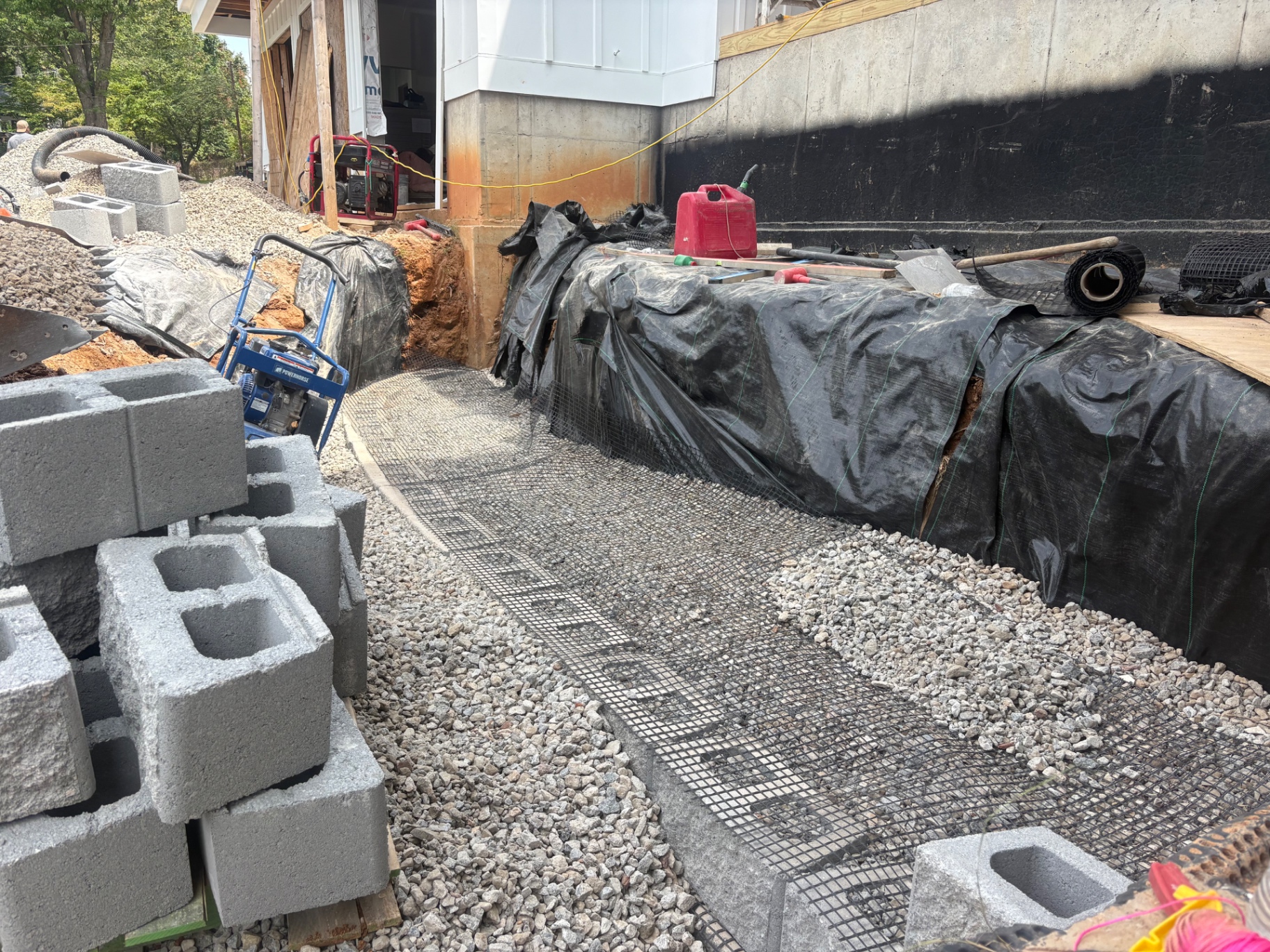
Perforated pipe behaves like a collector. It sits in a trench of washed drainage stone wrapped in filter fabric. Water in the surrounding soil moves into the coarse stone, which drains easily, and then enters the pipe through its perforations. The stone is not decoration — it is the reservoir and pathway that makes the pipe useful.
Filter fabric separates the stone from surrounding soil. In Piedmont clay this is essential, because fine particles migrating into the stone will eventually clog the void space and end the drain's usefulness.
Side-by-side comparison
The distinction is functional, and it applies to PVC and HDPE alike.
| Solid pipe | Perforated pipe | |
|---|---|---|
| Purpose | Transport collected water | Collect water from saturated soil |
| Typical location | Downspout lines, basin and channel drain outlets, mains | French drains, curtain drains, wall drainage |
| Surrounding material | Bedding and compacted backfill | Washed drainage stone wrapped in filter fabric |
| Water entry | At designed inlets only | Along the entire perforated length |
| Risk if misused | Rarely harmful; simply does not collect groundwater | Releases water where it was meant to be carried away, including near foundations |
Which way do the holes go?
This question comes up constantly, and the honest answer is that it depends on the design intent and the product. Some installations place perforations down so water is picked up as soon as it reaches the pipe invert; others place slots up in specific designs. What is consistent is the surrounding assembly: washed stone above, below and around the pipe, with fabric separating that stone from soil.
A perforated pipe laid directly in a clay trench with a thin scattering of gravel will underperform regardless of hole orientation. The stone envelope and the fabric do most of the work.
Why the mistake is expensive
The most costly version is perforated pipe used to carry downspout water. Roof runoff is concentrated, and a perforated line leaks it out along the trench — frequently within a few feet of the foundation, which is the exact condition the homeowner hired someone to eliminate.
The second version is solid pipe installed in a stone trench to fix a saturated lawn. Water has no way in, and the drain does nothing except create a buried stone strip.
Both mistakes are hidden underground and usually surface as 'the drain we paid for did not work,' months or years later.
Common installation mistakes
What we look for when diagnosing a system that underperformed.
- Perforated pipe used for conveyance beside a house or patio.
- Solid pipe buried in a stone trench intended to collect groundwater.
- No filter fabric, or fabric only sleeved on the pipe in heavy clay.
- Screenings or dirty gravel used instead of washed drainage stone.
- Perforated section extended past the collection zone all the way to the outlet.
- No transition fitting where perforated meets solid, allowing soil intrusion.
- Collection line installed with no viable outlet for the water it gathers.
When to call a professional
Call when water is reaching the foundation or crawlspace, when a previous drain has stopped working, when the collection area and the outlet are far apart or separated by hardscape, or when you cannot tell whether your problem is surface runoff or soil saturation.
Diagnosis should come before pipe selection. A contractor should be able to describe where water enters the system, how it travels and where it leaves before naming a product. Utility locating is required before excavation.
Key takeaways
Five points that prevent the most common drainage regret.
- Solid pipe transports; perforated pipe collects. They are not interchangeable.
- Perforated pipe belongs in washed stone wrapped in filter fabric, not bare soil.
- Downspouts and catch basins normally connect to solid pipe.
- Most complete systems combine both, with a clean transition between them.
- Whether your yard needs collection, conveyance or both is a site question, not a product question.
Helpful outside reference
For background on why hard surfaces send more water across a yard, see the EPA guidance on urban runoff.
Frequently asked questions
What is the difference between solid and perforated drainage pipe?
Solid pipe is closed and carries water from an inlet to an outlet. Perforated pipe has holes or slots so groundwater can enter along its length, and it is installed inside washed drainage stone wrapped in filter fabric to collect water from saturated soil.
Can I use perforated pipe for my downspouts?
That is generally the wrong choice. Downspout water is concentrated roof runoff and should be transported away in solid pipe, not released along a trench near the structure. Solid pipe keeps that water moving to a safe discharge point.
Does a French drain need stone and fabric, or just pipe?
A French drain normally uses perforated pipe surrounded by washed drainage stone with filter fabric separating that stone from the surrounding soil. The stone provides the void space water moves through, and the fabric keeps fine clay and silt from filling it.
Can one line be perforated in part and solid in part?
Yes, and that is standard practice. The perforated section sits in the wet collection zone, then transitions to solid pipe to carry the collected water past patios, foundations and dry areas to the outlet.
Should perforations face up or down?
It depends on the design and the product, and reasonable installers differ. What matters more in every case is the washed stone envelope surrounding the pipe and the filter fabric that keeps soil out of it.
Want this looked at on your property?
We give free, no-pressure on-site estimates across Denver, Mooresville, Cornelius, Davidson, Huntersville and Troutman.