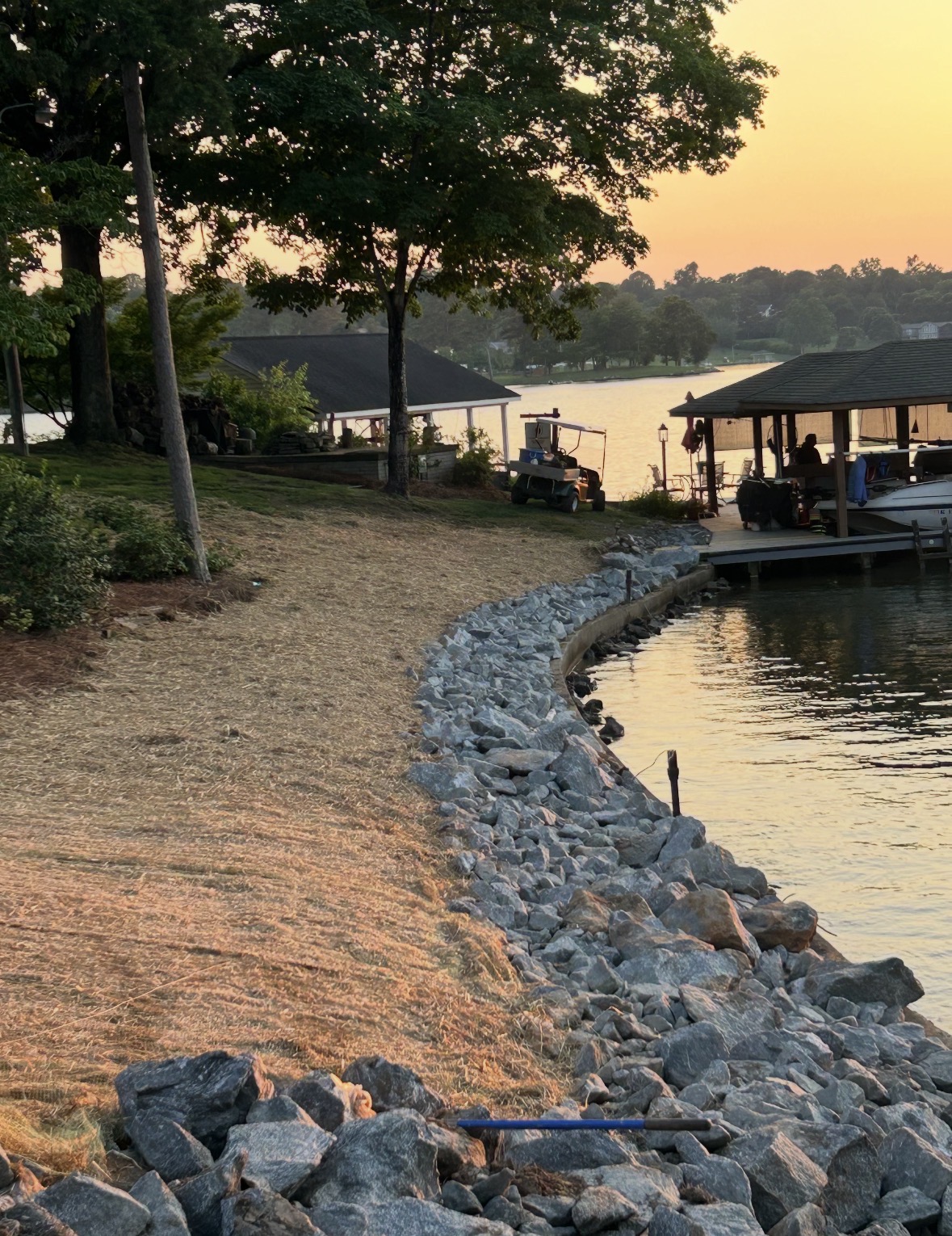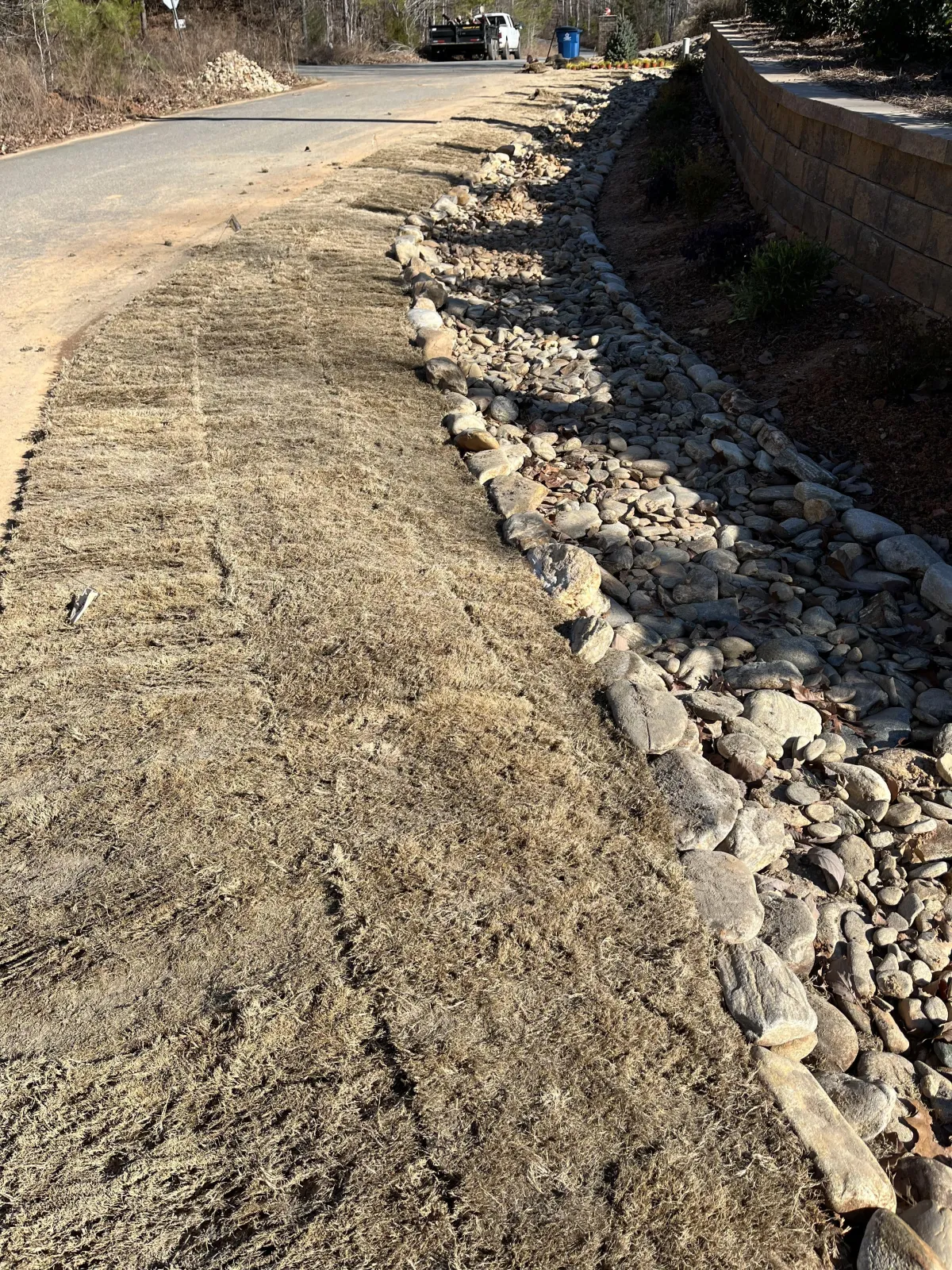
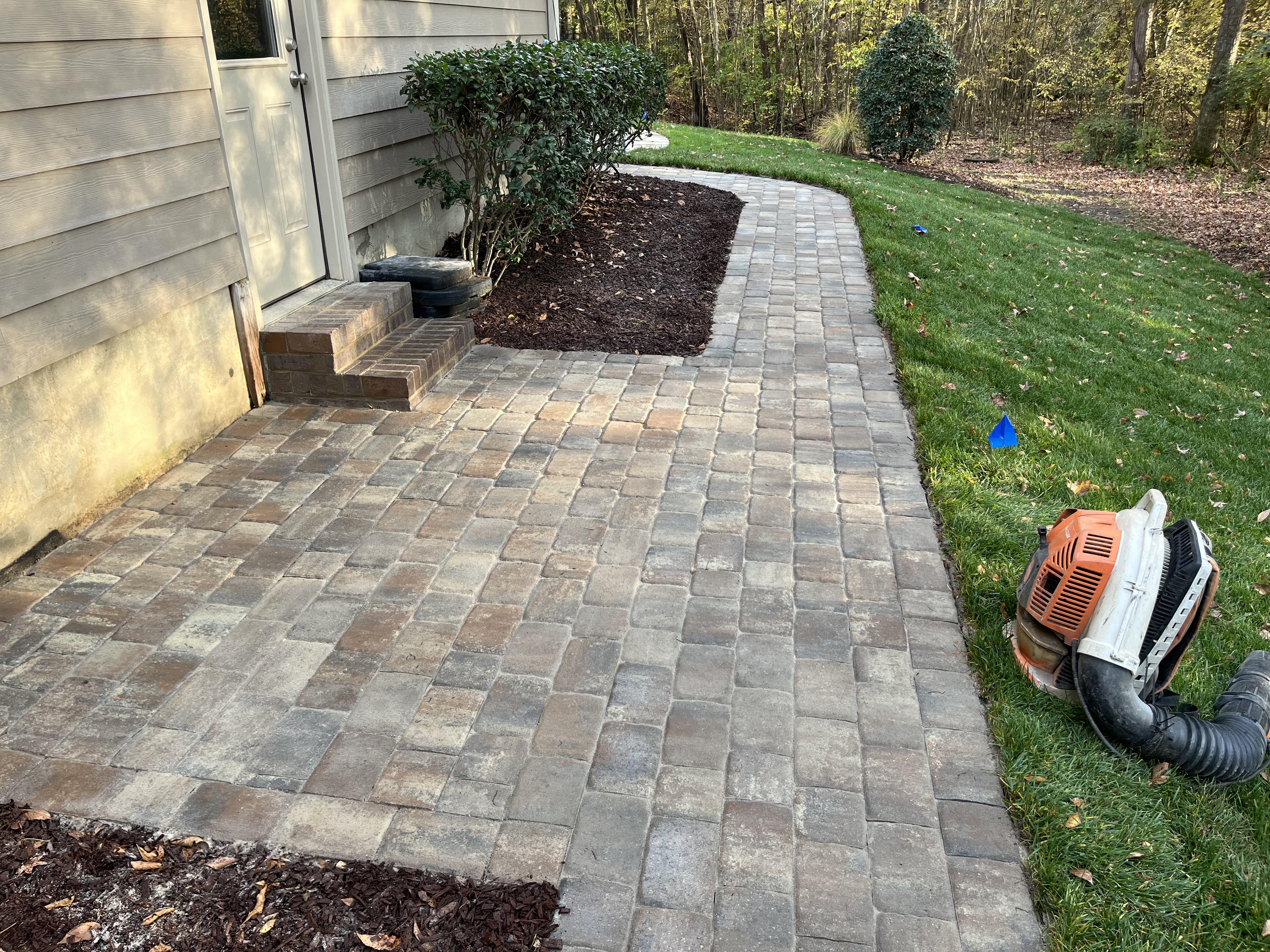
Water in a yard arrives two ways: it runs across the ground, or it sits in and moves through the soil. Surface drainage handles the first. Subsurface drainage handles the second. Fixing the wrong one is the most common reason a drainage job disappoints.
What surface drainage does
Surface drainage moves water that is running over the ground: roof runoff, driveway sheet flow, water coming off a neighbouring lot.
The tools are grading and shaping, swales, catch basins in low points, channel drains at hard-surface edges, and piped downspout extensions carrying roof water away from the house.
It is the first thing to fix, because most yard water problems around Lake Norman are simply too much water arriving too fast at a low point with nowhere to leave.
What subsurface drainage does
Subsurface drainage intercepts and moves water in the soil — the water that keeps a lawn spongy for days after the rain has stopped, or that keeps a crawlspace damp.
The tool is a perforated pipe in a stone-filled trench wrapped in geotextile, set at a depth and slope that catches the moving water. A French drain, correctly built.
It is slower to act and less dramatic than surface work, and it is what surface grading alone cannot fix on clay-heavy sites where water perches above a dense layer.
Telling which one you have
Water that appears during rain and is gone within hours is a surface problem. Route it and slope it away.
Ground that stays soft and squelching for days after rain, or a seep line partway down a slope that runs when it has not rained, is a subsurface problem.
Water that pools right at the foundation with a mulch bed sloping back toward the house is a grading problem first, and often nothing else is needed.
Most properties we survey around Lake Norman have some of each — a low spot that needs shaping, downspouts dumping at the wall, and one wet zone that needs interception.
Where the water finally goes
Neither system works without an outlet. Every pipe needs somewhere legal and lower to discharge — a daylight outlet on a slope, a pop-up emitter, or an approved connection.
A drain that outfalls into a low spot in your own yard has moved the puddle, not solved it.
Southern Style Turf & Design surveys the whole property, identifies which type of water you have, and builds surface and subsurface drainage across the Lake Norman area. Free on-site estimate.
Frequently asked questions
Do I need both types of drainage?
Often yes. Surface work is done first because it removes the bulk of the water; subsurface work then handles what is left in the soil.
Can regrading alone fix a soggy yard?
Sometimes. If the water is arriving on the surface and the low point can be shaped to drain, grading is the cheaper and better fix.
How long does a soggy yard take to dry after drainage is installed?
Surface improvements are visible in the next storm. Subsurface systems change how the soil behaves over weeks as the water table in that area drops.
Want this looked at on your property?
We give free, no-pressure on-site estimates across Denver, Mooresville, Cornelius, Davidson, Huntersville and Troutman.