A French drain is a gravel-filled trench with a perforated pipe at the bottom that gives water an easier path than the surrounding soil, and a place to go once it is in that path.
The parts and what each does
The trench sets the depth and, critically, the fall. Water moves because the trench bottom slopes continuously toward an outlet.
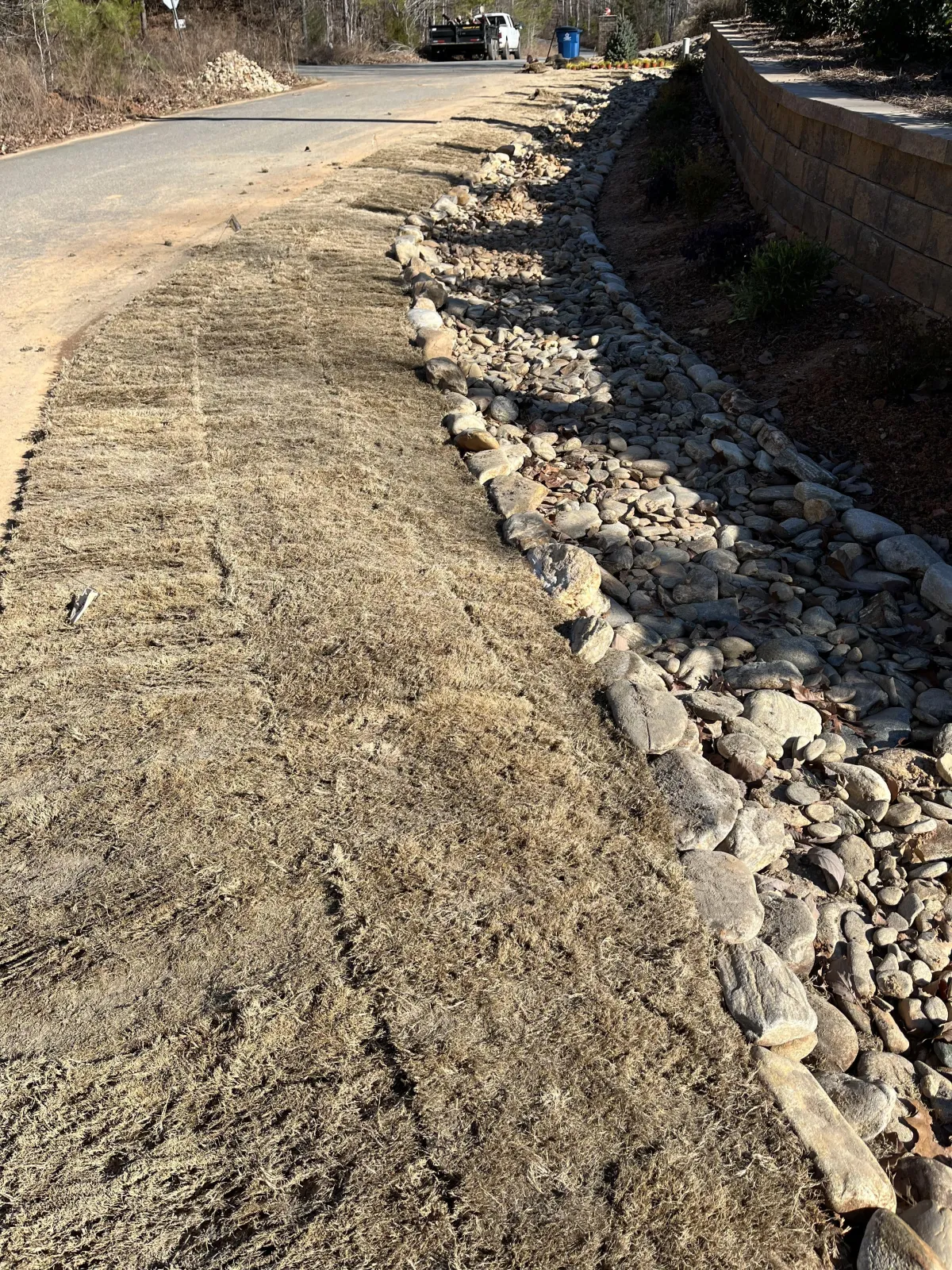
The washed stone fills the trench and creates void space. Water in the soil moves into that space far more readily than it moves through compacted clay.
The perforated pipe sits at the bottom, holes down in most designs, and carries the collected water out much faster than stone alone could.
The geotextile fabric wraps the stone and keeps soil fines out of it. Without fabric, silt clogs the voids and the drain quietly stops working — usually within a few years.
The outlet is the whole point. Daylight on a slope, a pop-up emitter, or an approved connection.
Why it works on clay soil
Piedmont clay transmits water slowly. After a heavy rain, water perches in the topsoil above the dense clay and sits there, which is why a yard can stay soft for days.
A trench of open stone gives that perched water somewhere to drain sideways into, and the pipe takes it away. The drain does not dry out the whole yard — it draws down the zone around it.
That is also why placement matters so much. A French drain uphill of the wet area, cutting across the flow, does far more than one running down the middle of the puddle.
What makes one fail
No fabric, or fabric laid only on the bottom. Silt migrates in and the stone blinds off.
Insufficient or inconsistent fall. A dip in the trench bottom becomes a standing pool inside the drain, and sediment settles there.
Corrugated pipe with a sock, run through soil with no stone. It is quick and it silts up.
An outlet that is buried, crushed, or higher than the drain. Water only leaves if there is somewhere lower for it to go.
Roots into a poorly sealed joint, and mowers or vehicles crushing shallow pipe near the outlet.
Is a French drain the right fix for you?
If water is running across the surface and pooling in a low point, grading, a swale or a catch basin usually gets more done for less.
If the ground is saturated, spongy for days, or there is a seep on a slope, a French drain is the tool.
Behind a retaining wall it is not optional — walls fail from water pressure more often than from any other cause.
Southern Style Turf & Design installs French drains, catch basins, channel drains and surface grading across the Lake Norman area, and checks the outlet before quoting the trench.
Frequently asked questions
How deep should a French drain be?
Deep enough to intercept the water causing the problem and to maintain continuous fall to the outlet. Depth is set by the site, not by a standard number.
Do the pipe holes face up or down?
Down in most residential designs, so water enters at the bottom of the stone and the pipe drains the trench from its lowest point.
How long does a French drain last?
Correctly built with washed stone, wrapped fabric and a clear outlet, decades. Built without fabric or fall, a few years.
Want this looked at on your property?
We give free, no-pressure on-site estimates across Denver, Mooresville, Cornelius, Davidson, Huntersville and Troutman.