Most homeowners focus on where the water enters a drainage system — the French drain trench, the catch basin grate, the downspout connection. The outlet point receives far less attention, which is why so many otherwise well-designed systems fail to actually move water off the property.
Why the Outlet Matters as Much as the Inlet
There are two primary discharge options for residential drainage in the Lake Norman area: pop-up emitters and daylighted pipe outlets. Understanding when to use each one is critical to making the system work long-term.
Pop-Up Emitters: What They Are and When They Work
A pop-up emitter is a small plastic device installed at the end of the drainage pipe at or just above grade. It stays closed when dry (preventing rodent entry and backflow) and opens under water pressure when the system is flowing. They're the right choice when the pipe outlet can't be elevated above a slope — for example, at the edge of a lawn area where you need the outlet flush with the ground surface.
Pop-up emitters work well for downspout drainage extensions and short French drain runs where the pipe terminates in a lawn or landscape area away from the foundation. They do not work well as the sole outlet for high-volume systems — during heavy rain, the small opening can't pass water as fast as a larger pipe is delivering it.
Daylighted Outlets: When Pipe Opens to Air
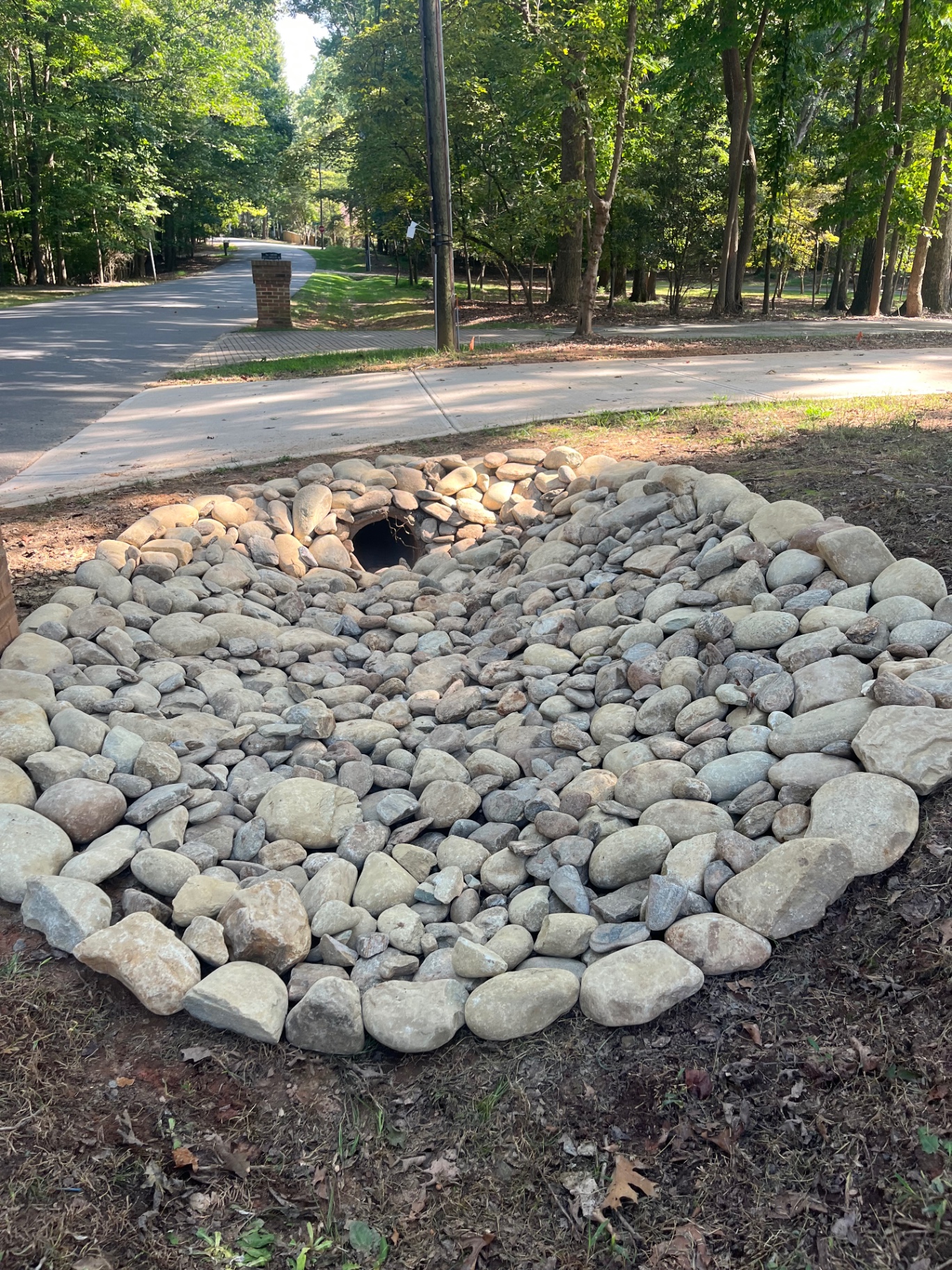
A daylighted outlet is exactly what it sounds like: the pipe exits the ground at a slope face or swale edge and discharges water into open air above a downhill grade. This is the highest-capacity and lowest-maintenance outlet option — no moving parts, no restriction, water flows freely as long as the pipe is sloped correctly.
Daylighted outlets require a slope face where the pipe can terminate above the ground level at the outlet end. On flat Lake Norman lots with no natural slope to daylight into, pop-up emitters or connection to a drainage swale may be the only option.
The outlet elevation must always be lower than the inlet elevation. If the discharge point is the same elevation or higher than where water enters the system, the system won't drain by gravity. This sounds obvious — it gets overlooked surprisingly often.
When Neither Is Enough
On lots with no usable slope and no connection to a storm drain or drainage swale, getting water off the property is the core challenge. In these situations, a dry creek bed or dispersal trench that spreads water slowly into a large area of soil may be the answer — but this requires confirming the soil has adequate permeability to accept the volume. A drainage consultation identifies which outlet strategy works for your specific lot before a system is designed around the wrong one.
Want this looked at on your property?
We give free, no-pressure on-site estimates across Denver, Mooresville, Cornelius, Davidson, Huntersville and Troutman.