A splash block — the rectangular concrete or plastic tray sitting under your downspout — redirects water away from the foundation for about 18–24 inches before it hits the ground and goes wherever the grade takes it. If the grade slopes away from the house, the water moves in roughly the right direction. If the grade is flat or slopes toward the house, the water ends up at the foundation anyway, just 2 feet further out than where the downspout discharged.
What a Splash Block Actually Does
In Lake Norman's clay soils, where surface water moves slowly and saturation persists long after rain stops, a splash block is rarely enough for a roof with significant drainage area discharging at a single point.
How Underground Extensions Work
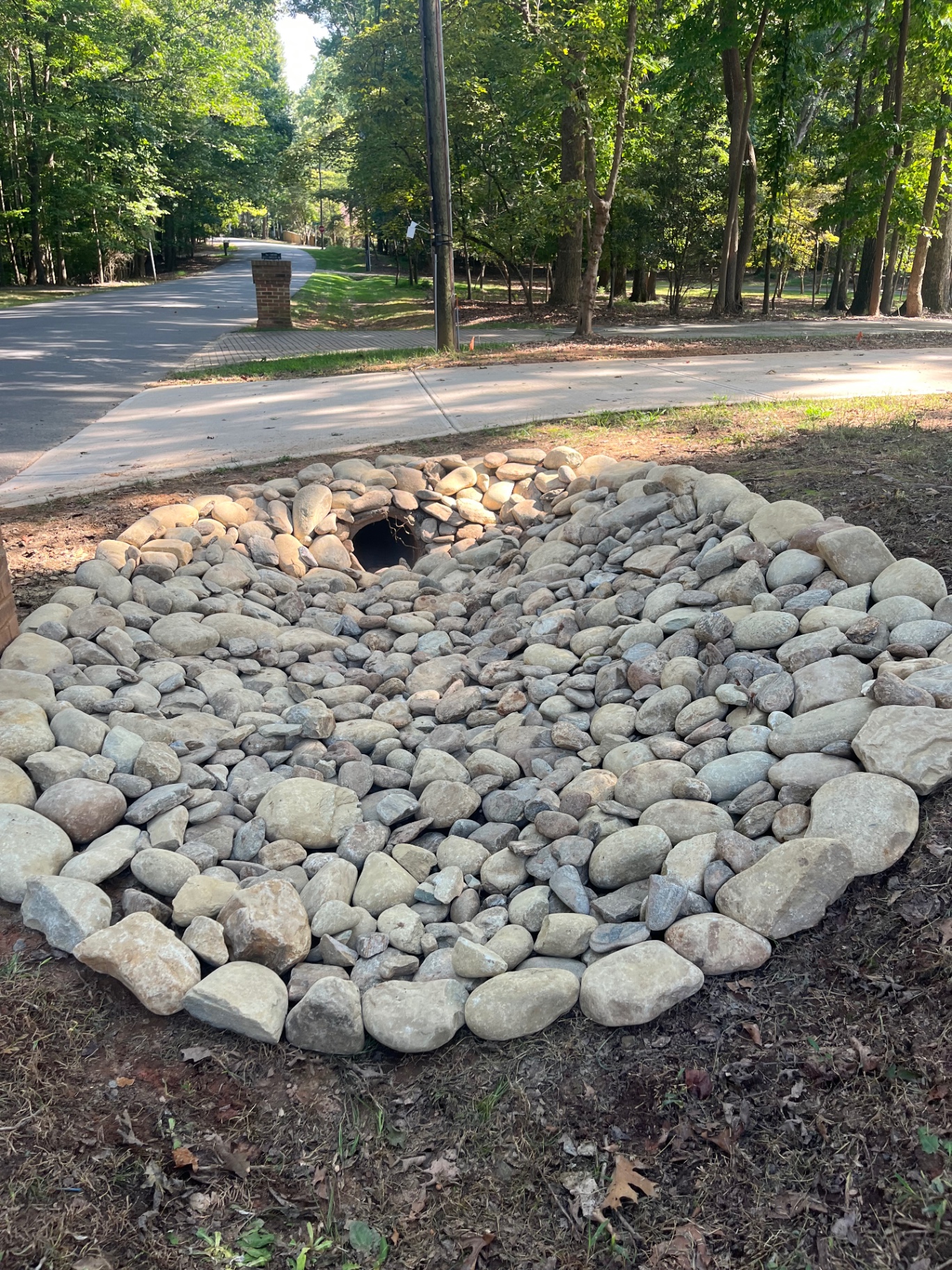
An underground downspout extension connects the downspout discharge to a solid PVC pipe that runs below grade to a discharge point — a pop-up emitter in the lawn, a daylight outlet at a slope face, or a connection to a larger drainage system. Water moves through the pipe underground and surfaces far enough from the foundation that it can't migrate back.
The pipe run needs a minimum slope of 1% (1 inch of drop per 8 feet of run) to drain by gravity. On flat lots, maintaining that slope requires careful planning of the pipe route and outlet point. On sloped lots, gravity does the work and the system is essentially self-maintaining.
When Underground Extensions Are Worth It
Any downspout that discharges within 6 feet of the foundation on a home with a crawlspace or basement. Downspouts at corners where two roof planes come together — these discharge the highest volume and are most likely to cause foundation saturation. Homes where mulch or bed areas adjacent to the foundation show consistent moisture or fungal growth. New construction where the builder's splash blocks are a code-minimum solution that isn't adequate for the actual water volume.
⚠️ The three most common underground extension mistakes: undersized pipe (3-inch pipe where 4-inch is needed), insufficient slope (the pipe holds water instead of draining), and a pop-up emitter in a low area with no outlet slope (water backs up into the pipe).
We install underground downspout extensions as standalone projects and as part of larger drainage systems throughout Lake Norman. Free estimate — no trip fee.
Helpful outside reference
If you want to slow roof water down instead of only piping it away, EPA's guide to rain gardens is a useful starting point.
Want this looked at on your property?
We give free, no-pressure on-site estimates across Denver, Mooresville, Cornelius, Davidson, Huntersville and Troutman.