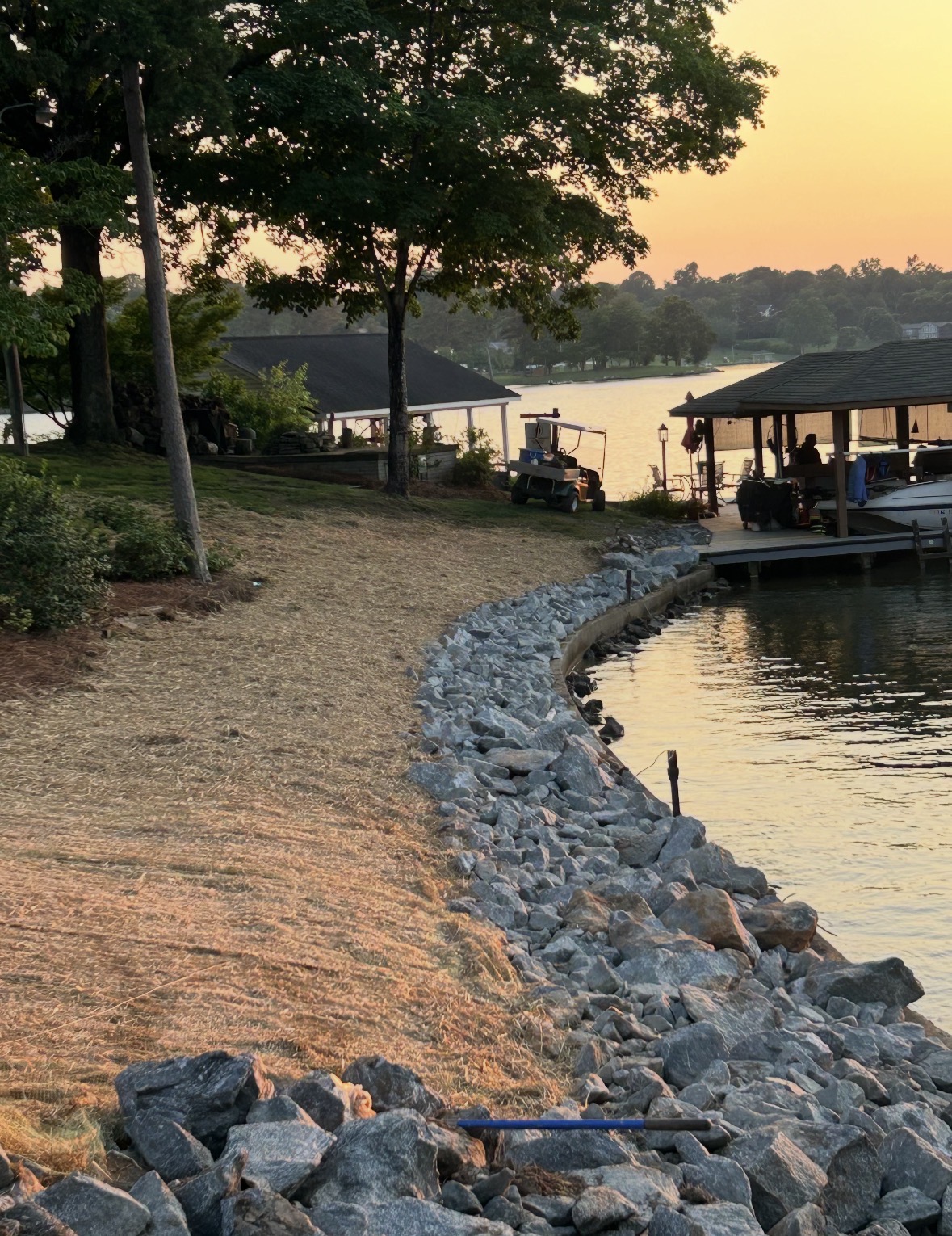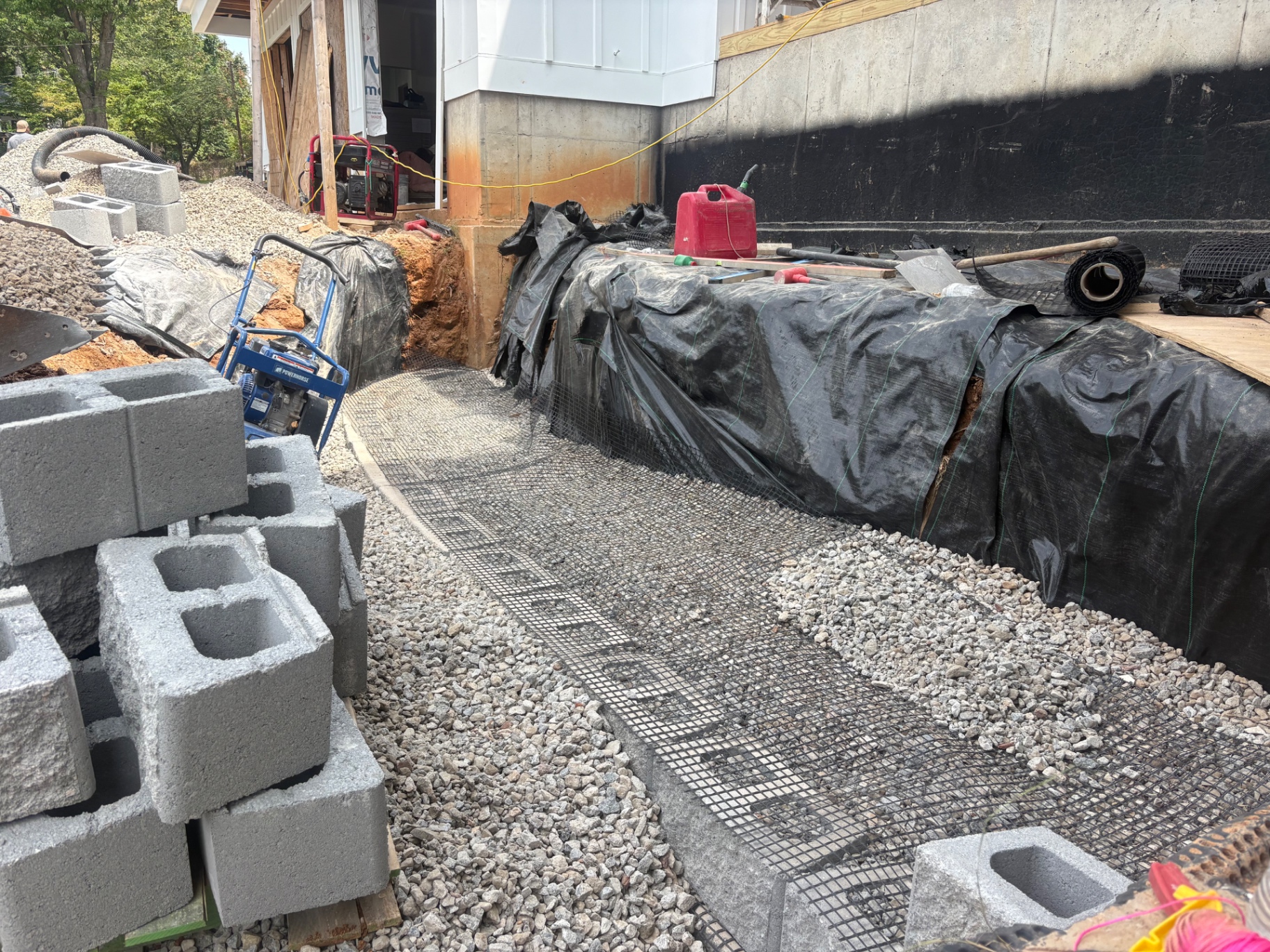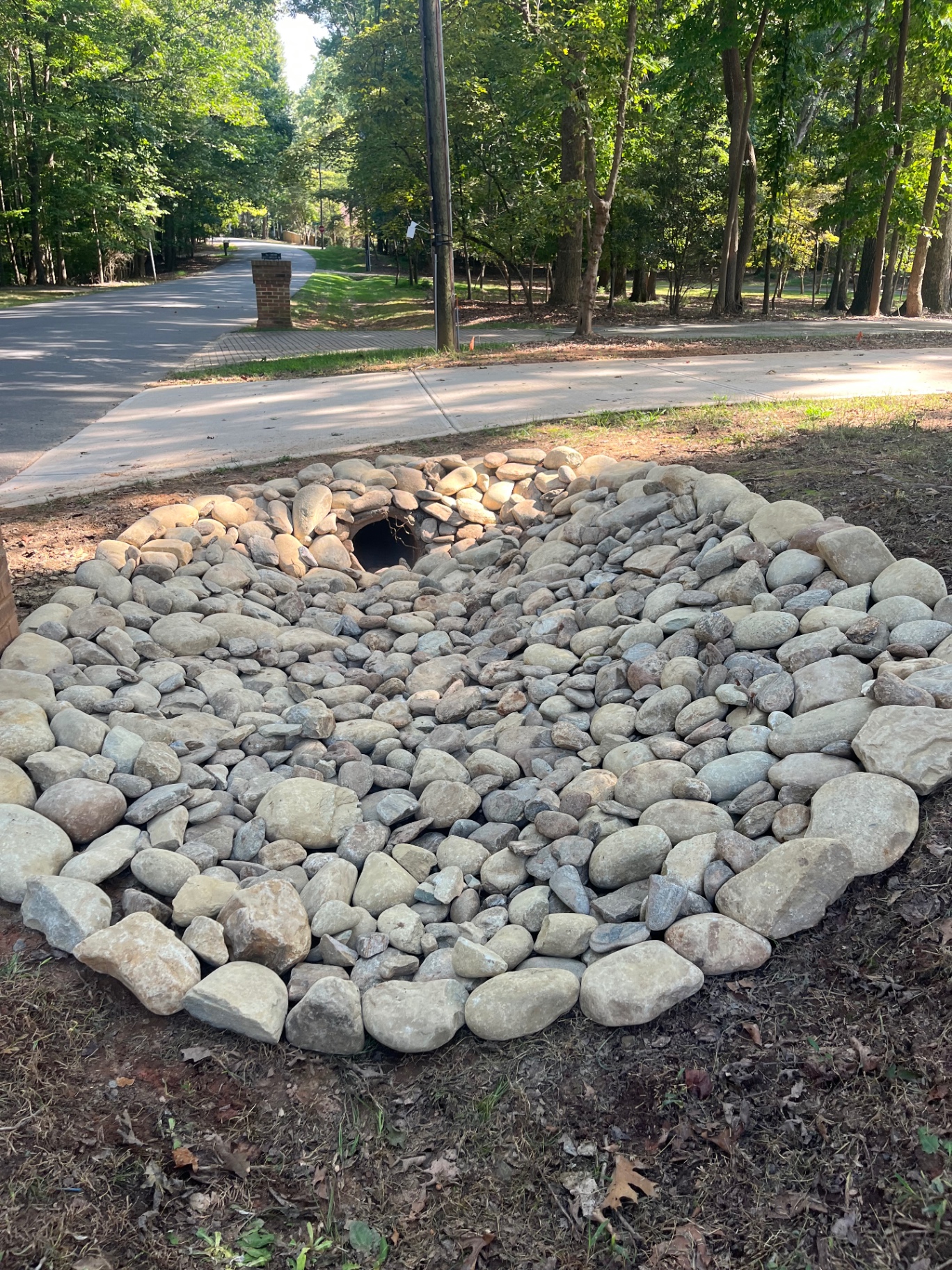
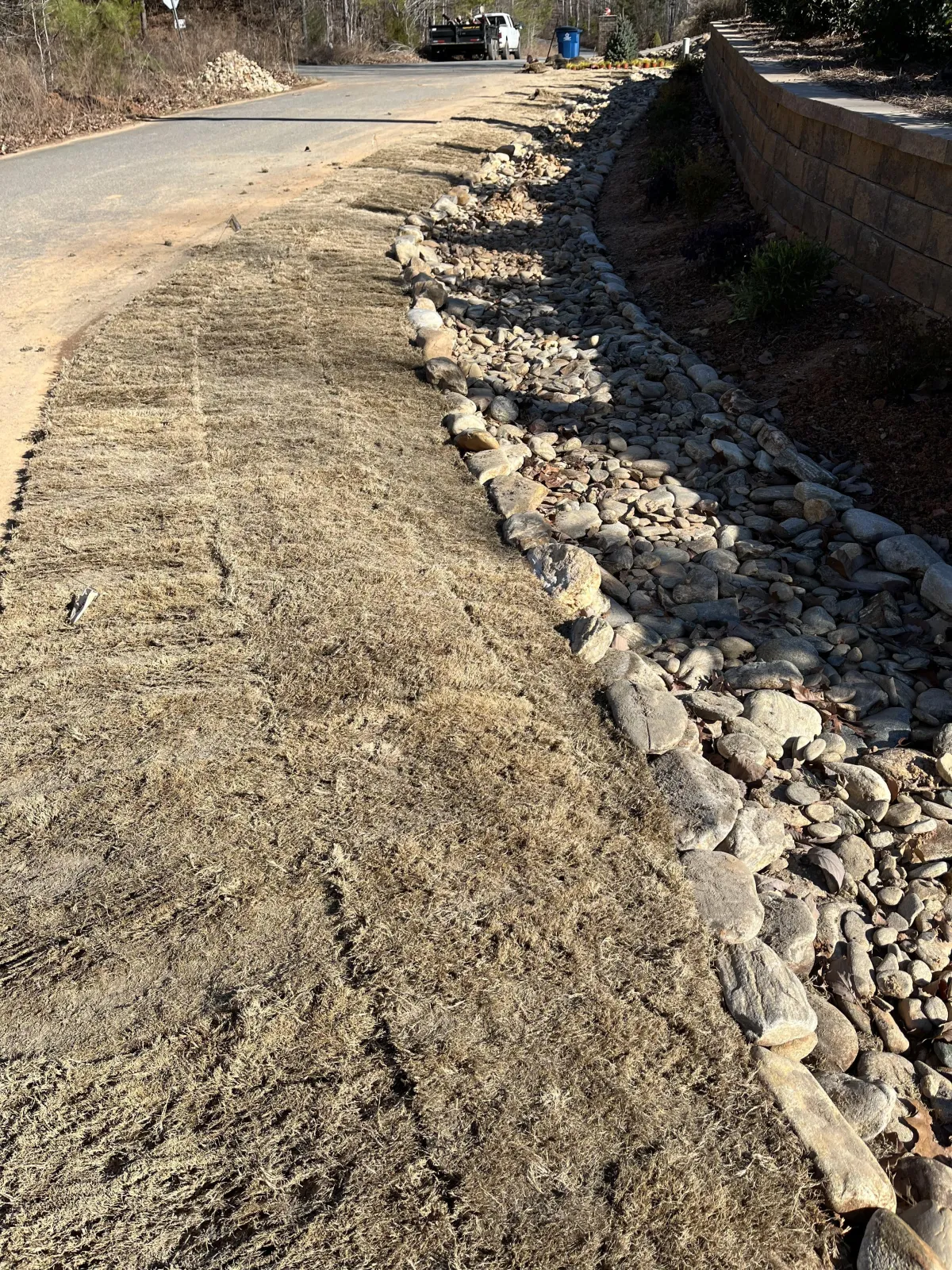
Most new homes around Lake Norman are sold with the grading already 'finished' — but what the builder leaves behind is usually the bare minimum needed to pass inspection, not a yard that sheds water well for the next thirty years.
Why builder grading falls short
Builders grade for a narrow goal: move water off the lot well enough to satisfy code and pass the final inspection. That is a different job from grading a yard that will hold up through years of Piedmont thunderstorms.
During construction, the lot is stripped of its topsoil, cut and filled with heavy equipment, and finished with whatever soil happens to be on site — often dense subsoil rather than anything plants want to grow in.
That leaves two lasting problems. First, water behavior: shallow swales that barely work, low spots over the septic or utility trenches that settle later, and grade that runs nearly flat right up to the foundation.
Second, soil condition: months of skid-steer and dump-truck traffic leave behind badly compacted soil that drinks water slowly, which pushes even more of every storm into surface flow. We cover that problem separately in our article on compacted soil and lawn health.
If you want the full picture of why this happens on almost every new lot, we explain it in why new construction yards have drainage problems.
Warning signs in a new-construction yard
Builder grading problems rarely announce themselves all at once. They show up over the first year or two of storms, and the sooner you catch them the cheaper they are to fix.
The signs your yard needs regrading are worth reviewing in full, but the ones we see most on new lots around Lake Norman are:
- Water pooling against the foundation or in the crawlspace after ordinary storms.
- Mulch and pine straw washing out of beds after every heavy rain.
- A lawn that stays spongy for days in some spots while other areas bake dry.
- Erosion channels starting where the yard slopes toward a neighbor or the street.
- Trenches cut in the soil directly below downspouts.
- Standing water that lingers over utility trenches or the low corner of the lot.
Walk the yard during a rain
Before spending anything, watch the yard in a real storm — not a drizzle. Put on rain gear about halfway through a decent downpour and see where the water actually goes.
Note where it collects, where it moves fast enough to carry soil, and whether anything is flowing toward the house instead of away from it. Ten minutes of observing in the rain tells you more than an hour of staring at a dry yard.
Pay attention to the first ten feet around the foundation in particular. That is where positive drainage matters most, and it is the area builders most often leave nearly flat.
Spot fixes versus a full regrade
Not every grading problem needs heavy equipment. The right fix depends on whether the issue is one isolated low spot or the whole lot's drainage pattern.
Isolated dips over a settled trench can often be filled, lightly tilled into the surrounding soil, and re-seeded. A mulch bed that erodes every storm may just need its edge raised and its slope redirected.
But when water sits against the foundation, crosses the whole yard the wrong way, or the entire lot was left dead flat, spot fixes just move the problem around. That is when a planned regrade is the better investment, and it helps to understand the difference between grading and leveling — one reshapes where water goes, the other only makes the surface flat.
If the yard will not drain no matter how the surface is shaped, grading usually needs to be paired with drainage work. Our step-by-step guide to fixing a yard that won't drain walks through how the two fit together.
What proper final grading includes
Good final grading is a system, not just pushing dirt around until the yard looks smooth.
The ground around the foundation should fall away from the house — a widely used guideline is about six inches of drop over the first ten feet — so roof water and surface flow head outward on their own.
Swales are shaped to collect water from the broad middle of the yard and carry it to a real outlet: the street, a drainage easement, or a piped system. Low corners get a deliberate destination for water, not just a shallow dish that fills up.
Downspout discharge is part of grading too. Water dumping out at the foundation undoes whatever slope the soil has, so downspouts should be extended or piped to a point where the yard can actually handle them.
Finally, the soil itself gets attention: compacted areas are loosened, decent topsoil goes back on top, and finish grades are set with room for settlement so the low spots do not simply reappear next year.
Southern Style Turf & Design handles grading and drainage corrections as one job for homeowners across the Lake Norman area, and our grading and excavation team reshapes whole lots the same way, not just problem corners.
Fix it before landscaping, not after
Timing is the part most new homeowners get wrong. Grading corrections are cheap relative to the hardscape and landscaping they protect — but only if they happen first.
Once a patio, walkway, retaining wall, or mature planting beds are installed on top of bad grade, fixing the grade later means working around, or redoing, everything built on it. We have seen patios installed on builder-flat lots turn into the low point of the whole yard within a couple of seasons.
The right sequence for a new lot is: correct the grade and drainage, establish the lawn and beds, then add hardscape. If you are unsure where your lot stands, a professional grading assessment is a small step that settles the question before you commit money to plants and stonework.
Frequently asked questions
How much slope should there be away from my house?
A widely used guideline is about six inches of fall over the first ten feet from the foundation. The right number for your lot depends on soil, roof water handling, and where the yard can legally discharge — which is why grading is designed as a whole, not per-spot.
Can grading be fixed without tearing up the whole yard?
Often, yes. Isolated low spots and eroding beds can usually be corrected in place. Whole-lot problems — water running toward the house or a yard with no outlet — need planned regrading to fix properly.
How soon after moving in should I check the grading?
Within the first big storm season, and definitely before installing landscaping or hardscape. New-lot problems show up quickly, and early corrections are far simpler than later ones.
Will adding topsoil over a low spot fix it?
Only if the water has somewhere to go. Filling a dip in a yard with no outlet just moves the standing water next door. Grading changes where water travels; drains handle the water grading cannot send away on the surface.
Want this looked at on your property?
We give free, no-pressure on-site estimates across Denver, Mooresville, Cornelius, Davidson, Huntersville and Troutman.