There is no single slope number that is correct for every drainage pipe. A gravity drain needs continuous fall toward its outlet, enough velocity that sediment keeps moving, and a diameter matched to the flow it receives. How much fall is achievable depends on the elevation difference between your inlets and the only usable discharge point, and that is a measurement, not a rule of thumb.
Quick answer
Slope and pipe size are determined together, from field conditions: how much roof and hardscape drains into the line, how long the run is, how many inlets it serves, what elevation is actually available at the outlet, and what the pipe has to pass under or around.
Two principles hold on every site. The line must fall continuously — no flat stretches, no reverse grade, no sags. And velocity matters: a pipe that is too large for its flow at very low slope can run slowly enough that sediment settles instead of being carried out.
If a contractor quotes a universal slope figure before shooting elevations, they are describing a habit rather than a design.
Why one number does not work
Slope is the elevation drop divided by the length of the run. On a property with 30 inches of fall between the downspout tie-in and a wooded outlet 80 feet away, you have options. On a flat lot with six inches of fall over 120 feet, you do not, and the design must change instead.
Flow changes the answer too. A single downspout line and a main collecting four downspouts plus two catch basins are different hydraulic problems even on identical ground.
Obstacles set the rest. Existing utilities, a septic field, tree root zones, a driveway, a patio footing or a neighbor's property line can force a route that is longer or shallower than the straight line you would prefer.
Start at the outlet, not the inlet
Experienced drainage work is designed backward. Find every place water could legally and safely be released, shoot the elevation at each, then work uphill to see what depth is left at the inlets.
That order prevents the most common field surprise: a trench dug from the house toward a discharge point that turns out to be higher than the pipe invert once it arrives. At that stage the options are all expensive.
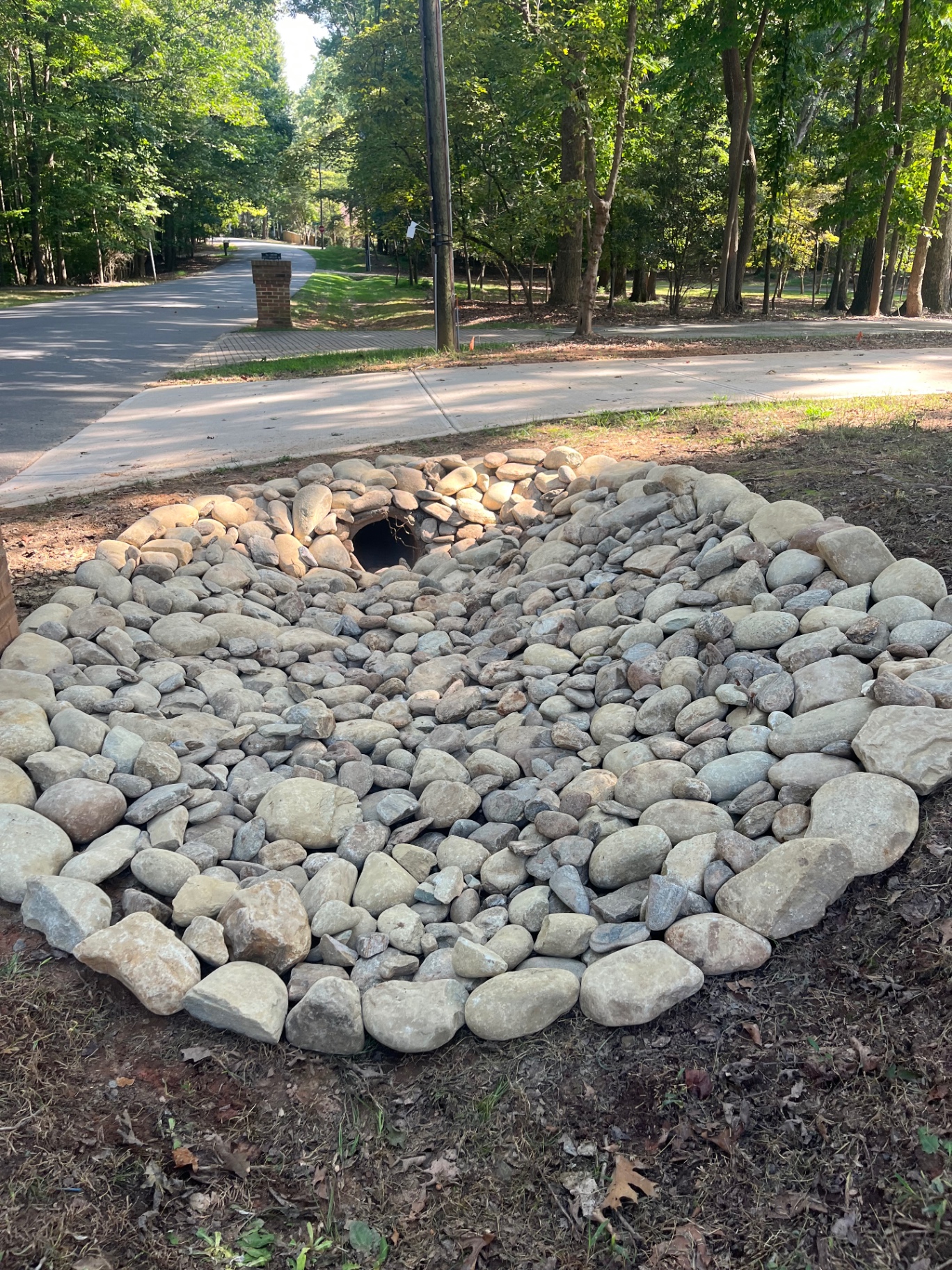
The outlet also has to be stabilized. Water released onto bare soil on a slope creates a new erosion problem, and discharge should not be aimed at a property line or a neighbor's yard.
Four-inch or six-inch pipe?
Both are common in residential drainage. Four-inch pipe is typical for individual downspout lines and short branch runs. Six-inch pipe is often used for mains that combine several inlets, for long runs, or where there is very little slope and a larger cross-section helps move volume.
Bigger is not automatically better. A large pipe running only partially full at a very low slope can have lower velocity than a smaller pipe carrying the same flow, and low velocity is how sediment accumulates.
Sizing should follow the tributary area feeding the line — roof, driveway, patio and lawn that drains into it — the length and slope of the run, and how the branches combine.
What to do when there is not enough fall
Sites with minimal elevation difference are common in parts of Huntersville, Denver and Troutman where lots were graded flat. Options include finding a different outlet with more drop, shortening the run, using surface solutions such as a shaped swale that needs less depth, reshaping the grade so water sheds before it reaches the low spot, or using a pumped system such as a basin with a pump where gravity cannot reach.
Each option has consequences. A pump adds power, maintenance and a failure mode. A swale needs room and changes the look of the yard. Regrading may affect adjacent areas and requires care near property lines.
The one option that does not work is installing a level pipe and hoping. Flat lines hold water, silt in, and become the next contractor's diagnosis.
Common installation mistakes
These are the slope and sizing errors we most often find in failed systems.
- Digging from the house toward an outlet whose elevation was never checked.
- A reverse grade section hidden between two properly sloped runs.
- Sags from an ungraded trench bottom or settled backfill.
- Oversized pipe at very low slope, producing sluggish flow and sediment buildup.
- Too many inlets tied into an undersized main.
- Sharp 90-degree fittings where sweeps would preserve velocity.
- An outlet buried by mulch or soil later, effectively raising the discharge elevation.
When to call a professional
Call when you cannot identify a clearly lower outlet, when the run is long, when the line serves multiple inlets, when it must cross hardscape or utilities, or when a previous system never drained properly.
Proper design uses measured elevations, not visual judgment — ground that looks like it slopes often does not, and the reverse is equally common. Expect a contractor to explain the outlet, the route, the pipe size and the fall they measured. Utility locating through NC 811 is required before excavation.
Key takeaways
The points that matter most when reviewing a drainage proposal.
- There is no universal slope requirement for residential drainage pipe.
- Continuous fall with no sags or reverse grade is non-negotiable.
- Velocity, not just capacity, keeps a line self-cleaning.
- Pipe size follows tributary area, run length, slope and how branches combine.
- Design starts at the outlet elevation and works uphill.
Helpful outside reference
For background on why hard surfaces send more water across a yard, see the EPA guidance on urban runoff.
Frequently asked questions
How much slope does a drainage pipe need?
Enough continuous fall to keep water and sediment moving to the outlet — the specific amount depends on flow, pipe size, run length and the elevation actually available between the inlet and the discharge point. A single universal figure cannot account for those variables, so slope should be set from measured field conditions.
Can a drain pipe be installed level?
A level line is a poor design for gravity drainage. It holds standing water, accumulates sediment and loses capacity over time. When fall is genuinely unavailable, the usual alternatives are a different outlet, a surface solution, regrading or a pumped system.
Should I use four-inch or six-inch drainage pipe?
Four-inch pipe commonly serves individual downspouts and short branches, while six-inch pipe is often used for mains combining multiple inlets or for long, low-slope runs. Size should be based on the area draining into the line rather than a default choice.
Does a bigger pipe always drain better?
No. An oversized pipe at very low slope can run with low velocity, which lets sediment settle and reduces performance over time. Matching size to flow and slope produces a more self-cleaning line.
How deep should a drainage pipe be buried?
Depth is driven by the slope needed to reach the outlet, the loads passing above the pipe, and the location of utilities and roots. It is a result of the design rather than a fixed dimension, and shallow cover under traffic is a common cause of crushed lines.
Want this looked at on your property?
We give free, no-pressure on-site estimates across Denver, Mooresville, Cornelius, Davidson, Huntersville and Troutman.