The best paver patios here are designed around what the yard already gives you — the shade, the slope, the view, the door you actually use — rather than dropped in as a rectangle behind the house. Pattern and colour matter, but placement and size matter more.
Laying patterns and what each one suits
Running bond is the simplest and reads quietly. It suits large areas where the paving should recede and the furniture and planting do the talking.
Herringbone interlocks the strongest of the common patterns, which is why it is standard on driveways and vehicle areas. On a patio it adds visible texture and works well in smaller spaces.
Basketweave has a traditional feel that suits older homes and brick-faced houses.
Random or modular blends, using three or four paver sizes in a repeating layout, give a natural stone appearance without natural stone labour. It is the most popular choice on newer Lake Norman homes for good reason.
Circle kits and radial patterns work as a feature — under a table or around a fire pit — rather than across a whole patio.
Borders, banding and where contrast helps
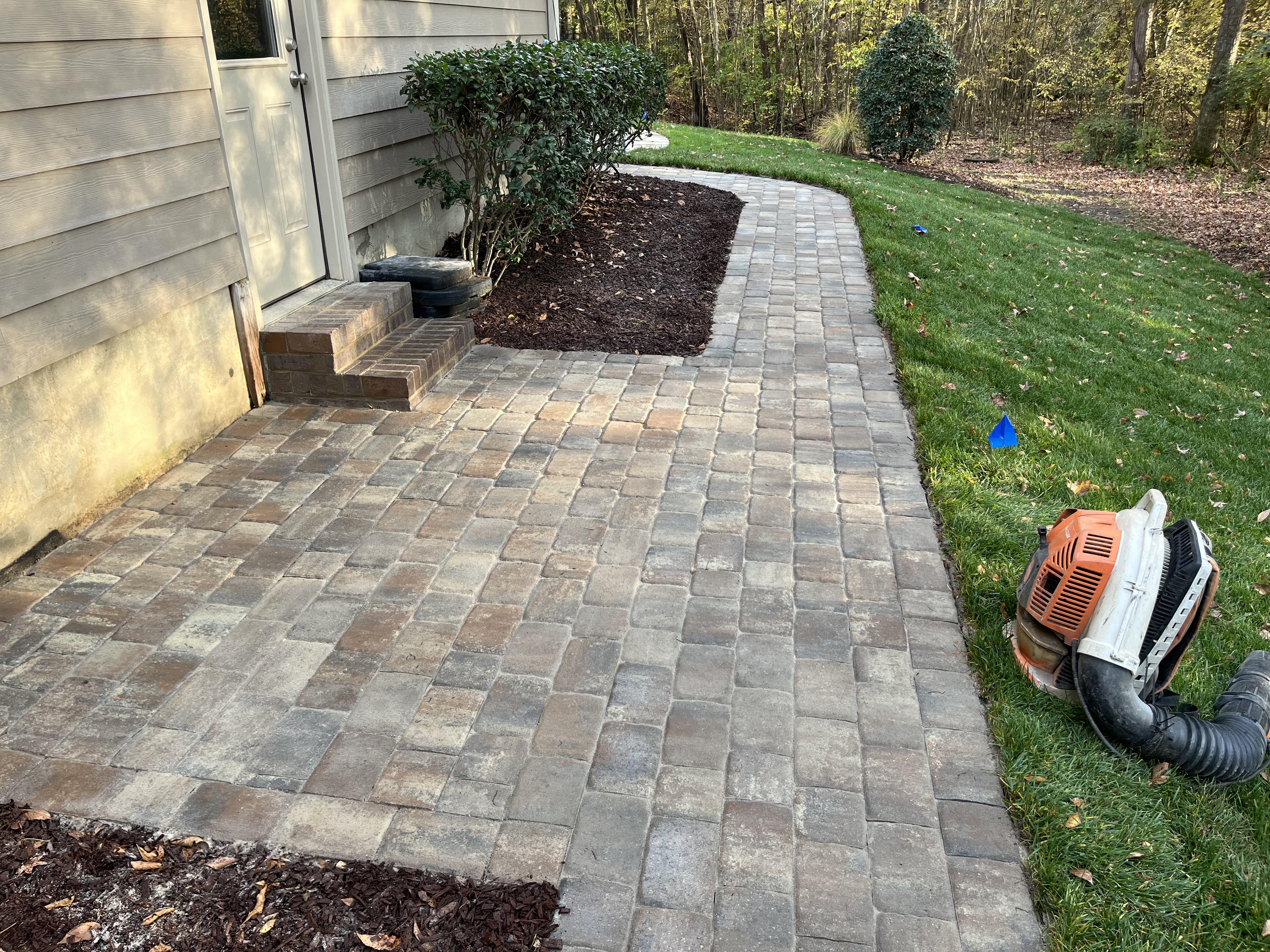
A soldier course border — pavers set end to end around the perimeter — frames the patio and gives the field pattern a clean edge to die into. On almost any patio it is worth doing.
Contrast should be deliberate and limited. One accent colour, used for the border and perhaps a single band, reads as designed. Three colours in a small space reads as busy.
Banding is also useful functionally: a contrasting band can mark a level change, define the edge of a dining zone within a larger patio, or lead the eye toward steps.
Designing around what the yard already has
Follow the sun. A patio that bakes from noon onward gets used in the evening only. Note where the shade falls at the times you would actually be outside, and place the seating accordingly.
Follow the door. The route from the kitchen to the table decides how often the patio gets used, and a patio around the corner from the door people actually use is a patio that stays empty.
Work with the slope rather than against it. A grade change at the edge of a patio becomes a seating wall or a set of steps rather than a problem, and often the wall is doing structural work at the same time.
Keep the trees. A mature tree is worth designing around, and pavers can be laid to a curved edge that respects the root zone in a way a poured slab cannot.
Features worth building in from the start
Fire pit area, with enough surrounding space for chairs pulled back. Grill or outdoor kitchen run, with utilities routed before the base goes in. Lighting cable for step, wall and perimeter fittings. Sleeving for irrigation crossing under the patio.
All of these are inexpensive during construction and expensive afterward, because they mean lifting pavers or trenching around finished work.
Even if the fire pit and kitchen are a later phase, run the conduit now.
What makes it look expensive
Generous size, a clean border, restrained colour, tight consistent joints, and edges that are cut properly rather than gapped and filled. None of those are exotic materials — they are execution.
The other one is proportion. A patio sized to the house and the furniture, with planting softening its edges, looks considered. A small patio floating in the middle of a lawn does not.
Southern Style Turf & Design designs and installs paver patios across Lake Norman. Free on-site estimate, written quote, base and edge detail specified.
Frequently asked questions
What is the best paver pattern for a patio?
Random or modular blends give a natural-stone look and suit most newer homes; herringbone interlocks strongest and adds texture in smaller spaces; running bond recedes on large areas.
Should a paver patio have a border?
Almost always. A soldier course border frames the patio, gives the field pattern a clean edge to finish against, and makes the whole surface look deliberate.
How do I decide where to put a patio?
Where the shade falls when you would actually use it, close to the door you actually use, and working with any slope so the grade change becomes seating or steps.
What should be installed before the pavers go down?
Lighting cable, irrigation sleeves, and any gas, water or electrical runs for a fire feature or outdoor kitchen. Adding them later means lifting the patio.
Want this looked at on your property?
We give free, no-pressure on-site estimates across Denver, Mooresville, Cornelius, Davidson, Huntersville and Troutman.