Most homeowners compare drainage and retaining wall proposals by looking at the bottom number, because that is the only part of the document that is easy to read. But the total is just arithmetic performed on a list of quantities. Once you understand how each line is measured and what makes its quantity move, a proposal stops being a mystery and becomes something you can actually discuss. This guide walks through the anatomy of those line items. It does not contain prices — what a line costs depends on your site, current material costs, and the scope you and your contractor agree on.
Every line has a unit, and the unit tells you a lot
Before you compare numbers, look at how each line is measured. Estimators price work in the unit that best tracks the labor and material behind it, and the unit itself explains what drives that line up or down.
The units you will see most often on Lake Norman drainage and wall proposals:
- Linear foot — trenching, pipe, drain line, edge restraint, and wall length. Longer runs cost more almost proportionally.
- Square foot — patio surface, sod or seed restoration, erosion blanket, and sometimes the exposed face of a wall.
- Square foot of wall face — the standard way block wall work is measured. Height matters as much as length, because face area is height times length.
- Cubic yard — excavation, spoil haul-off, and topsoil. This is volume, so depth multiplies fast.
- Ton — washed stone, base stone, and riprap, since aggregate is bought by weight.
- Each — catch basins, pop-up emitters, grates, cleanouts, and outlet structures.
- Lump sum — mobilization, site protection, permits and locates, final cleanup, and design work.
A drainage quote, line by line
A thorough drainage proposal usually follows the water from where it collects to where it leaves the property. Reading it in that order tells you whether the contractor actually solved the problem or only intercepted part of it.
Typical lines and what determines each quantity:
- Mobilization and site protection — equipment delivery, plywood or matting over turf, and access setup. Driven by how far equipment must travel across your yard and how tight the access is.
- Utility locates and hand-digging — free public locates do not cover private lines like irrigation, gas to a grill, or landscape lighting, so hand work near those areas shows up as its own line.
- Trenching — linear feet at a stated depth and width. Depth is set by the fall you need to reach a legal outlet, not by preference.
- Pipe — linear feet, with the type and diameter named. Solid versus perforated, and the wall rating, should both be written down.
- Stone and fabric — tons of washed stone and square feet or linear feet of geotextile wrapped around the trench. This is the line that quietly disappears from cheap drainage bids.
- Collection points — each basin, grate, or channel drain, with its size.
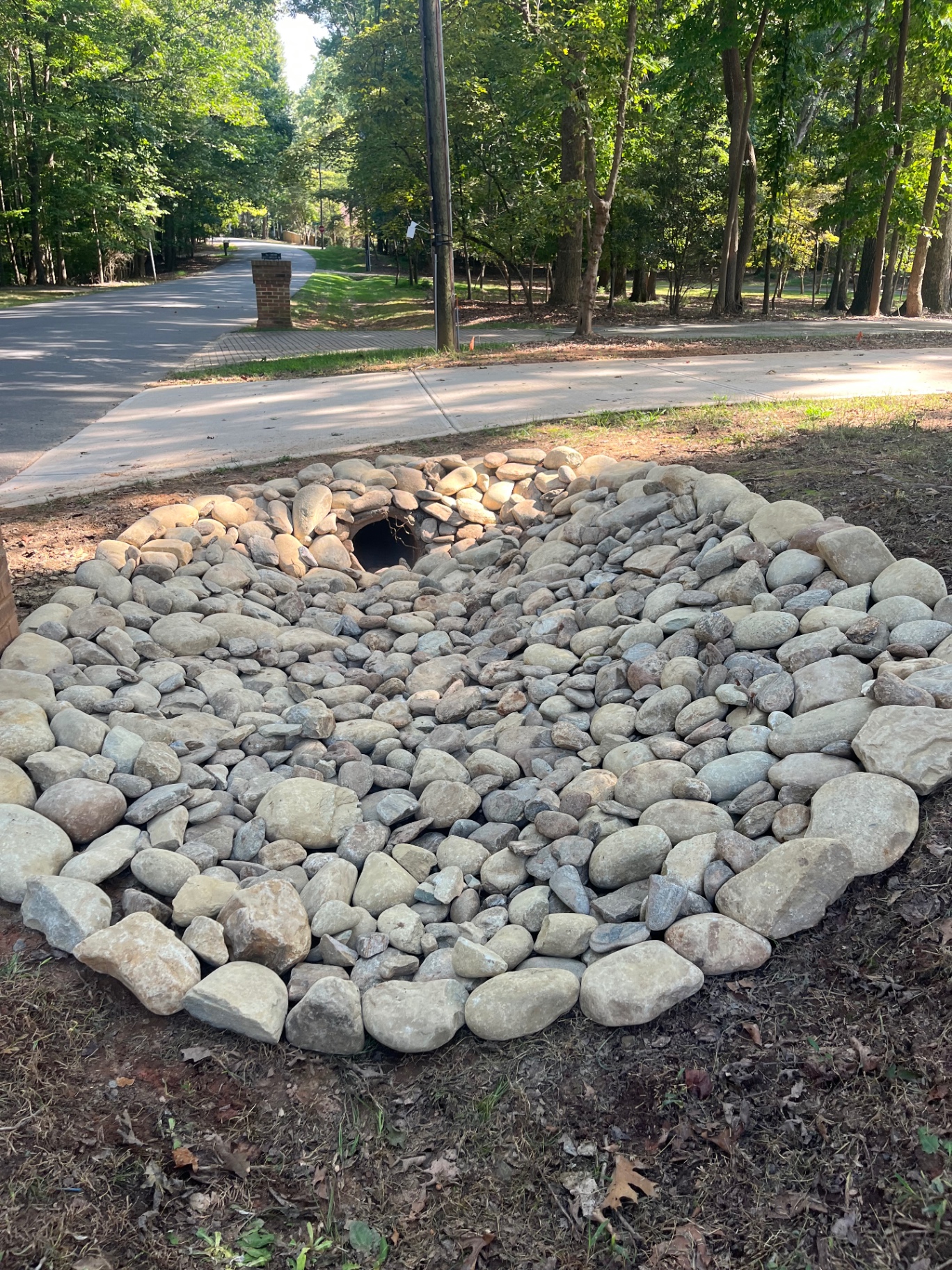
- Outlet — pop-up emitter, headwall, daylight point, or connection to an existing system, priced per each plus any additional pipe to reach it.
- Spoil handling — cubic yards spread on site or hauled away. Hauling is almost always its own line because it involves trucking.
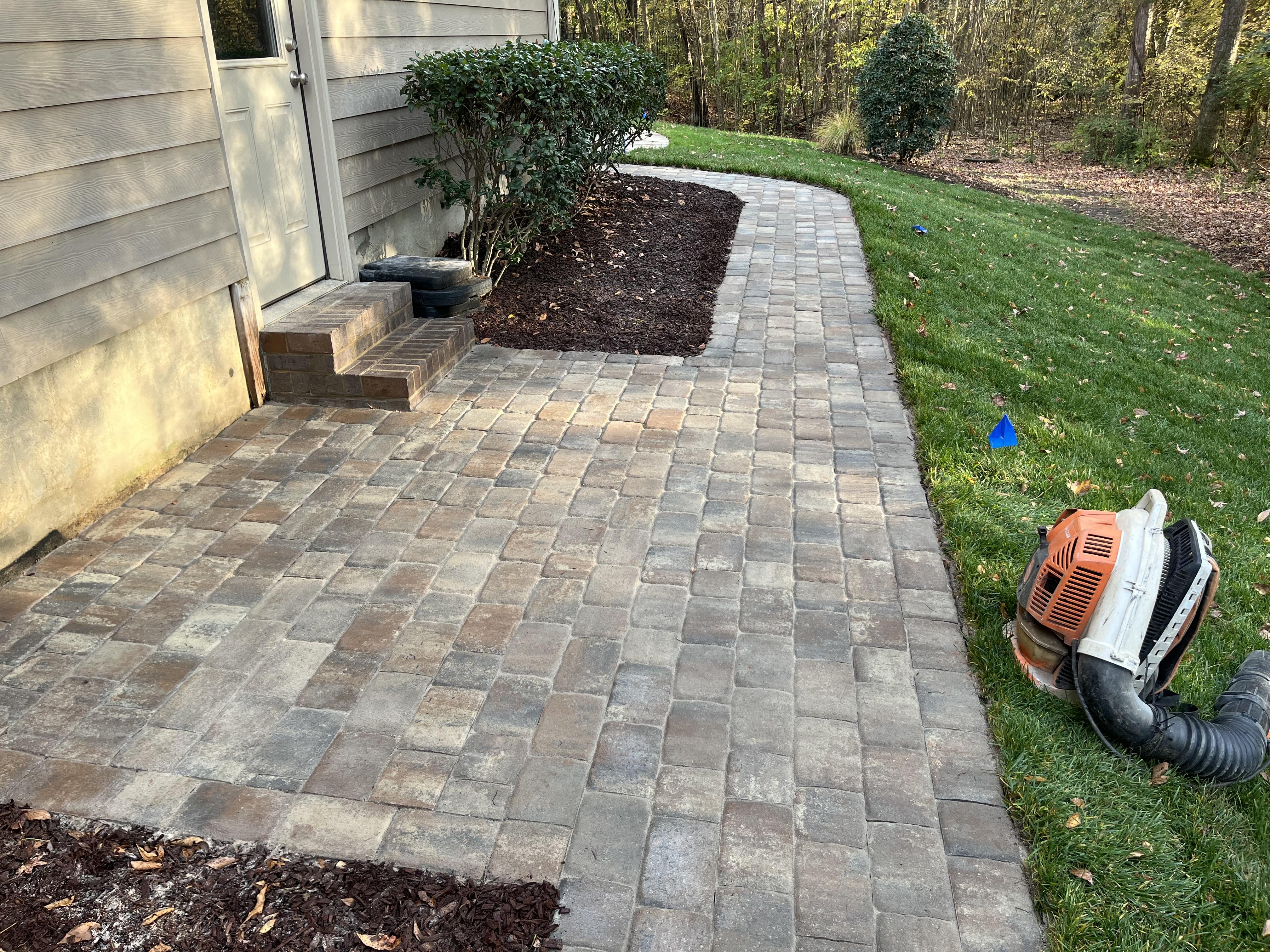
- Restoration — square feet of sod or seed and straw, and any hardscape cut and replaced.
- Regrading — square feet or cubic yards where surface shaping is part of the fix rather than pipe alone.
A retaining wall quote, line by line
Wall proposals look simple from the outside — you see block and caps — but most of the cost sits under and behind the wall where nothing is visible after backfill.
What the lines usually cover:
- Excavation — cubic yards for the base trench and the space behind the wall. Deeper embedment on taller walls increases this quickly.
- Base stone — tons of compacted aggregate under the first course, with thickness stated.
- Block — square feet of wall face, by product. Face area, not just wall length, is the measure.
- Geogrid reinforcement — square feet or linear feet, in layers at stated elevations. Whether grid is required depends on height, slope, and what sits above the wall.
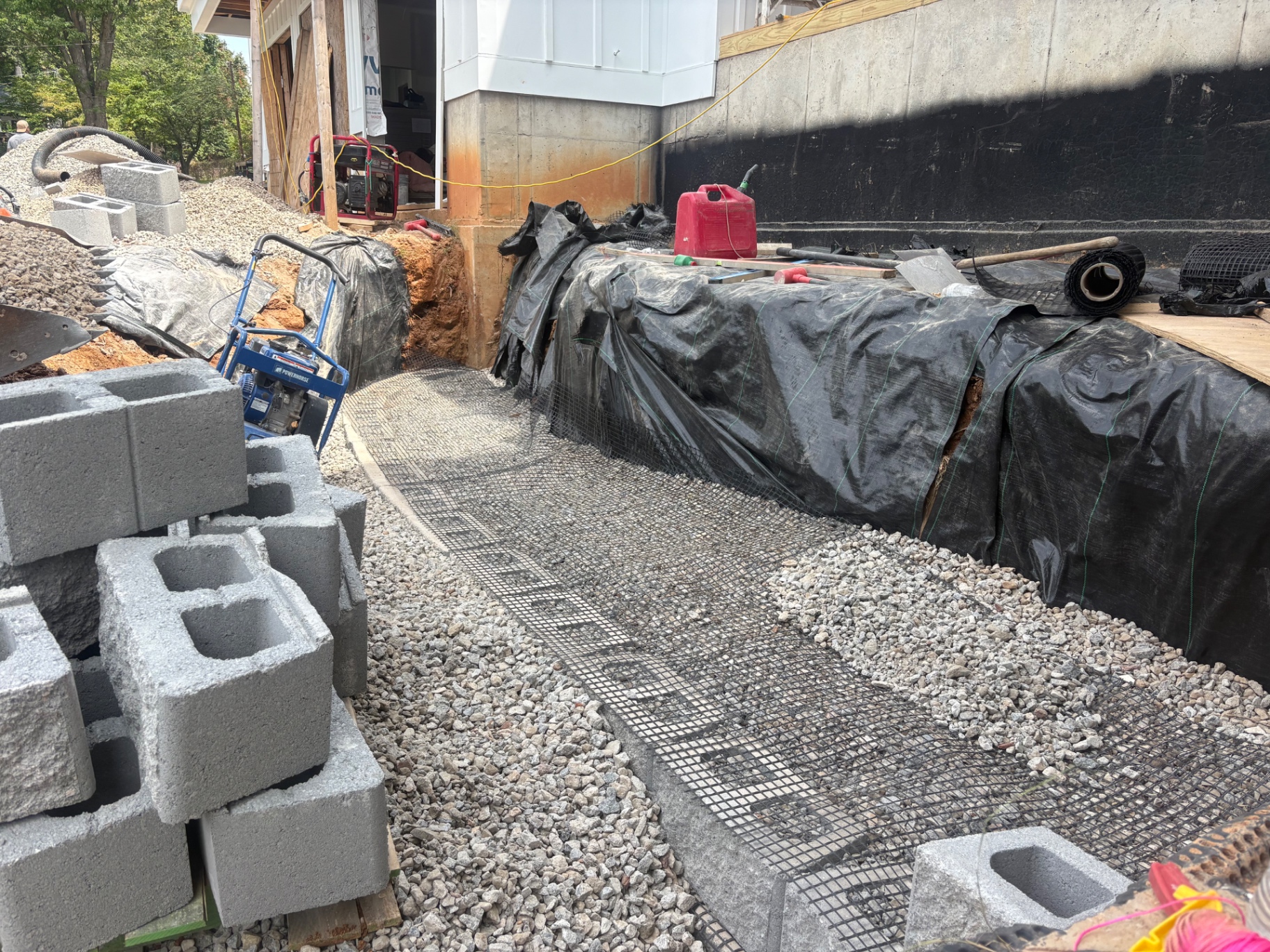
- Drainage stone and pipe behind the wall — tons and linear feet, plus outlets. A wall without this is a wall holding back saturated clay.
- Filter fabric — separating the drainage stone from the soil so the stone does not silt up.
- Backfill and compaction — placed in lifts, which takes more time than dumping soil in at once.
- Caps and adhesive — linear feet along the top of the wall.
- Steps, corners, and curves — often priced separately because they take disproportionate labor.
- Engineering, survey, or permit fees — listed as their own line or an allowance when the design may require them.
- Restoration and cleanup — grading, sod, and hauling excess soil.
Allowances, unit prices, and lump sums are not the same promise
Three different pricing structures can appear on the same page, and they carry different risk for you.
A lump sum is a fixed amount for defined work — the contractor absorbs the risk if it takes longer, and you pay the same if it goes quickly. A unit price is a rate applied to whatever quantity actually gets installed, common for trenching or stone where the real quantity is not known until the ground is open. An allowance is a placeholder for something not yet chosen or not yet knowable, like a block style or a permit fee, and it will be trued up later.
None of these is better than the others. The problem is only when you assume a line is fixed and it is actually an allowance. Ask which lines could change and what would cause the change.
Why the same yard produces different quantities
Two contractors can measure the same project honestly and arrive at different numbers, because they are proposing different work.
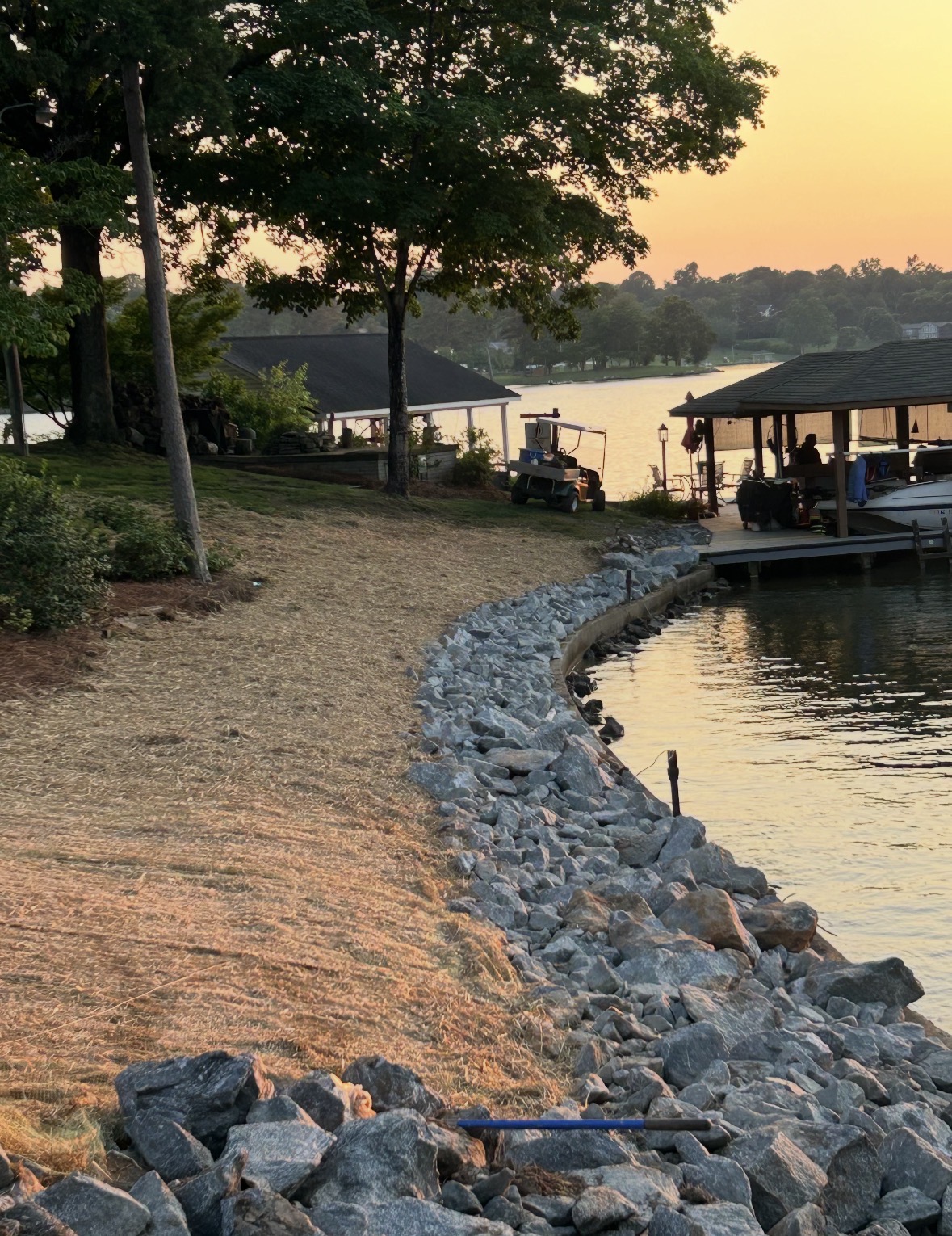
In our area the common variables are red clay that holds water and compacts differently than sandy soil, new-construction lots where the builder's grade sends water toward the house, lake and creek lots where the outlet has to respect buffers and shoreline conditions, and mature trees whose roots turn a straight trench into hand work.
Access matters as much as the work itself. A backyard reachable by a skid steer through a wide gate is a different job than one where every ton of stone moves by wheelbarrow, even though the finished result looks identical.
Questions that make a quote readable
You do not need to negotiate the numbers to get value out of a proposal. You need to understand what each number buys.
Bring these to your walkthrough:
- Which lines are lump sum, which are unit price, and which are allowances?
- What depth and width is the trenching line based on, and what happens if rock or roots change it?
- How many tons of stone and how much fabric are included, and where do they go?
- Where exactly does the water outlet, and is that point included in the price?
- For a wall, what is the base thickness, is geogrid included, and at what elevations?
- What is excluded — irrigation repair, hardscape replacement, permit fees, tree removal?
- Is spoil hauled away or left on site, and if left, where?
- What restoration is included, and is it sod or seed?
- What triggers a change order, and how is it approved and priced?
What a clear proposal looks like
A good proposal is one you could hand to a neighbor who would then describe the job back to you correctly. Quantities are stated, materials are named by type and size, the outlet is identified, exclusions are written rather than implied, and the payment schedule is tied to stages of work.
Southern Style Turf & Design writes proposals with excavation, base, drainage, materials, and restoration broken out as separate items, and our own in-house crew performs the drainage, grading, and wall work rather than handing it to a subcontractor. If you want to walk through a line-item scope for your yard, request a free estimate or call 704-460-2019.
Frequently asked questions
Why will a contractor not give a price over the phone?
Because almost every quantity on the proposal depends on things that can only be measured on site — depth to a workable outlet, soil condition, access width, wall height at each point, and what has to be protected or restored. A phone number is a guess, and guesses get corrected upward once work begins.
Is a detailed quote more expensive than a one-page bid?
Not inherently. A detailed quote simply shows you what is included. A shorter bid for a lower total often excludes base depth, drainage behind a wall, fabric, haul-off, or restoration — work that still has to happen eventually, usually as a change order or a repair later.
What does a unit price protect me from?
It keeps you from paying for work that was never performed. If trenching is priced per linear foot and the run comes in shorter than estimated, you pay for the actual footage. The tradeoff is that the final number is not known until the work is complete.
Should I ask contractors to price identical scopes?
Yes. Write down the specific items you want included — drainage behind the wall, haul-off, sod restoration — and give the same list to everyone. Otherwise you are comparing different projects that happen to be on the same property.
What if a proposal has no line items at all?
Ask for a breakdown before signing. Not every contractor itemizes by default, and many will provide it when asked. If no breakdown is available, you have no way to compare bids or to tell what a future change order should cost.
Want this looked at on your property?
We give free, no-pressure on-site estimates across Denver, Mooresville, Cornelius, Davidson, Huntersville and Troutman.