Piedmont clay is the reason retaining walls in this region live or die by their drainage. Clay holds water, swells when it takes it on, shrinks when it dries, and drains too slowly to relieve pressure on its own. A wall built with clay backfill against its face is loaded in ways the block was never designed for.
Why clay backfill puts pressure on a wall
Three effects stack up. Saturated clay is much heavier than dry clay, so the wall carries more weight. Water that cannot drain adds hydrostatic pressure directly. And clay swells as it absorbs water, pushing outward on its own.
Clay also has a high lateral earth pressure compared with granular soils — it pushes sideways harder for the same height, even before water is involved.
That combination is why walls in this region fail after wet winters rather than during storms. The pressure builds over weeks, not minutes.
Drainage aggregate as a replacement, not an addition
The zone immediately behind the wall is not clay with some stone in it. It is clean angular crushed aggregate replacing the clay entirely, for a width appropriate to the wall.
Water reaching that zone drops through it to the drain pipe at the base rather than accumulating in soil pressed against the block. The clay behind the aggregate stays wet; the wall does not care, because the pressure never reaches it.
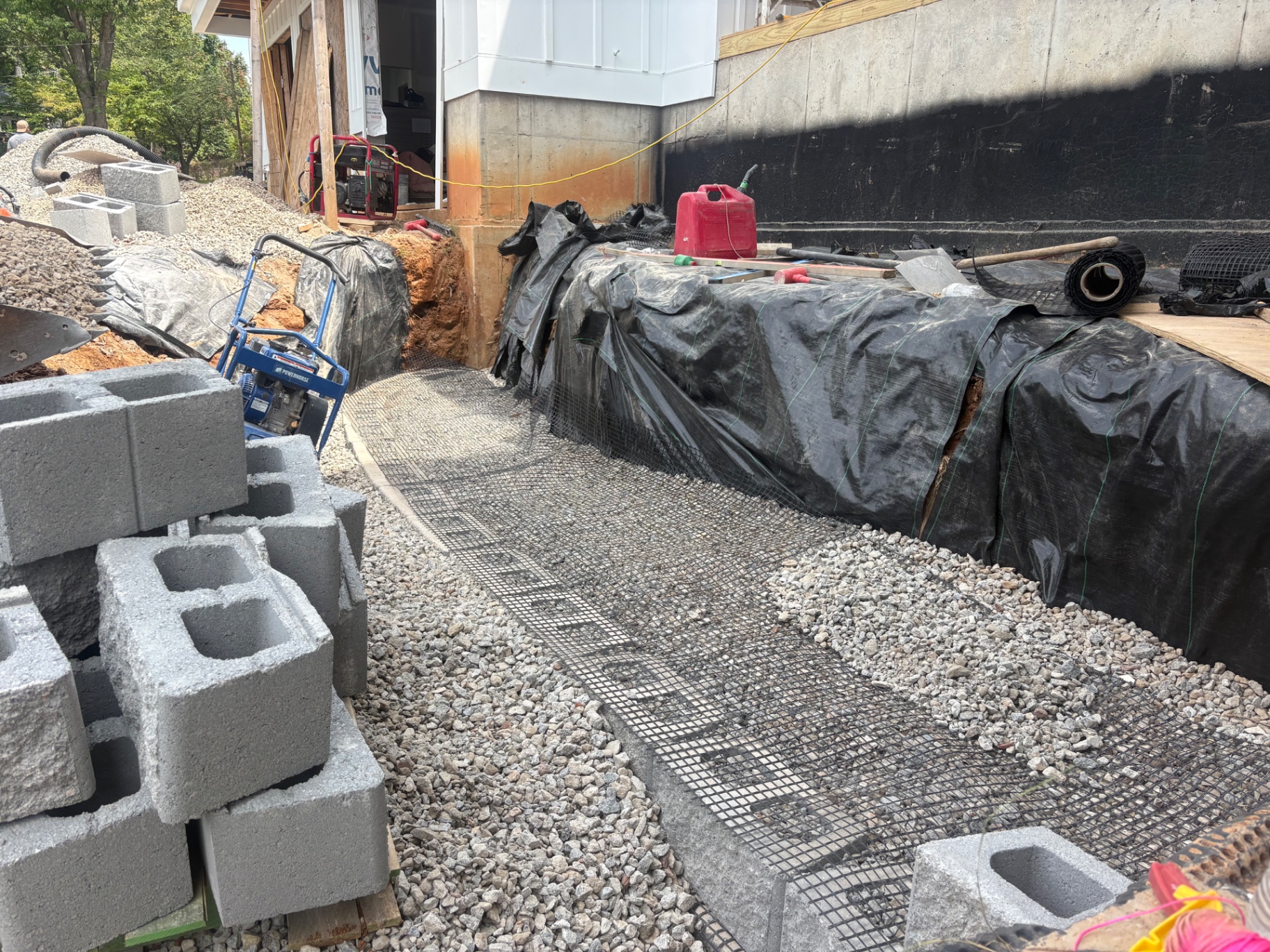
Filter fabric between the aggregate and the clay is essential here. Clay fines are exactly the material that clogs stone, and without separation the drainage zone becomes clay again within a few years.
This is also why reinforced walls on clay use imported granular backfill in the reinforced zone. Geogrid develops its strength through friction with the soil around it, and wet clay does not provide it.
Seasonal movement and what it does over years
Clay shrinks in dry summers and swells in wet winters. That cycle works on everything buried in it, year after year.
Behind an undrained wall, the swelling pushes and the shrinking leaves voids that fill with water next season. Over enough cycles a wall that seemed fine develops a bulge, and once it has moved it does not move back.
The same cycle is why base preparation matters more here than on sandy soils. A base sitting on clay that moves seasonally has to be deep enough, compacted enough and drained enough that the wall is not riding those cycles.
Building on clay: what changes
Excavation goes deeper, because the top layer of disturbed or fill material has to be removed to reach stable ground.
Backfill is imported rather than reused. Excavated clay can be used well away from the wall for general grading, but not in the drainage or reinforced zones.
Surface water above the wall is managed deliberately — graded away from the top of the wall, with downspouts piped clear — because on clay it will not soak away harmlessly.
And the schedule respects the weather. Compacting clay when it is saturated does not work, so a wet week delays the build rather than being pushed through.
Why this is the local detail that matters
A wall system's design tables assume a soil type. Around Lake Norman the soil is clay, and a wall priced as though the backfill were free-draining sand is priced for a different site than the one it is built on.
That is the honest explanation for why a properly built wall here costs what it does: the excavation is deeper, the aggregate is imported, and the drainage is not optional.
Southern Style Turf & Design builds on this soil every week across Denver, Mooresville, Huntersville, Cornelius, Davidson and Troutman. Free on-site estimate, written scope including base and drainage.
Helpful outside reference
Before adding lime or fertilizer, a sample through the NCDA&CS soil testing service shows what your soil actually needs.
Frequently asked questions
Can you build a retaining wall in clay soil?
Yes, and it is standard here — but the clay behind the wall is replaced with clean drainage aggregate, separated by filter fabric, with a drain pipe to a real outlet. Clay backfill against the wall face is what causes failures.
Why is clay bad behind a retaining wall?
It is heavy when saturated, drains too slowly to relieve water pressure, pushes harder sideways than granular soil, and swells as it takes on water.
Can excavated clay be reused as backfill?
Only well away from the wall for general grading. It cannot be used in the drainage zone or in a geogrid-reinforced zone, where granular material is required.
Does clay affect how deep the base has to be?
Yes. Excavation has to reach stable ground below disturbed or fill material, and the base has to be deep, compacted and drained enough that seasonal shrink-swell does not move the wall.
Want this looked at on your property?
We give free, no-pressure on-site estimates across Denver, Mooresville, Cornelius, Davidson, Huntersville and Troutman.