Everything a retaining wall does is transferred into the ground through its base course, and that base course sits on compacted aggregate below grade. Get it level, compacted and deep enough and the wall stays straight for decades. Rush it and no amount of care above ground will save the result.
Excavation depth and why the first course sits below grade
The bottom course of a retaining wall is buried. A common rule of thumb is roughly one course, or a proportion of the wall height, below finished grade — the taller the wall, the deeper it starts.
That embedment does two things. It resists the wall being pushed outward at the bottom, which is where the pressure is highest, and it protects the base from erosion and from soil being scoured away at the toe.
Excavation also has to reach undisturbed, stable soil. Building on fill, topsoil or the loose spoil left by earlier work means the wall settles as that material consolidates, and it settles unevenly.
The compacted aggregate base
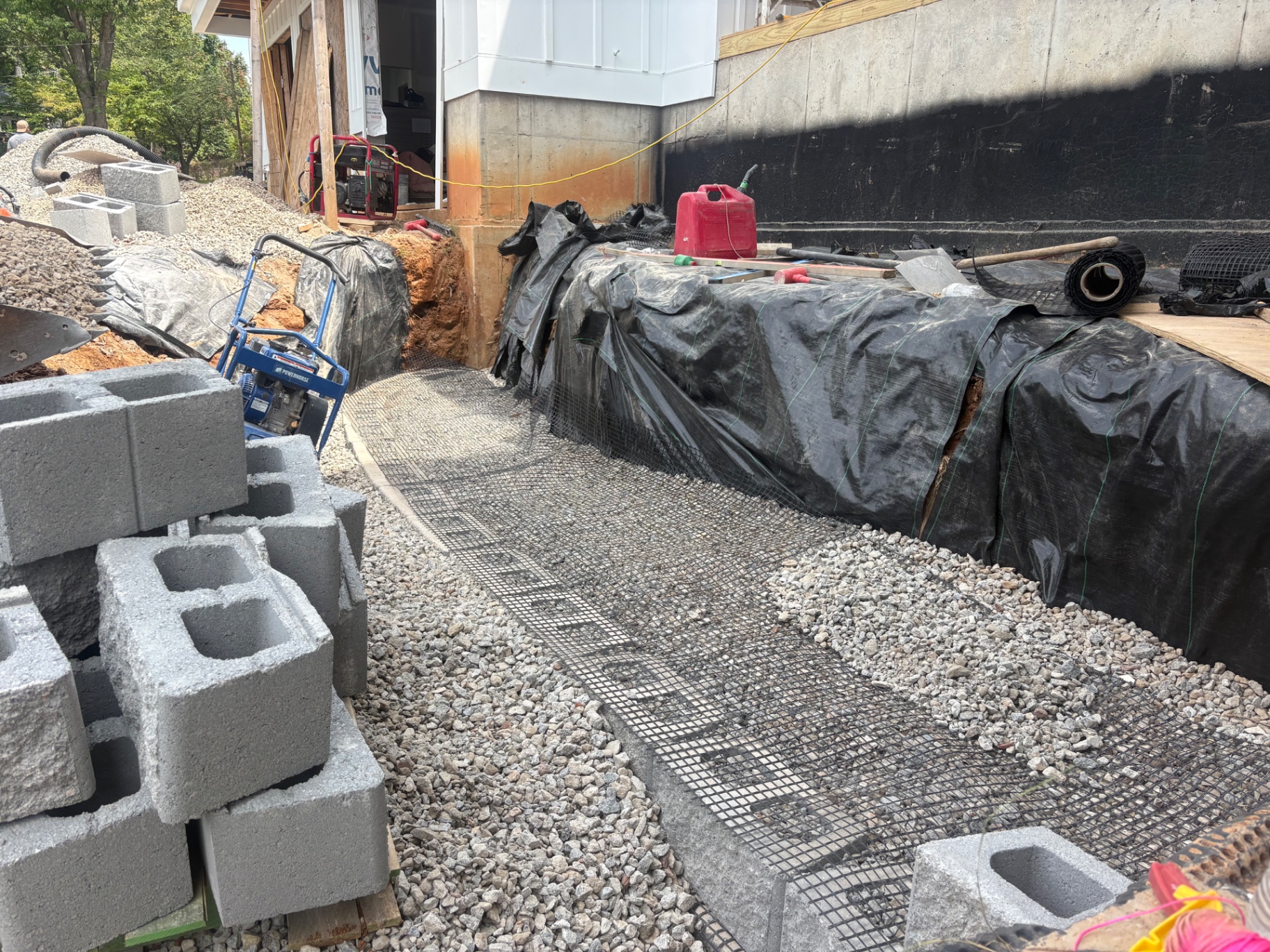
Below the buried course sits a bed of compacted crushed aggregate. It spreads the wall's load across the subgrade, provides a dead-level surface to build from, and drains so that water never sits under the base.
It is built in lifts — layers thin enough to be compacted properly — rather than dumped and rolled once. Compacting a thick layer only densifies the top of it, leaving loose material beneath that consolidates later.
Level matters more here than anywhere else in the build. Every course above copies the first one, so an error in the base is magnified up the wall and cannot be corrected later.
How compaction is verified
On residential work, compaction is confirmed by method and observation rather than laboratory testing: correct lift thickness, the right plate compactor for the material, multiple passes, and material at a workable moisture content rather than saturated or dust-dry.
The practical test on site is behaviour. Properly compacted aggregate is firm underfoot with no give and no visible movement under the compactor on the final pass. Loose material moves and sounds different.
On engineered walls, larger structures, or walls supporting a driveway or structure, formal compaction testing may be specified — and where it is, it should be documented.
What a rushed base looks like three winters later
Base failures are recognisable. A wall that dips in the middle of a run has settled into a soft spot. Vertical joints that were tight at handover and now open unevenly are showing differential settlement. Caps sitting proud or unevenly along a section, courses no longer level with each other, and a wall that leans in one place rather than uniformly are all base symptoms rather than drainage symptoms.
The distinction matters when you are deciding what to do about it. A drainage failure bulges the wall outward in the middle of its height. A base failure moves the wall down and takes everything above it out of line.
Neither can be fixed from the front. Both mean taking the wall apart back to the base.
Why it gets skipped
Base preparation is roughly the largest share of the labour on a small wall and none of the visible result. On a competitive quote it is the easiest place to save money, and the customer cannot see what was left out.
That is worth knowing when comparing prices. Ask how deep the excavation goes, what aggregate is used, in what lift thickness, and how far below grade the first course sits. A builder who does it properly will answer immediately.
Southern Style Turf & Design excavates to stable soil and builds a compacted base on every wall, and the scope is written into the quote. Free on-site estimate across Lake Norman.
Helpful outside reference
Before anyone digs, NC811 utility marking is required, and the OSHA trenching and excavation safety page explains why trench work needs care.
Frequently asked questions
How deep should a retaining wall base be?
Deep enough to reach undisturbed stable soil and to bury the first course below finished grade — commonly around one course, increasing with wall height — with compacted aggregate beneath it.
Why is the first course of a retaining wall buried?
Embedment resists the outward pressure at the base, where it is highest, and protects the toe of the wall from erosion and scour.
How do you know the base is properly compacted?
Correct lift thickness, the right compactor, multiple passes and workable moisture. On site it should be firm underfoot with no movement under the compactor on the final pass; engineered walls may require formal testing.
Can a settled retaining wall be fixed without rebuilding?
Rarely. Settlement comes from the base, and the base cannot be reached without taking the wall apart down to it.
Want this looked at on your property?
We give free, no-pressure on-site estimates across Denver, Mooresville, Cornelius, Davidson, Huntersville and Troutman.