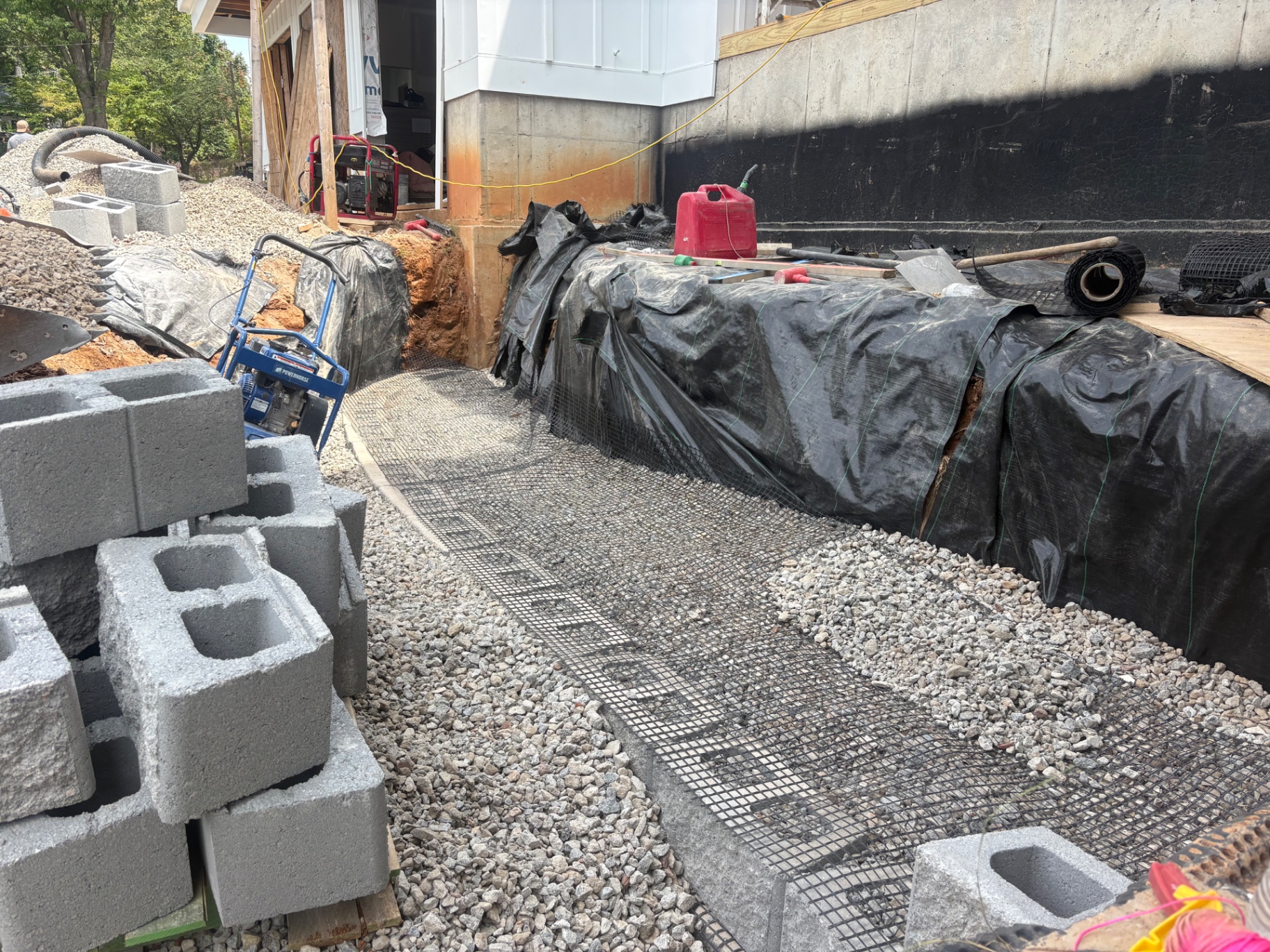
Geogrid is a strong polymer mesh laid in horizontal layers into the soil behind a retaining wall, connected to the wall face between courses. It turns the backfill into a reinforced mass that resists movement as a unit, which is what allows a segmental wall to be built taller than the blocks alone could support.
How geogrid turns soil into part of the structure
Stacked block resists overturning by its own weight and by the setback of each course. That works to a point, and beyond that point the pressure behind the wall exceeds what the blocks can hold.
Geogrid changes the problem. Layers of mesh extend from the wall face back into the compacted backfill, and the soil above and below each layer grips it. The result is a reinforced soil mass that behaves like a single large block, far heavier and more stable than the wall face alone.
The wall is then effectively holding itself back. That is why geogrid lengths are related to wall height — the reinforced mass has to be deep enough to be stable.
The heights and loads where it becomes necessary
Each block system publishes design tables setting out how tall an unreinforced wall can be for given conditions. Above that height, reinforcement is required. The exact figure depends on the block, the soil, the slope above the wall and what the wall supports, which is why a specific number is meaningless without the site.
Height is not the only trigger. Reinforcement is commonly needed where there is a slope above the wall rather than level ground, where a driveway, parking area or structure sits above it, where the wall supports vehicle loads, and where poor soils reduce what the backfill can contribute.
Above certain heights, or where a wall supports a structure, engineered design by a licensed engineer is typically required as well.
Why it has to go in during construction, not after
Geogrid layers sit between courses of block and extend back into backfill that is placed and compacted in lifts around them. The only way to install them is as the wall goes up.
Adding reinforcement to a finished wall means excavating all of the backfill behind it, which is most of the work of rebuilding. In practice, a wall that needed geogrid and did not get it will be rebuilt rather than retrofitted.
This is also why the decision cannot be deferred. A wall built to unreinforced height with the intention of adding fill or a patio above it later has been designed for the wrong load.
Getting it right on site
Geogrid is only as good as its installation. The layers have to be the correct length for the height, laid at the specified vertical spacing, oriented the right way — it is stronger in one direction — pulled taut rather than left slack, and properly connected at the wall face.
The backfill matters too. Reinforced zones are built with material that compacts well and drains, in controlled lifts. Clay dumped behind the grid does not develop the friction the design depends on, and it holds water.
Heavy equipment is kept off the grid layers during construction for the same reason.
What to ask about it
If you are getting quotes for a wall of any real height, ask directly: does this wall need geogrid, what does the block manufacturer's design table say for this height and this slope, and is it included in the price?
A quote that is noticeably cheaper on a tall wall has often left it out, and it is entirely invisible once the backfill is in.
Southern Style Turf & Design builds reinforced walls to system design requirements and states reinforcement in the written scope. Free on-site estimate across Lake Norman.
Frequently asked questions
What is geogrid in a retaining wall?
A strong polymer mesh laid in horizontal layers into the compacted backfill and connected to the wall face, turning the soil behind the wall into a reinforced mass that resists movement as a unit.
When does a retaining wall need geogrid?
Above the unreinforced height in the block system's design tables, and also where there is a slope above the wall, a driveway or structure above it, vehicle loads, or weak soils — regardless of height.
Can geogrid be added to an existing wall?
Not practically. The layers sit between courses within compacted backfill, so installing them means excavating everything behind the wall — effectively rebuilding it.
How long does geogrid need to be?
It is related to the wall height and the design conditions, and it often extends further back into the soil than the wall is tall — which can limit what is buildable near a property line.
Want this looked at on your property?
We give free, no-pressure on-site estimates across Denver, Mooresville, Cornelius, Davidson, Huntersville and Troutman.