Most lighting disappointment comes from using the wrong fixture for the job. Each type is built to do one thing well.
Path lights
Purpose: lighting a surface you walk on, plus the bed edge beside it.
They throw light downward in a pool. They are not meant to light plants or the house.
Space them to create overlapping pools with dark between, not a continuous runway. Staggering them across a path looks far better than matched pairs.
Common mistake: too many, too evenly spaced, too tall.
Uplights and well lights
Purpose: lighting something vertical — a tree trunk and canopy, a column, a chimney, a specimen shrub.
Beam spread is the key choice: narrow spot for tall trunks, wider flood for canopies and broad features.
Well lights sit flush in the ground where a visible fixture would be intrusive, such as in lawn or against paving.
Common mistake: aiming so the source is visible from the patio or the street.
Spotlights, wash and flood
Spotlights use a tight beam to pick out one object — a sculpture, a specimen, a sign.
Wash and flood lights use a broad beam to lift a whole surface evenly: a facade, a hedge, a wall.
Grazing — placing a wash light close to a textured wall and aiming along it — brings out stone and brick texture dramatically.
Common mistake: flooding a whole facade at high output, which flattens the house and annoys the neighbours.
Hardscape, step and down lighting
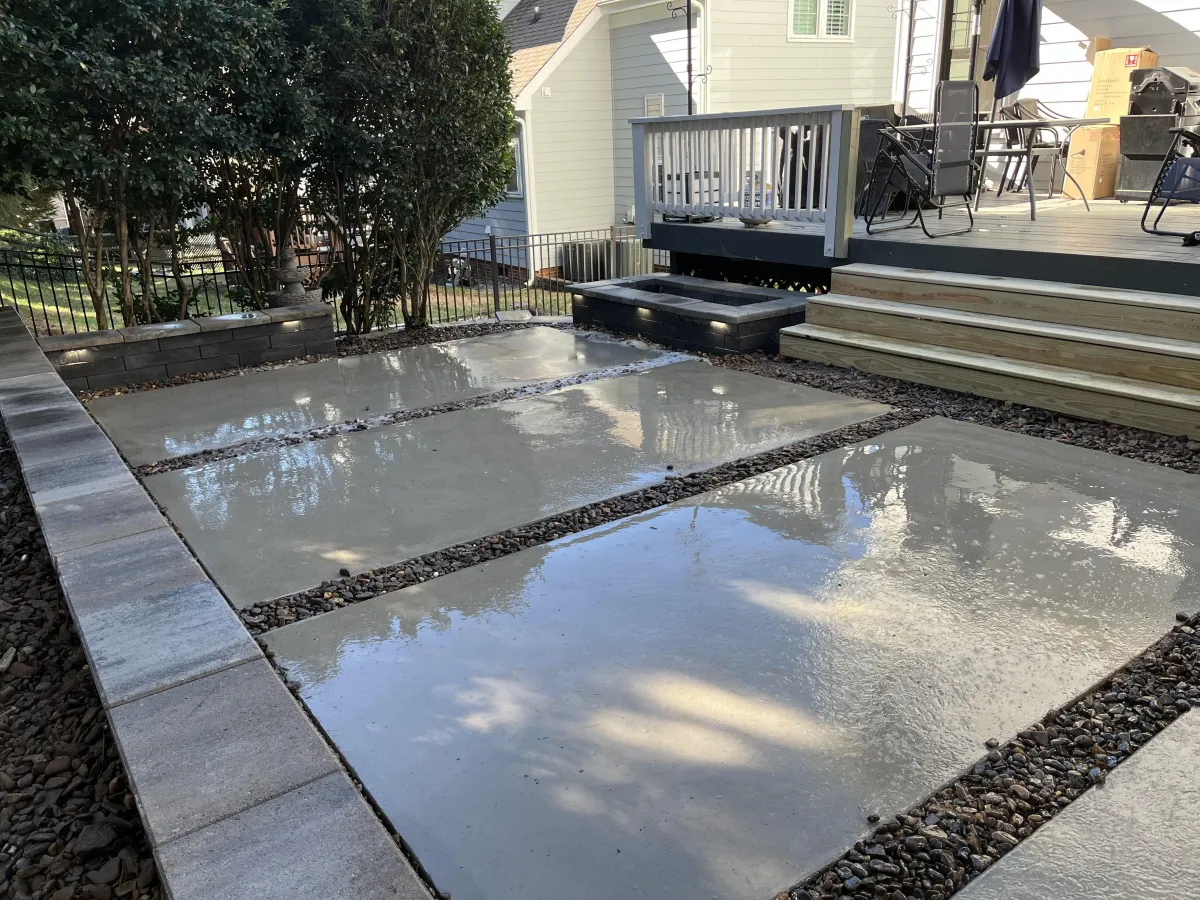
Hardscape lights tuck under caps and treads to light walls, steps and seat walls without a visible fixture.
Step lights are a safety item first — every change in level in an outdoor living area should be lit.
Down lighting mounted high in a tree throws dappled light across a patio or lawn and is the most natural-looking effect available.
The best schemes mix three or four types. A yard lit entirely with path lights always looks like a car park.
Southern Style Turf & Design designs lighting layouts around Lake Norman that mix fixture types for effect rather than defaulting to one.
Frequently asked questions
How far apart should path lights be?
Far enough that pools of light overlap only slightly, with darker sections between. Even, close spacing looks institutional.
Spot or flood for a tree?
Narrow spot for a tall narrow trunk, wider flood for a spreading canopy. Large trees often want two or three fixtures at different angles.
How many fixture types should a design use?
Usually three or four. Variety in fixture type is what makes lighting look designed rather than installed.
Want this looked at on your property?
We give free, no-pressure on-site estimates across Denver, Mooresville, Cornelius, Davidson, Huntersville and Troutman.