Good walkway lighting is not a line of identical fixtures every few feet. It is a few deliberate pools of light at the places where footing changes, with enough spill between them that the route reads as continuous.
Light the hazards, not the whole path
Steps, level changes, turns and the landing at the door are where light does real work. Straight, flat runs between them need far less than most installations use.
Step lights set into a wall or riser are safer than a path light beside the steps, because they light the tread rather than the person.
At the door, light the lock and the threshold rather than the visitor's face.
Spacing and glare
Alternate sides rather than lining fixtures up like an airstrip. Overlapping pools from either side reads as a lit route without the runway effect.
Choose shielded fixtures where the lamp is not visible from standing height. A bright point of light in the eye makes everything beyond it darker, which is the opposite of a safety improvement.
Keep colour temperature consistent and warm across the property. Mixed colour temperatures are the tell of a system added to piecemeal.
Installing alongside hardscape
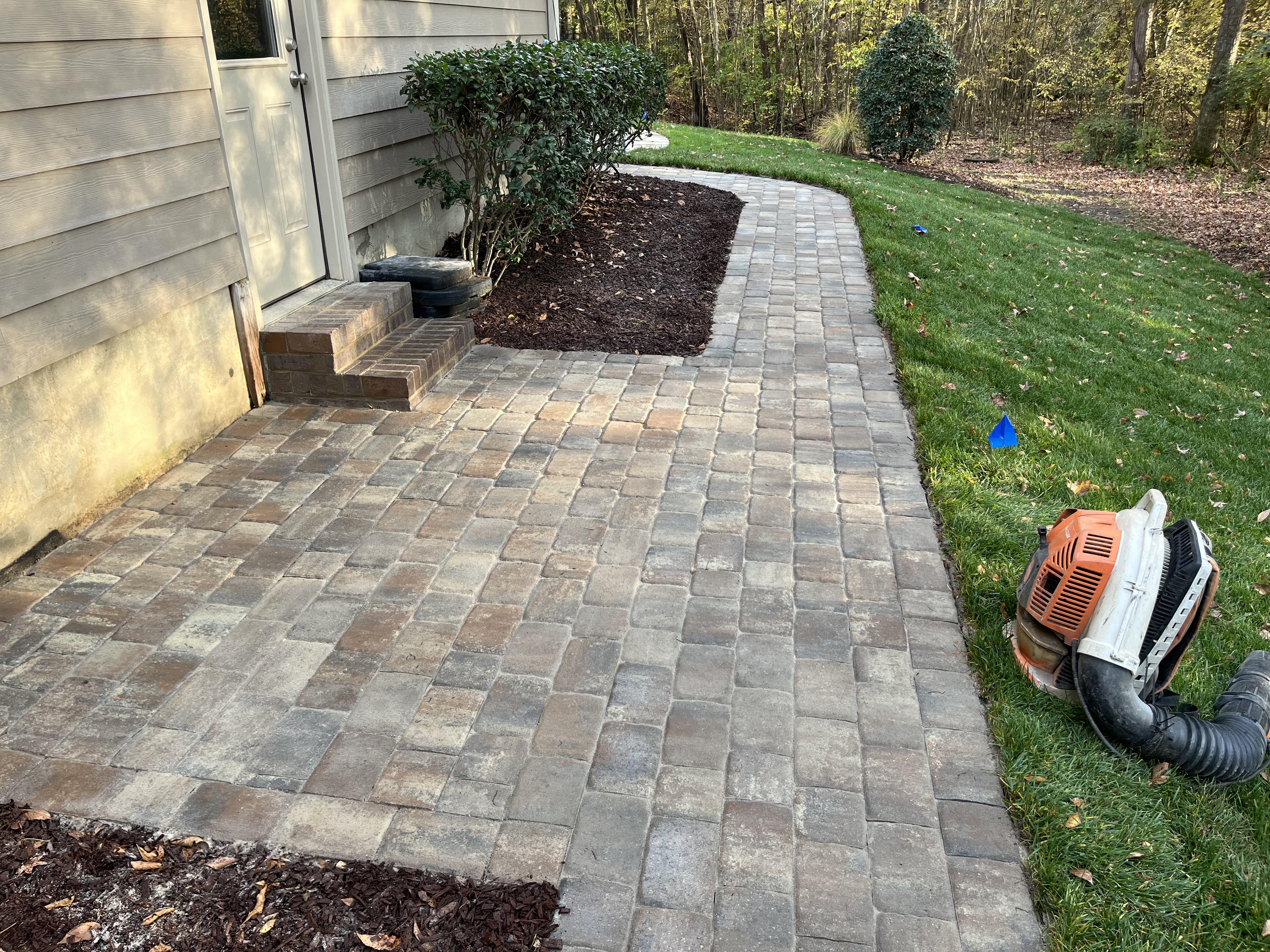
Cable and sleeves should go in before paving and before beds are mulched. Running cable afterwards means lifting pavers or trenching finished planting.
Sleeve under any walk, patio or driveway crossing, even where no fixture is planned yet. An empty sleeve costs almost nothing during construction.
Keep fixtures out of mower and string-trimmer lines, and set them back far enough from the paving edge that they are not kicked.
Controls and maintenance
An astronomical timer or a photocell handles dusk-to-set-time operation without adjustment through the year. Smart controllers add zone scheduling and remote control if you want it.
Check aiming annually — plants grow into fixtures and mulch buries them. Clean lenses at the same time.
Southern Style Turf & Design designs and installs low-voltage landscape lighting across the Lake Norman area, including step, path and wall lighting integrated into new hardscape.
Frequently asked questions
How far apart should path lights be?
Far enough that the pools just overlap or nearly meet, alternating sides. That is usually fewer fixtures than homeowners expect.
Are solar path lights worth it?
They are easy to install but dim, inconsistent through winter and short-lived. A low-voltage system is what holds up.
Can lighting be added to an existing walkway?
Yes. Cable can be run in bed edges and under paving by boring or by lifting a small number of units, though it is more work than planning it in.
Want this looked at on your property?
We give free, no-pressure on-site estimates across Denver, Mooresville, Cornelius, Davidson, Huntersville and Troutman.