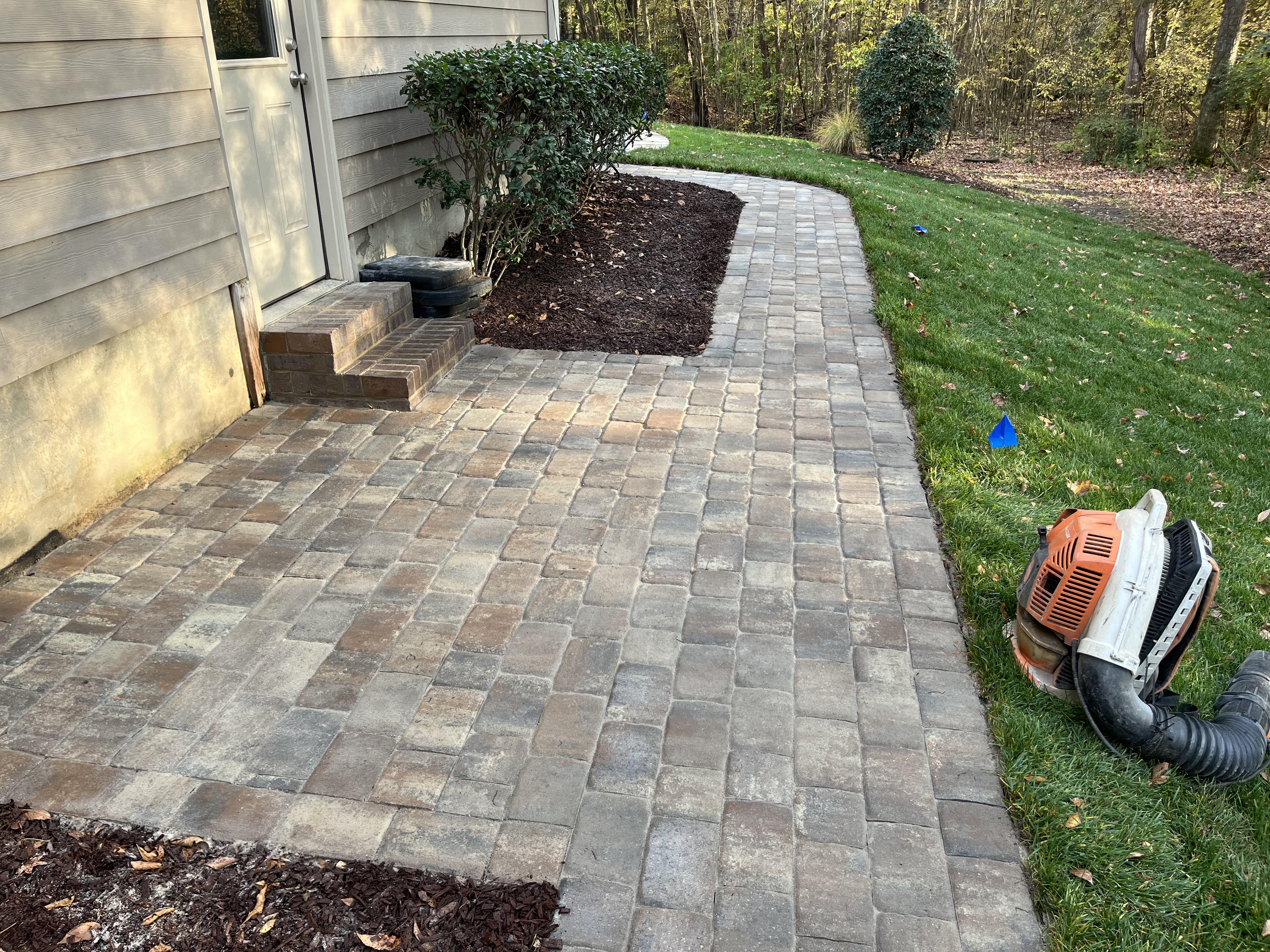
Both make a good walk. The real differences show up in how they handle movement, how they can be repaired, and how they look against your house.
How they handle movement
Pavers are a flexible system. Small movements from roots, settlement or frost show as a slight unevenness that can be lifted and reset.
Concrete is rigid. The same movement produces a crack, and a crack is permanent unless the section is replaced.
On lots with mature trees — common across Lake Norman neighbourhoods — that repairability is a real advantage for pavers.
Appearance and design freedom
Pavers offer colour, pattern, borders and curves without formwork, and they suit brick and stone houses naturally.
Concrete reads calmer and more monolithic, which suits modern designs, and it can be dressed up with tooled joints, borders or a decorative finish.
Pavers hide dirt and staining better; a large plain slab shows everything.
Cost and installation
Plain concrete is typically the lower up-front cost for a simple straight walk.
Pavers cost more in labour and material but need no cure time — the walk is usable the day it is finished.
Both need the same excavation and compacted base. Quotes that differ wildly usually differ in base depth, not in surface material.
Pavers require edge restraint; concrete does not, but benefits from a border where it meets beds.
Maintenance and drainage
Pavers need joint sand topped up occasionally and the odd weed pulled from joints; permeable versions let water through the surface entirely.
Concrete needs almost nothing beyond cleaning, though shaded slabs grow algae and want a wash.
Either way, the walk must shed water and not trap it against the house or across the lawn.
Southern Style Turf & Design installs both paver and concrete walkways around Lake Norman and will tell you plainly which suits your site.
Frequently asked questions
Which lasts longer, pavers or concrete?
Both last decades on a good base. Pavers stay serviceable longer in practice because damaged sections can be lifted and reset instead of broken out.
Are paver walkways slippery?
No more than concrete. Shade and algae make any surface slippery; keeping debris off is what matters.
Can I put pavers over an existing concrete walk?
Sometimes, if the slab is sound and the resulting height works at doors and steps. Often it is better to remove it and build a proper base.
Want this looked at on your property?
We give free, no-pressure on-site estimates across Denver, Mooresville, Cornelius, Davidson, Huntersville and Troutman.