Permeable pavers let water pass through open joints into a storage layer of clean stone beneath, instead of shedding it off the surface. They are an elegant solution on soil that drains. On Piedmont clay, which drains slowly, they need to be designed differently — and sometimes they are the wrong tool entirely.
How permeable paving works
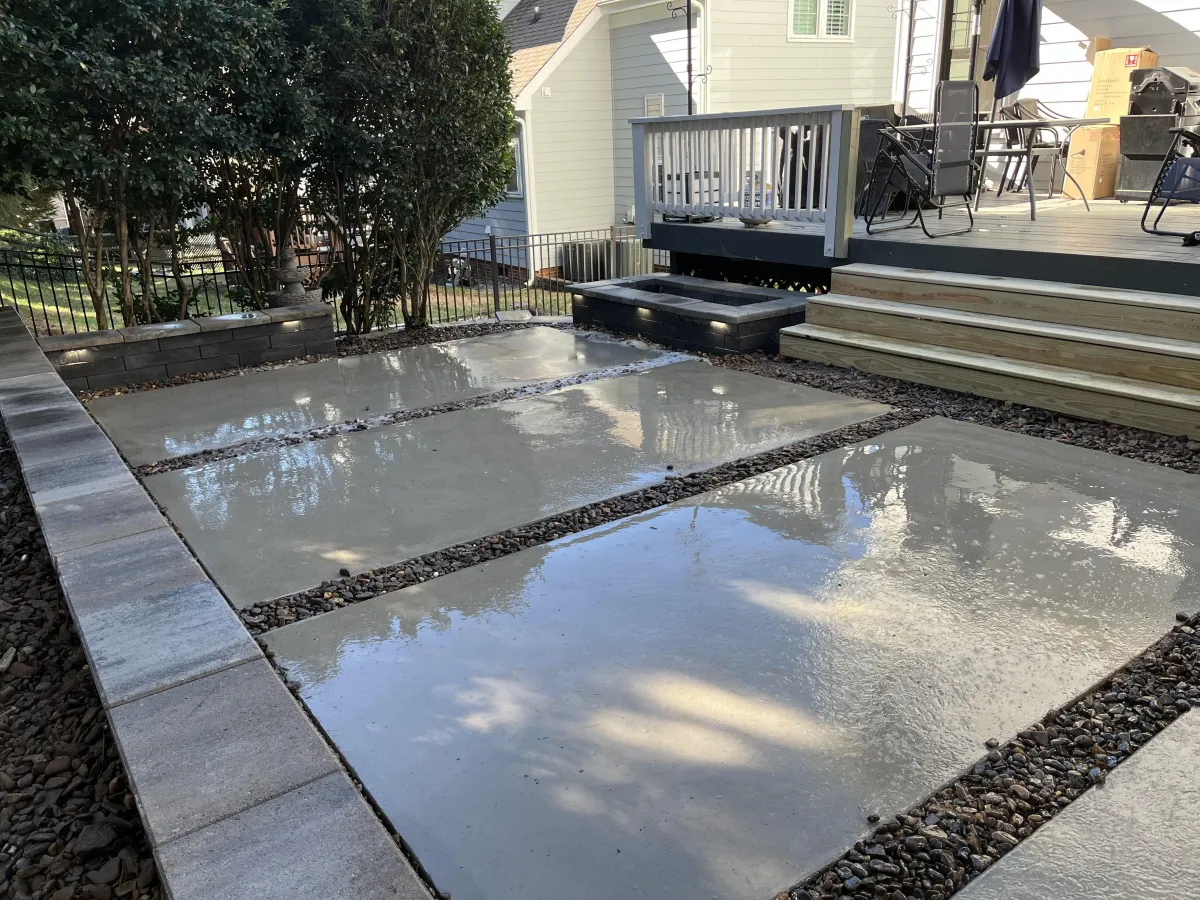
The units are set with wider joints filled with small clean stone rather than sand. Water passes through those joints immediately.
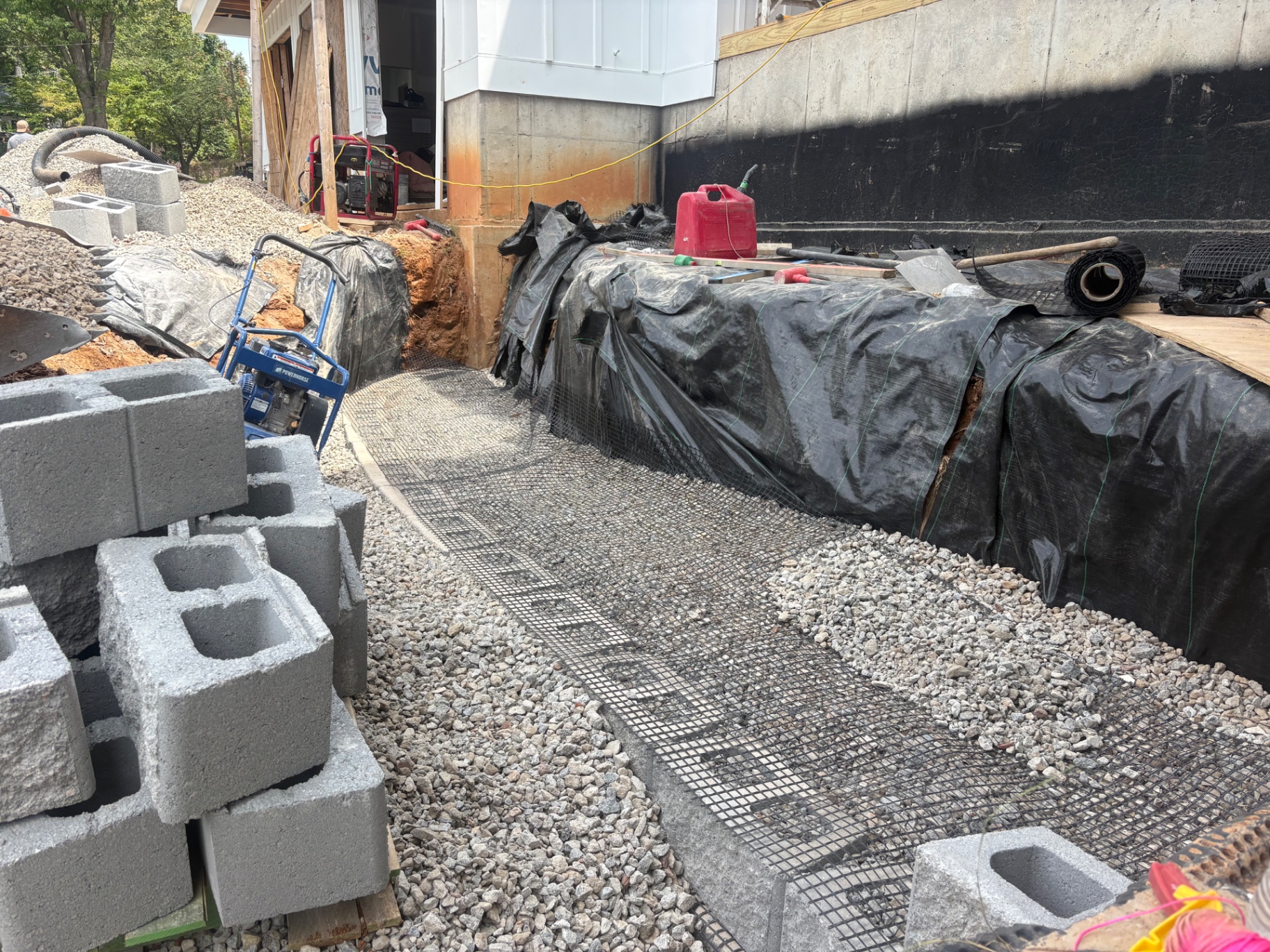
Beneath sits an open-graded aggregate base — clean angular stone with deliberate void space — which is both the structural base and a reservoir. Water held there infiltrates into the subgrade over the following hours or days.
Because the joints and base are meant to pass water, the details are the opposite of a conventional patio: no fines in the base, no polymeric sand in the joints, and geotextile placed to keep surrounding soil from migrating into the stone.
Why clay soil changes the calculation
The system only empties as fast as the subgrade accepts water. On sandy soil that is quick. On the tight clay common across the Piedmont it can be very slow, and a reservoir that never empties cannot absorb the next storm.
That does not automatically rule permeable paving out, but it changes the design. On slow soil the storage layer is deeper, and it usually needs an underdrain — a perforated pipe within the stone that carries away whatever the subgrade cannot take, to a safe outlet.
At that point the system is doing something worth naming honestly: it is detaining and slowly releasing runoff rather than making it disappear. That is still valuable — it takes the peak off a storm — but it is not infiltration.
An infiltration test on the actual subgrade is what separates a design that works from one that ponds.
When permeable paving makes sense here
Where runoff is genuinely the problem you are solving — a large hard surface adding water to a yard that already struggles.
Where an ordinance, HOA rule or lot coverage limit treats permeable surfaces differently. Requirements vary by jurisdiction, so this is worth confirming with the relevant authority rather than assuming.
Where the surface sits over an area you would rather not pipe, or where there is no convenient outlet for a conventional drainage run.
Where the subgrade has some capacity and the design can be built properly, with the depth and the underdrain the soil requires.
When it is the wrong choice
Immediately against a foundation, where storing water in a reservoir beside the house is the last thing you want.
On steep slopes, where the water runs across the surface faster than it can enter and the storage layer cannot be held level.
In a low spot that already collects water from the wider yard — the system is designed for the rain landing on it, not for a catchment.
Where budget is tight. Permeable systems use more excavation and more stone than a conventional patio, so they cost more to build.
In many yards the better answer is a conventional patio with correct fall plus a proper drainage system taking the runoff somewhere useful.
Maintenance
The one thing permeable paving demands is that the joints stay open. Sediment, leaf litter and organic debris gradually clog them, and a clogged permeable patio is just an ordinary patio with wide joints.
Keep the surface swept, keep soil and mulch from washing onto it, and expect periodic cleaning of the joint stone. Never fill the joints with regular or polymeric sand — that ends the system's function permanently.
Southern Style Turf & Design builds both conventional and permeable paver surfaces across Lake Norman, and will tell you plainly which one your soil supports. Free on-site estimate.
Helpful outside reference
Before adding lime or fertilizer, a sample through the NCDA&CS soil testing service shows what your soil actually needs.
Frequently asked questions
Do permeable pavers work in clay soil?
They can, but the subgrade drains slowly, so the design needs a deeper storage layer and usually an underdrain. In that form the system detains and slowly releases runoff rather than fully infiltrating it.
Are permeable pavers more expensive?
Yes. They require more excavation and more clean open-graded stone than a conventional patio base, so the installed cost is higher.
What maintenance do permeable pavers need?
The joints must stay open. Sweep the surface, keep soil and mulch from washing across it, and have the joint stone cleaned periodically. Never fill the joints with regular or polymeric sand.
Where should permeable pavers not be used?
Against a foundation, on steep slopes, or in a low spot that already collects runoff from the rest of the yard.
Want this looked at on your property?
We give free, no-pressure on-site estimates across Denver, Mooresville, Cornelius, Davidson, Huntersville and Troutman.