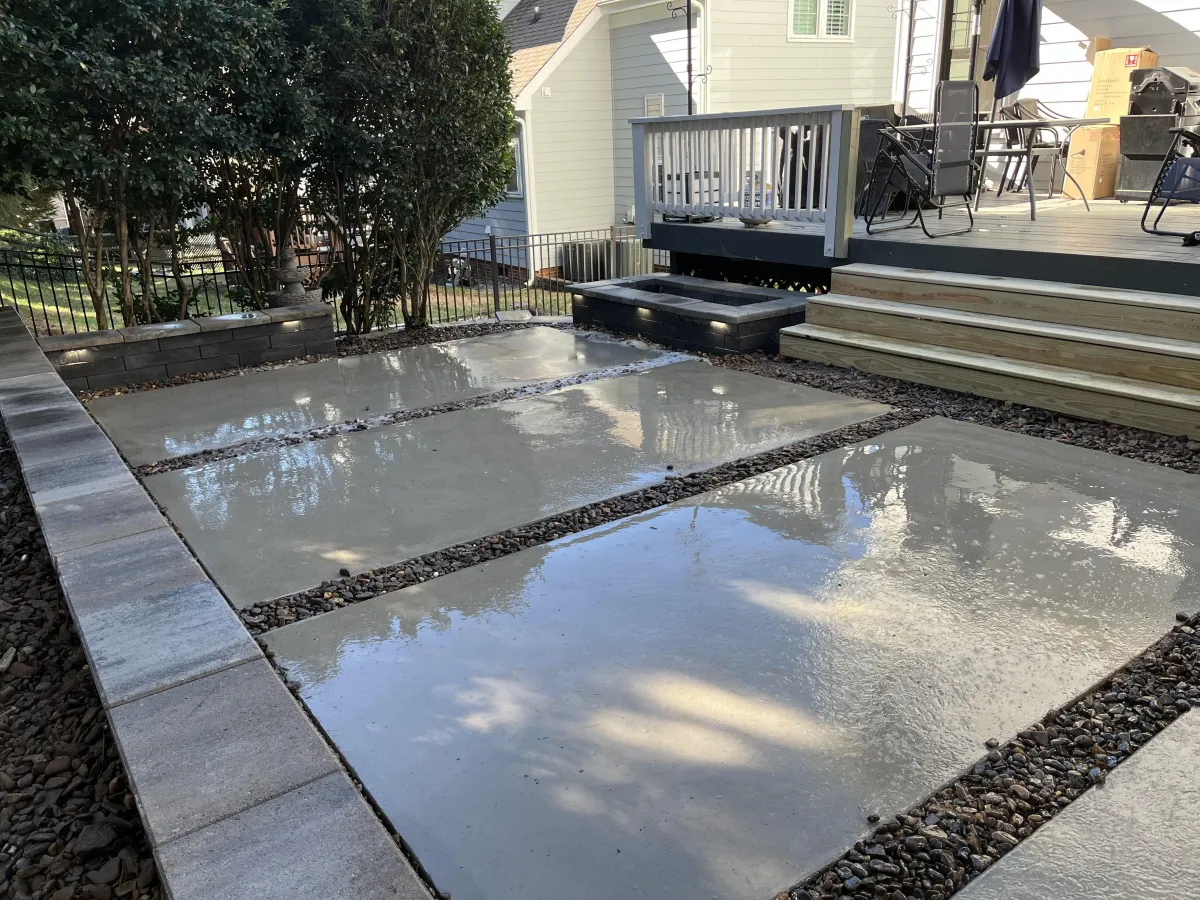
Polymeric sand is jointing sand mixed with a binder that hardens when wetted, locking paver joints against washout, weeds and insects. It works very well when installed in the right conditions and fails visibly when it is not — and almost every failure traces back to the installation day rather than to the product.
Why joint sand matters more than it sounds
Pavers work as a system because they are locked against one another. Full joints transfer load between units, so a weight on one paver is shared by its neighbours rather than pressing it alone into the bedding.
Empty joints break that. Pavers begin to move independently, edges chip against each other, water runs straight into the bedding layer, and weeds and ants colonise the gaps.
Regular jointing sand does the mechanical job but washes out steadily. Polymeric sand adds a binder so the joint resists washout, which is why it has become standard on quality installations.
Installation conditions that ruin it
This is where nearly all polymeric sand problems begin.
- Damp pavers. The surface must be completely dry when the sand is swept in. Any moisture starts the binder curing on the paver face, and it leaves a haze that is hard to remove.
- Residue left on the surface. Every grain has to be swept and blown off the paver faces before watering. A leaf blower on low, used carefully, is the standard final step.
- Underfilled joints. Sand has to be worked down the full joint depth and topped up, not just dusted across the top.
- Wrong watering. Too little and the binder does not cure through; too much and it washes the binder out of the joint. The product instructions give a sequence, and it matters.
- Rain too soon after installation. The forecast is part of the job planning.
- Joints too narrow or too wide for the product. Each polymeric sand has a joint width range it is designed for.
Where it is not the right choice
Polymeric sand needs a joint it can bond within. On very tight joints there is not enough depth of material to cure properly, and on very wide joints it can crack.
It also assumes a stable surface. On a patio that is still moving because the base is inadequate, the hardened joints crack as the pavers shift, and you are looking at the symptom rather than the cause.
For permeable paver systems it is generally wrong entirely — those joints are meant to let water through, and a binder defeats the purpose.
Signs yours needs replacing
Joints noticeably lower than the paver surface. Sand visibly washing out after rain. Weeds or moss establishing in the joints. Ant activity bringing sand to the surface. Pavers that rock or click underfoot. A hazy white film across the paver faces from a poor original installation.
Any of those is worth acting on, because open joints accelerate everything else. Water entering the bedding layer is what turns a joint problem into a base problem.
Replacing it
Old joint material is removed to a sufficient depth — by hand tools on a small area, or with a proper joint cleaning tool on a larger patio. The surface is then cleaned and allowed to dry completely.
New polymeric sand is swept in and worked down the joints, the surface is swept and blown clean, and the joints are watered per the manufacturer's sequence.
The whole job hinges on the patio being dry and the surface being clean. Done on the right day it lasts for years; done on a damp morning it hazes and has to be dealt with.
Southern Style Turf & Design installs and re-sands paver patios across Lake Norman. Free on-site estimate, no trip fee.
Frequently asked questions
What is polymeric sand?
Jointing sand mixed with a binder that hardens when watered, locking paver joints so they resist washout, weeds and insects.
Why did my polymeric sand haze the pavers?
Almost always because the surface was damp when it was installed, or residue was left on the paver faces before watering. Both start the binder curing on top of the paver rather than in the joint.
How long does polymeric sand last?
Years when installed correctly on a stable patio. On a patio whose base is still moving, the hardened joints crack and the real problem is underneath.
When should joint sand be replaced?
When joints sit noticeably below the paver surface, sand washes out after rain, weeds or ants establish in the joints, or pavers begin to rock underfoot.
Want this looked at on your property?
We give free, no-pressure on-site estimates across Denver, Mooresville, Cornelius, Davidson, Huntersville and Troutman.