Erosion is a symptom. Soil leaves a slope because water is arriving faster than the ground can absorb or shed it, so the fix starts at the top of the hill rather than at the bare patch halfway down. Stabilising the visible damage without addressing the inflow buys you one season.
Reading the channels to find where water enters
Walk the slope after a storm and follow the rills — the small channels cut into the soil — uphill rather than downhill. They lead to the entry point.
What you usually find at the top is one of a handful of things: a downspout discharging onto the slope, a driveway or patio edge shedding sheet flow over the crest, a neighbouring property draining across the boundary, a gap in a planting bed where bare soil is exposed, or a compacted area shedding water it should be absorbing.
Fix the entry point and the slope below often stabilises with very little further work. This is the step almost everyone skips.
Diverting before stabilising
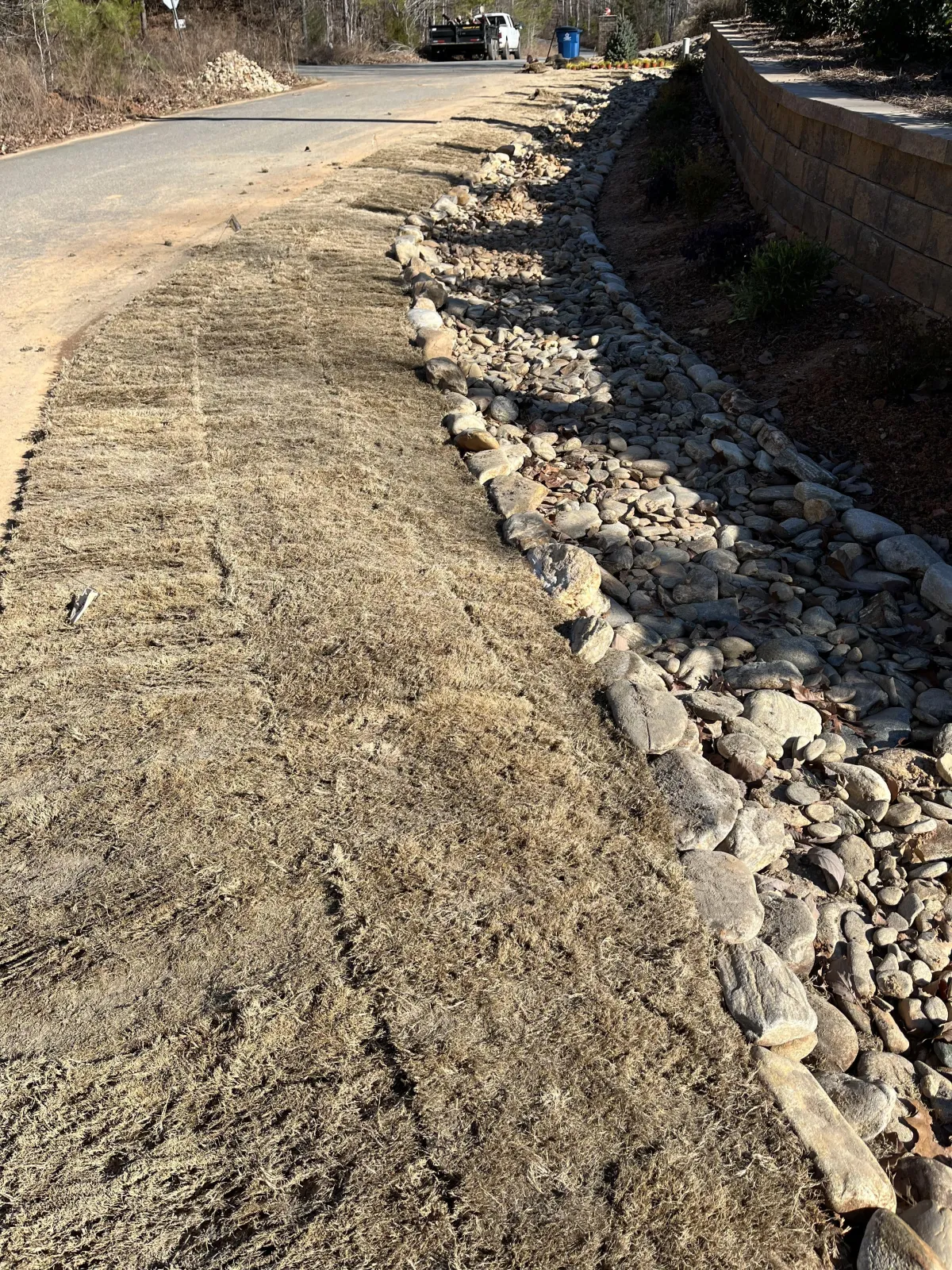
Where the inflow cannot be eliminated, it can usually be intercepted above the slope. A shallow swale or a curtain drain running across the top of the hill catches water before it starts down and carries it around to a controlled outlet.
This is the highest-value work on most sloped yards. It reduces the volume the slope has to handle, which reduces everything else you need to build.
Terracing, matting and planting compared
Planting is the cheapest long-term stabiliser and the slowest to take effect. Deep-rooted groundcovers and native grasses knit the soil together permanently, but they need a season or two and they need to survive establishment on a slope that is currently washing.
Erosion control matting bridges that gap. Biodegradable blankets pinned over seeded soil hold everything in place while roots establish and then break down. On steeper ground, heavier matting or coir logs across the slope slow the water further.
Terracing breaks one long slope into several short ones. Each terrace is short enough that water never builds up the speed to cut a channel. It is more work up front and it creates usable planting space, which is often worth it on its own.
Rip-rap and stone armour have their place where flow is concentrated — at an outlet, in a channel — but scattering stone across a whole slope tends to look like what it is and does little for soil that keeps moving beneath it.
When the slope needs a wall rather than a fix
Some slopes are past stabilising. Signs to take seriously: soil visibly moving in sheets rather than channels, a slope steeper than roughly the angle soil naturally rests at, undercutting at the toe, cracks or step-like breaks in the surface, or a structure at the top or bottom that failure would threaten.
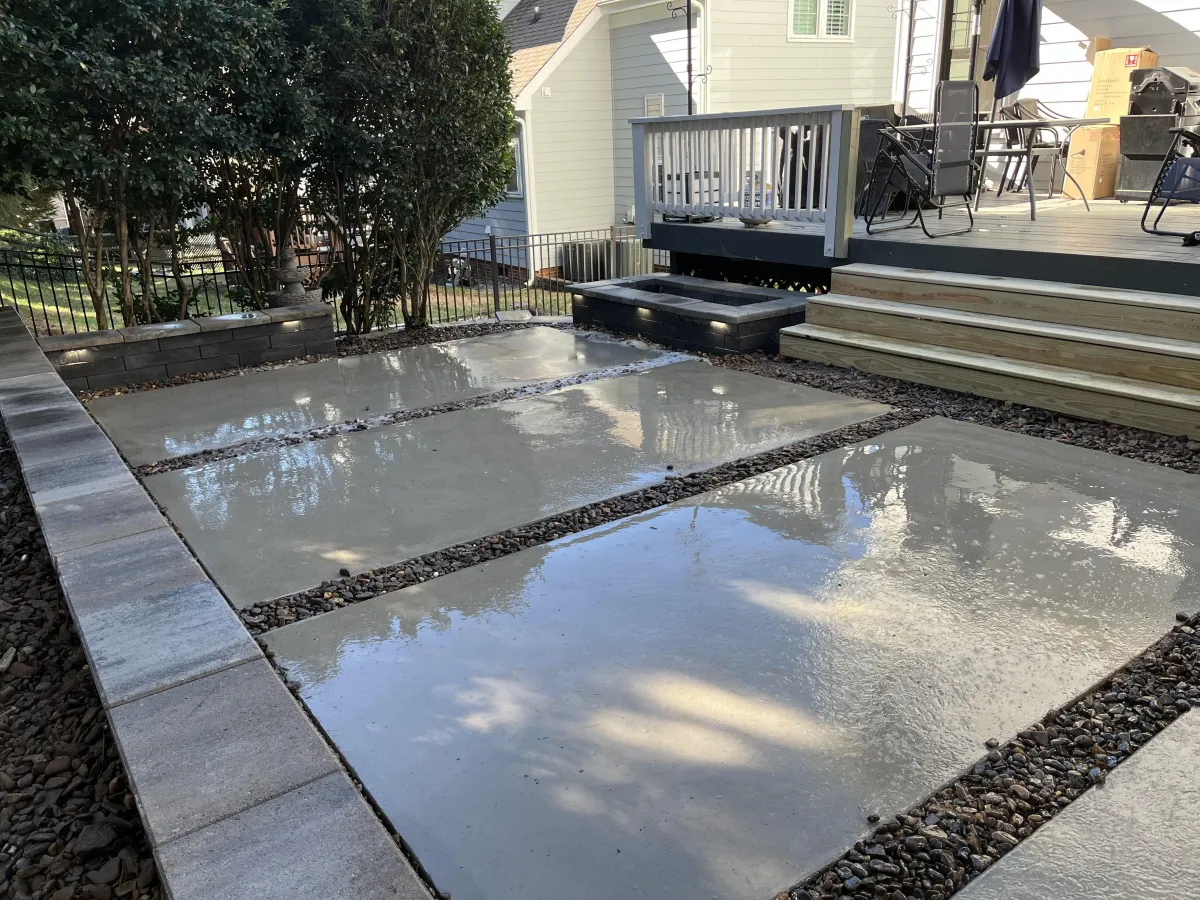
At that point the answer is a retaining wall — a structure that holds the soil rather than a surface treatment that hopes it stays. Walls above a certain height, or supporting a driveway or structure, need engineered design and proper drainage behind them.
The drainage behind a wall is not an accessory. Water pressure building up behind a wall with no drain is the most common reason walls fail, and it is entirely preventable.
Slopes around Lake Norman
Lots sloping toward the lake, drop-offs at the back of subdivision lots, and cut banks left behind by construction are the three that come up most often here. All three tend to share the same clay subsoil with a thin cover of topsoil — which erodes readily once the cover is broken.
Acting early is dramatically cheaper. A slope losing topsoil is a planting and diversion job. A slope that has started to slip is an excavation and wall job.
Southern Style Turf & Design handles erosion control, grading and retaining walls across Lake Norman. Free on-site estimate, no trip fee.
Frequently asked questions
How do you stop erosion on a sloped yard?
Find and divert the water entering at the top of the slope first, then stabilise the surface with matting and deep-rooted planting, and terrace the slope if it is long or steep enough to let water build speed.
What is the cheapest way to control erosion?
Diverting the inflow. Redirecting a downspout or cutting a swale across the top of the slope removes the cause, and often means the surface work needed below is minor.
When does a slope need a retaining wall?
When soil is moving in sheets, the toe is undercutting, the surface is cracking or stepping, or a structure above or below would be at risk if it slipped.
Does mulch stop erosion on a slope?
Not on its own — heavy rain floats it off and it ends up at the bottom. Matting pinned over seeded soil holds far better while planting establishes.
Want this looked at on your property?
We give free, no-pressure on-site estimates across Denver, Mooresville, Cornelius, Davidson, Huntersville and Troutman.