If your yard is wet, start with the downspouts. Roof water is the biggest single volume of water landing on most properties, it is concentrated into a handful of discharge points, and redirecting it is the cheapest fix in drainage. On a meaningful share of yards it is also the only fix needed.
How much water your roof actually sheds
Rain falling on a roof does not disperse — it is collected by the gutters and delivered to a few points on the ground. An inch of rain on a typical suburban roof amounts to well over a thousand gallons, and a house with four downspouts is dropping a quarter of that at each one.
That is why the ground beside a downspout erodes, why mulch keeps washing out of the bed at that corner, and why the soil there is still soft three days later. It is not a soil problem. It is a volume-in-one-place problem.
Concentrated at the foundation, that same water is the leading cause of crawl space moisture and soil pulling away from the wall.
Splash blocks, extensions and buried pipe compared
A splash block prevents the water from cutting a hole in the ground. That is all it does. It moves water about a foot from the wall, which is not far enough for anything.
Flexible or rigid surface extensions carry the discharge several feet further out. Cheap, effective, and easy to fit yourself. The downsides are that they are visible, they get in the way of mowing, and the flexible corrugated type sags and holds debris over time.
Buried solid pipe is the proper version. The downspout drops into a fitting, the pipe runs underground with fall, and the water emerges at a pop-up emitter or daylight outlet well away from the house. It is invisible, it does not interfere with the lawn, and it lasts.
Two rules for buried runs: use solid pipe, not perforated — you do not want the water leaking back out beside the house — and keep consistent fall the whole way. Smooth-wall pipe carries debris through far better than corrugated.
Where the discharge point should and shouldn't go
NC State Extension's mold and moisture guidance recommends downspouts discharge six to ten feet from the foundation as a minimum. On clay, further is better, because the water will not soak away where it lands.
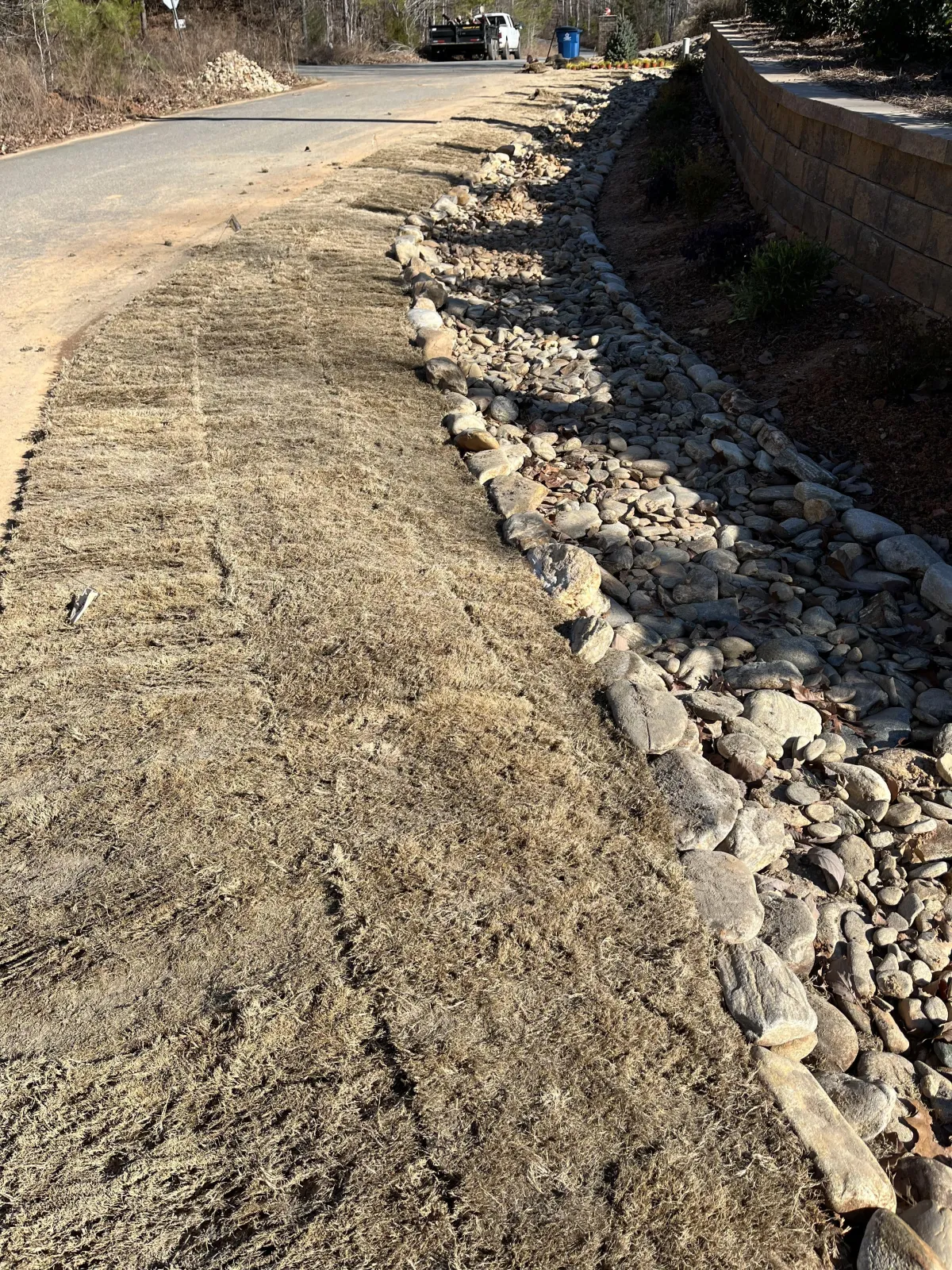
- Good: somewhere lower on your own property where water can spread out and run off — a lawn area with fall, a planted swale, a dry creek bed.
- Good: tied into an existing yard drainage system with a real outlet.
- Bad: a few feet from the wall onto a splash block. This is the default on most houses and the cause of most of the trouble.
- Bad: onto a hard surface that runs it straight back toward the house.
- Never: into a sanitary sewer or a septic field, or piped to dump onto a neighbour's lot.
Maintenance, briefly
Clear gutters at least twice a year, and more often under pines or oaks. A blocked gutter overflows at the wall, which puts the water in the worst possible place — worse than having no gutter at all.
Check that buried runs still flow. A hose in the downspout should produce water at the outlet within seconds. If it does not, the line is blocked or has lost its fall.
Pop-up emitters occasionally get held shut by soil or mulch. Keep the area around them clear.
When downspouts are not the whole story
If you have extended every downspout well away from the house and water is still standing in the yard, you have a second source — surface runoff arriving from uphill, or water moving through the soil.
That is the point to look at grading, a catch basin, or a French drain. But doing it in this order means the system you install is sized for the water that is genuinely left over, rather than for the roof water you could have redirected for a fraction of the cost.
Southern Style Turf & Design pipes downspouts as standalone work and as part of larger drainage systems across Lake Norman.
Frequently asked questions
How far should downspouts discharge from the house?
At least six to ten feet, per NC State Extension guidance, and further on clay soil where the water will not soak away where it lands.
Are buried downspout drains better than surface extensions?
They last longer, stay out of the way of mowing, and can carry water much further. Surface extensions are cheaper and are a perfectly good first test of whether roof water is your problem.
Should buried downspout pipe be perforated?
No. Use solid pipe so the water is carried away rather than leaking back into the soil beside the house. Perforated pipe belongs in a French drain, not a downspout run.
Can downspout water go into a French drain?
It can be tied into the solid outlet pipe of a drainage system, but it should not be dumped into the perforated collection section — that just recharges the soil you are trying to dry out.
Want this looked at on your property?
We give free, no-pressure on-site estimates across Denver, Mooresville, Cornelius, Davidson, Huntersville and Troutman.