Every concrete slab cracks. The difference between a slab that looks intentional and one that looks damaged is whether someone decided in advance where those cracks would go.
Why concrete cracks at all
Concrete shrinks slightly as it cures and moves with temperature swings afterward. It is strong in compression and weak in tension, so when that shrinkage pulls the slab apart, it relieves the stress by cracking.
No mix, reinforcement, or finishing technique eliminates that movement. What good practice does is control where it shows up.
What control joints do
A control joint is a deliberate weak line — tooled in while the concrete is plastic or saw-cut soon after — that creates the thinnest cross-section in the slab.
When shrinkage stress builds, the slab cracks at that weakened line, below the surface, where the joint hides it. The result is a straight, tidy line instead of a jagged crack wandering across the middle of the patio.
Joints have to be cut deep enough to work — roughly a quarter of the slab thickness is the usual target — and cut early enough, before shrinkage cracking beats them to it.
Spacing and layout
Joint spacing is tied to slab thickness, with a common rule of thumb putting panels at around two to three times the slab thickness in feet. A four-inch slab, for example, typically gets joints every eight to twelve feet.
Good layouts also follow these habits:
- Keep panels roughly square rather than long and narrow.
- Line joints up with inside corners, column bases, and other places cracks naturally start.
- Continue joint lines through adjoining sections so the pattern reads as intentional.
- Isolate the slab from the house, steps, and posts with a separate isolation joint so those elements can move independently.
When joints go wrong
Missing, shallow, or widely spaced joints are the most common reason a newer patio has a random crack across it. The slab moved, and the only available path was through the field of the concrete.
Timing matters too: saw cuts made too late do nothing because the shrinkage crack has already formed.
Joints also need to stay functional. Sealant that has failed lets water into the joint, where freeze-thaw cycles chew at the edges. That is one of the contributors to surface deterioration we cover in our article on concrete spalling and scaling.
Joints and appearance
Because joints are permanent, they are worth treating as a design element. On a stamped or colored patio the joint layout can follow the pattern, and on a plain broom-finished slab a clean grid simply looks deliberate.
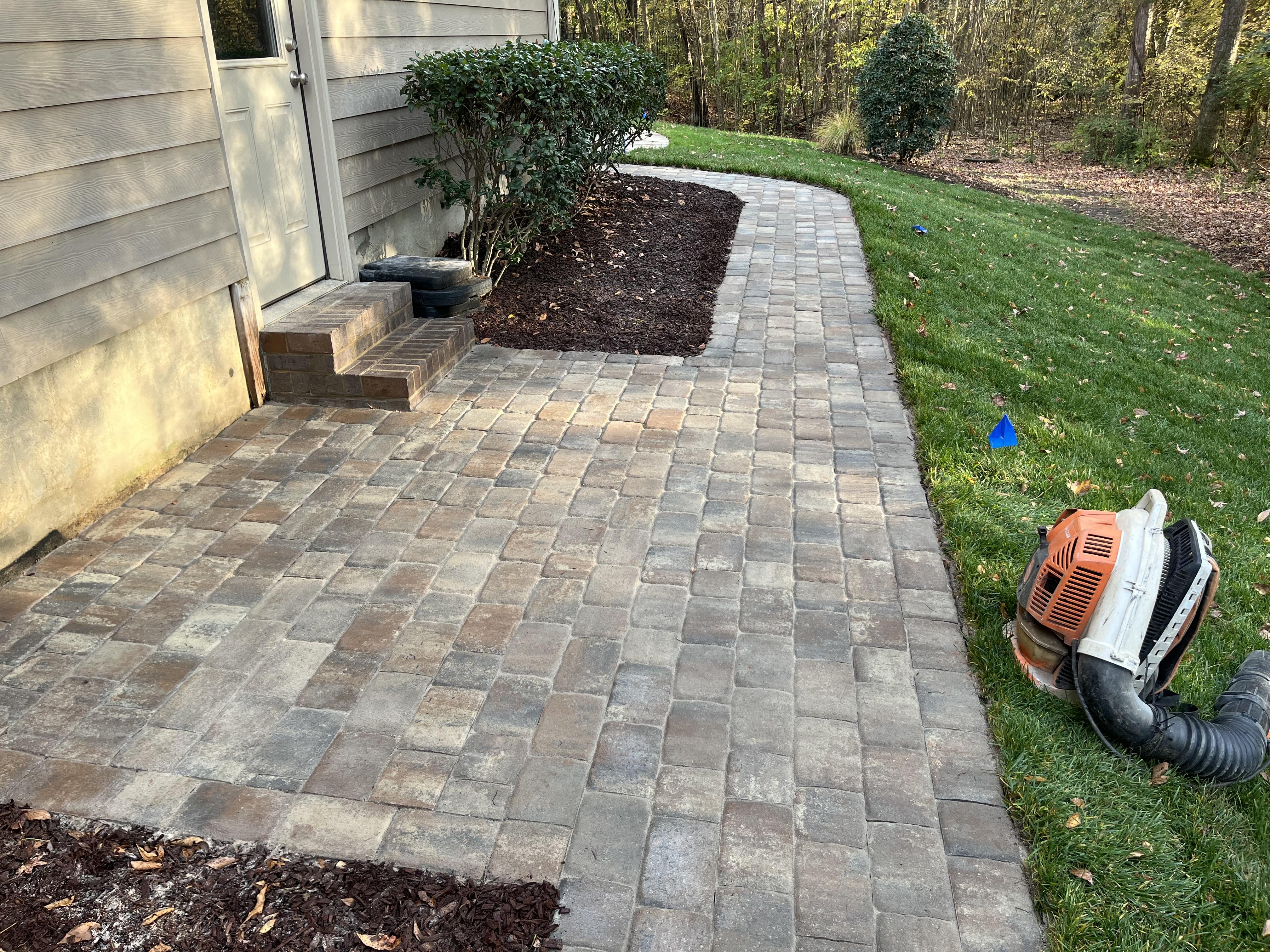
If the look of joints bothers you, pavers are worth considering — they handle movement through their own joints instead. Our comparison of paver patios and concrete patios lays out the trade-offs.
Southern Style Turf & Design plans joint layout with the slab design on concrete patios, walkways, and flatwork around Lake Norman.
Frequently asked questions
Are the lines in my driveway cracks or joints?
Straight, uniform, consistently spaced lines are control joints cut on purpose. Irregular lines that wander or change width are cracks.
Can control joints be added after the concrete has cured?
A slab can be saw-cut later, but once shrinkage cracking has already occurred the joints cannot undo it. Cutting early is what makes them work.
Does reinforcement remove the need for joints?
No. Reinforcement helps hold cracks tight and keeps the slab acting as one piece, but the slab still shrinks and still needs joints to control where it relieves stress.
Want this looked at on your property?
We give free, no-pressure on-site estimates across Denver, Mooresville, Cornelius, Davidson, Huntersville and Troutman.