Artificial turf has come a long way, and for certain spaces around a Piedmont home it genuinely outperforms grass. For others it creates problems a lawn never had. The difference usually comes down to what the space is for.
Where synthetic turf works well
Small, heavily used areas where grass has already given up are the strongest case: a dog run, a shaded side yard, a narrow strip between a patio and a fence, a rooftop or dock-adjacent space.
It also suits places where mowing is awkward — steep slivers of slope, tight courtyards, and areas boxed in by hardscape.
In deep shade under mature trees, where no turf type will establish, synthetic is often the only green option short of converting the area to beds or groundcover.
Where natural grass still wins
Large open lawns are the clearest case. Cost scales directly with area, and a big synthetic lawn is a substantial investment with a finite lifespan.
Grass also stays dramatically cooler in summer. Synthetic surfaces in full Carolina sun get hot enough to be uncomfortable barefoot and for pets in the afternoon.
And a healthy lawn absorbs rainfall. Replacing a large area with a synthetic system changes how water moves across the property, which has to be designed for.
The base is the whole job
Synthetic turf installed over existing soil fails in Piedmont clay. Water has to be able to get through the turf and then away, or the area stays wet and smells.
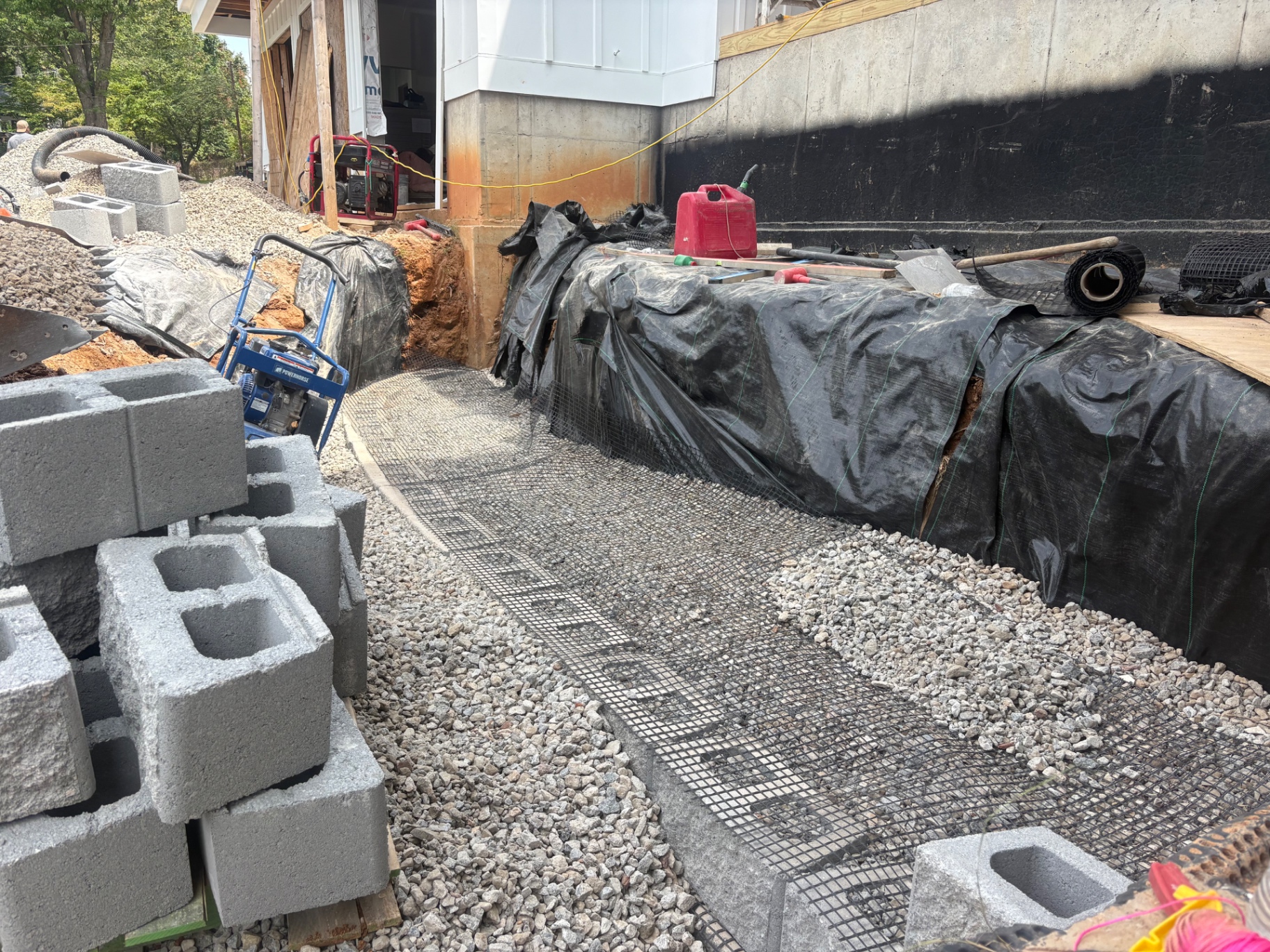
A proper installation looks a lot like hardscape base work: excavation, a compacted aggregate base that drains, a leveling course, secure edging, and turf seamed and anchored so it does not wrinkle.
Where the subsoil will not accept water, the base needs its own drainage outlet — the same principle as base preparation under a patio.
Maintenance reality
Low maintenance is not no maintenance. Synthetic turf needs ongoing care to look and smell right, especially with pets.
- Rinsing, particularly in pet areas.
- Blowing or raking off leaves and debris before they mat down.
- Brushing fibers upright in high-traffic areas.
- Topping up infill over time.
- Weed control at the edges and seams.
- Eventual replacement, since the product has a service life rather than lasting indefinitely.
A practical middle ground
Most homeowners are best served by using synthetic only where grass has repeatedly failed, and improving conditions for real turf everywhere else.
Often the underlying problem is compaction, shade, or drainage rather than the grass itself, and fixing those is less expensive than replacing the lawn with a manufactured surface. Choosing the right turf type for the site matters too.
Southern Style Turf & Design handles the grading, drainage, and base work that either option depends on for properties around Lake Norman.
Helpful outside reference
For grass-specific mowing, feeding and timing calendars, NC State TurfFiles is the state's turf research resource.
Frequently asked questions
Does artificial turf drain in clay soil?
Only if it is installed over a properly excavated and compacted aggregate base, with an outlet where the subsoil will not absorb water. Laid on clay, it holds water underneath.
Does synthetic turf get hot?
Yes. In full afternoon sun it runs considerably hotter than grass, which matters for barefoot use and pets.
How long does artificial turf last?
It has a service life rather than being permanent, and heavy traffic or intense sun shortens it. Plan on eventual replacement as part of the cost comparison.
Want this looked at on your property?
We give free, no-pressure on-site estimates across Denver, Mooresville, Cornelius, Davidson, Huntersville and Troutman.