A retaining wall holds soil that cannot hold itself. If your slope is stable and you simply do not like it, there are cheaper ways to deal with it — regrading, planting, matting, terraced beds. If the slope is moving or supporting something, those alternatives buy time rather than solve the problem.
Regrading a slope instead of holding it
The most direct alternative is to make the slope gentler. Cut soil from the top, fill at the bottom, and lay the whole face back to an angle that holds itself and can be mown.
It works where there is horizontal room to spread the slope out, where nothing at the top would be undermined by cutting into it, and where the total height difference is modest.
The advantages are real: no structure, no drainage system behind it, nothing to maintain, and nothing to fail. Where the site allows it, regrading is usually the better long-term answer.
Planting and matting for erosion, not structure
Deep-rooted planting stabilises the surface of a slope permanently. Native grasses, junipers and spreading groundcovers knit soil together and slow water crossing the face.
Erosion control matting holds the surface while that planting establishes. Biodegradable blankets pinned over seeded soil stop the first season of rain from undoing the work, then break down.
Both address surface erosion. Neither addresses mass movement — a slope sliding as a body is not stopped by roots, and planting a moving slope is a way of losing the plants as well as the soil.
Diverting the water first
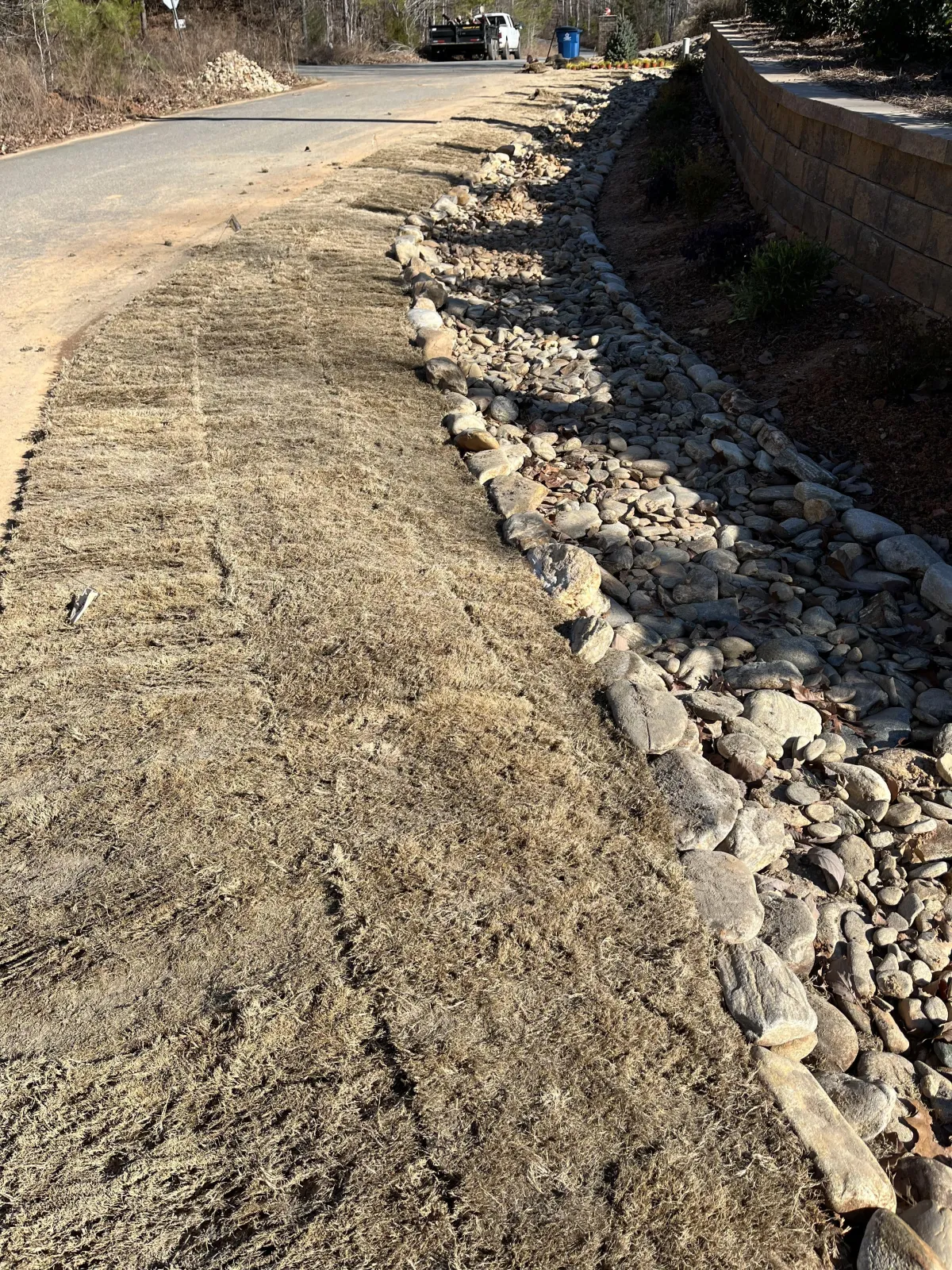
Often the cheapest intervention of all. Much slope erosion is caused by concentrated water arriving at the top — a downspout, a driveway edge, a neighbouring property.
A swale or curtain drain across the top of the slope intercepts that water and routes it to a controlled outlet, and the slope below frequently stabilises with nothing further. Where a wall is still needed, reducing the water first reduces what the wall has to deal with.
Boulders, timber edging and planted terraces
Boulder placement suits informal settings and gentle banks. Large stones set into a slope break up the length of the face and create planting pockets. They are not a substitute for an engineered wall, but on a modest bank they do useful work and look at home.
Low timber or block edging holding shallow planted terraces is a landscape treatment rather than a structural one. It works where each step is small and the slope is already stable.
The honest limit on both: as soon as the height being held at any one point becomes significant, you are building a retaining wall without the base, drainage and reinforcement one would have.
The point where an alternative stops being cheaper
Alternatives stop being the sensible choice when the slope is moving as a mass, when a structure, driveway or boundary sits above or below it, when there is not enough horizontal room to lay it back, or when you need genuinely level usable ground rather than a gentler slope.
They also stop being cheaper when they have to be redone. Two rounds of planting and matting on a slope that was always going to need a wall costs more than the wall, and it costs a couple of seasons as well.
Southern Style Turf & Design will tell you when a slope does not need a wall — regrading and erosion control are services we provide too. Free on-site estimate across Lake Norman.
Frequently asked questions
What can I do instead of building a retaining wall?
Regrade the slope to a gentler angle where there is room, divert the water arriving at the top, and stabilise the surface with matting and deep-rooted planting. Boulders and low planted terraces suit modest banks.
Will planting stop a slope from slipping?
Planting stops surface erosion, not mass movement. A slope sliding as a body needs a structure; planting it simply loses the plants along with the soil.
Is regrading cheaper than a retaining wall?
Usually, where there is horizontal space to lay the slope back and nothing at the top would be undermined. It also has no drainage system or structure to maintain afterward.
When is a wall unavoidable?
When the slope is moving, when a structure or driveway sits above or below it, when the lot is too narrow to regrade, or when you need level usable ground rather than a gentler slope.
Want this looked at on your property?
We give free, no-pressure on-site estimates across Denver, Mooresville, Cornelius, Davidson, Huntersville and Troutman.