Yards flood after rain in Denver NC for three reasons that usually show up together: the clay soil underneath absorbs water far more slowly than water arrives, the lot was graded during construction in a way that sends runoff toward the house instead of away from it, and the roof dumps hundreds of gallons at the foundation with nowhere to go. Fixing one without the other two rarely holds.
The soil is the starting point
If you have lived in Lincoln County through a few storm seasons, you already know the pattern. It rains hard for twenty minutes, and a section of the yard turns into a pond that is still there two days later. Grass thins out. The crawl space smells damp. A low spot near the patio never quite dries. That is not bad luck, and it is not something that will settle out on its own.
Most of the Lake Norman region sits on Piedmont clay. Cecil and related soil series dominate the area, and they share a trait that matters enormously for drainage: very fine particles, packed tightly, with little pore space for water to move through. Sandy soil might take in an inch of rain in an hour. Heavy clay can take a small fraction of that.
That does not make clay bad soil. It holds nutrients well, and it is why the region grows what it grows. But it means the margin between “the ground absorbed the rain” and “the rain is now sitting on top of the ground” is narrow, and a heavy Carolina thunderstorm clears it easily.
Here is the practical test. After a soaking rain, look at how long standing water lasts. Water gone within a few hours is normal. Water still sitting after 24 hours means infiltration has failed, and no amount of aerating or reseeding is going to change that.
Construction made it worse
This is the part most homeowners are never told. When a house goes up, the topsoil across the building envelope is stripped off. Heavy equipment then works the site for months, compacting whatever subsoil is left. At the end, a thin layer of soil and sod goes down over the top, the yard looks finished, and the homeowner moves in.
North Carolina State Extension describes this directly in its guidance on modifying soil for plant growth around your home, noting that topsoil and subsoil are commonly removed during construction and that compacting soil, while necessary for structural strength, restricts the growth and drainage that a landscape depends on afterward.
So a newer subdivision lot often behaves worse than an older one, even though the grass looks better. What you have is a few inches of decent soil sitting on a compacted clay layer that functions closer to a hard pan. Water soaks through the top few inches, hits the compacted layer, and stops. It then travels sideways along that layer until it surfaces somewhere lower — which is why the puddle often appears nowhere near where the water landed.
Where the water is actually coming from
Before anyone starts digging, it is worth working out the source. In this area it is almost always one of four things.
- Your roof. A moderately sized roof sheds a startling volume of water in a single storm, all of it concentrated at a handful of downspouts. Discharging onto a splash block at the foundation is a machine for saturating the soil against your house — the most common cause we see, and the cheapest to fix.
- The grade. Ground should fall away from the foundation for the first ten feet or so. On plenty of lots it does the opposite, either from rough original grading or from years of mulch, bed edging and settling reversing it.
- The lot next door. Subdivisions are graded as a system, with swales that move water between properties toward a common outlet. Those swales get filled in without anyone knowing what they were. The water still arrives; it just no longer has a path.
- Hard surfaces. Driveways, patios and walkways absorb nothing. A driveway sloping toward the garage or the yard delivers its entire surface area of runoff to one spot.
Diagnosing your own yard
You can learn a lot in one rainstorm with no tools at all. Go outside while it is raining, not after. Watch where the water enters the yard, what path it takes, and where it stops. Photograph it. The path is the information; the puddle is only the endpoint.
Then check the downspouts. Are they discharging at the foundation or carried away from it? Follow each one and note where it lets out. Walk the perimeter of the house and look at which way the ground falls in the first few feet. If you cannot tell by eye, a level on a straight board will show it quickly.
Finally, dig a small hole about a foot deep in the problem area, fill it with water, and see how long it takes to drain. If it is still holding water hours later, the soil is the constraint, and surface fixes alone will not be enough.
What actually solves it
The right fix depends entirely on what the diagnosis turned up, which is why we will not quote a solution over the phone.
- Downspout drainage. Solid pipe carrying roof water well away from the house to a daylight outlet that does not create a problem somewhere else. Often the highest-value single change on a property.
- Regrading. Reestablishing positive fall away from the foundation and restoring swales that were filled in. Sometimes minor shaping, sometimes machine grading and excavation work.
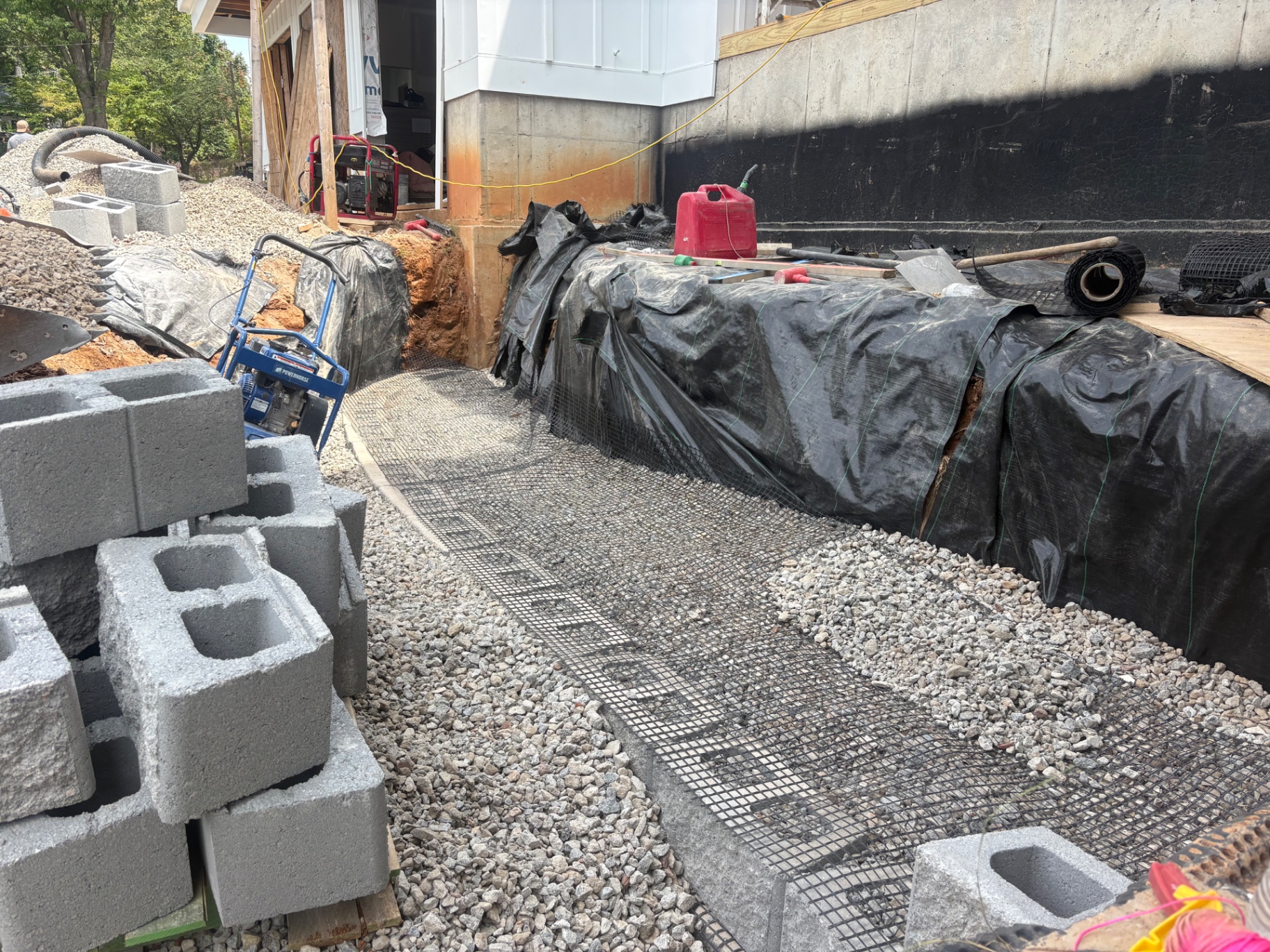
- French drains. Perforated pipe in a gravel-filled trench, wrapped in filter fabric, intercepting subsurface water and carrying it to an outlet. Done correctly these last decades. Done as a gravel trench with no pipe, no fabric and no outlet, they silt up and quit within a couple of seasons.
- Catch basins. For a defined low spot that collects water, a basin tied into a solid pipe run gives that water somewhere to go.
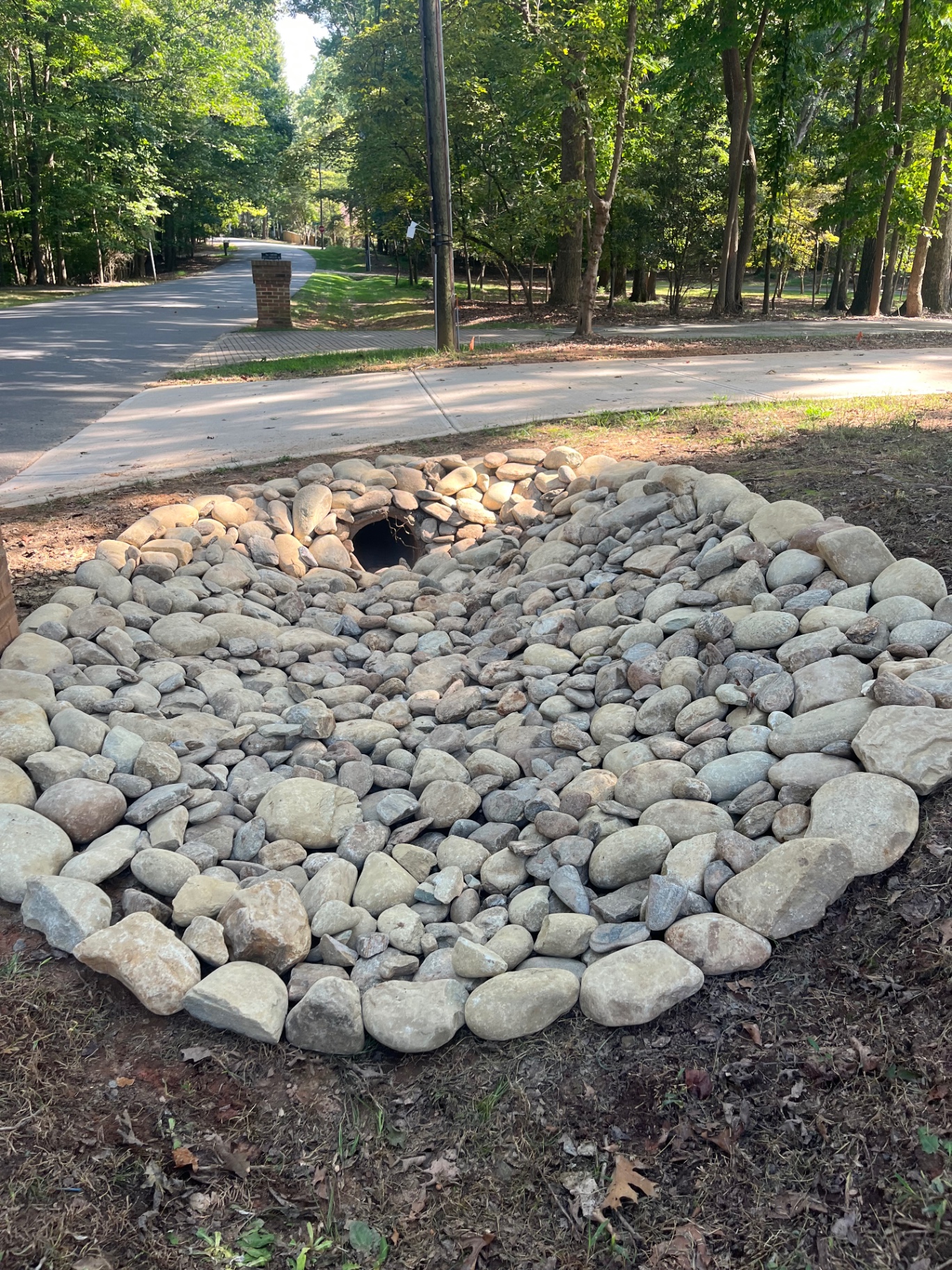
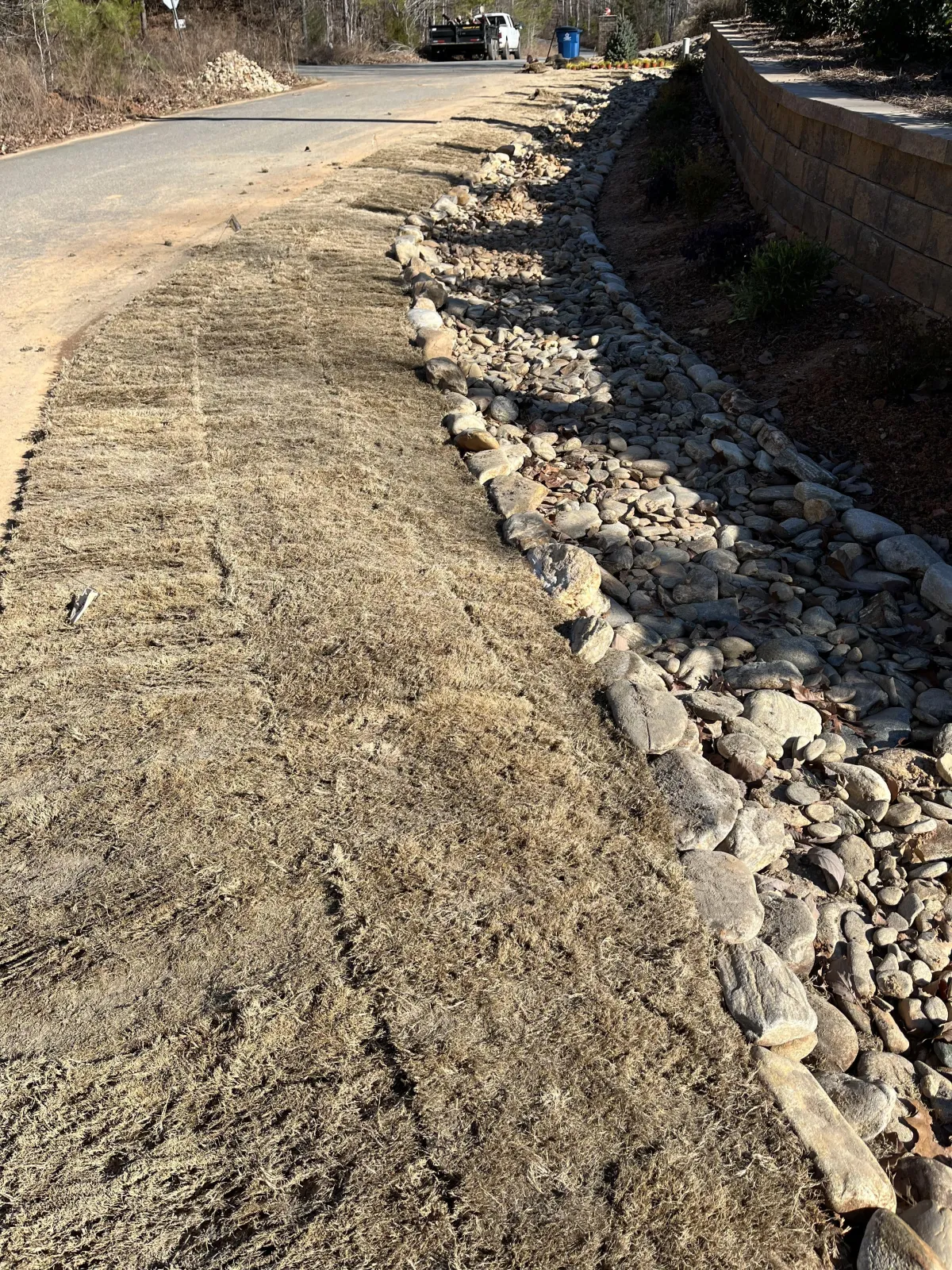
- Dry creek beds. Where runoff crosses a yard along a consistent path, a stone-lined channel handles the volume and looks like it belongs there. We built one in Mooresville for exactly that reason after runoff started washing out the ground behind the house.
What does not solve it
The one thing every real option has in common is an outlet. Water has to end somewhere lower than where it started, and that is often the hardest part of the design on a flat Lake Norman lot.
Core aeration helps compacted turf breathe. It does not fix a drainage failure, and it will not move water off a lot. Hauling in topsoil to fill a low spot moves the puddle rather than removing it, and on a lot that already drains poorly it can make the neighbor’s problem worse.
Gravel poured into a trench with no pipe and no fabric works for one season and then packs with silt. And French drains installed without an outlet simply relocate the water underground, where you cannot see what it is doing to your foundation.
When to bring someone in
Call if water reaches the foundation, if a crawl space or basement is taking on moisture, if a low area holds water more than 24 hours, or if runoff is actively eroding soil. Those conditions get more expensive the longer they run.
Southern Style Turf & Design handles drainage solutions across Lake Norman, including Denver and the surrounding Lincoln County neighborhoods. Every project is diagnosed on site by our own crew before anything is quoted, and the estimate is free with no trip fee.
Frequently asked questions
Why does my yard flood after every rain in Denver NC?
Because Piedmont clay soil absorbs water slowly, and most subdivision lots had their topsoil stripped and the subsoil compacted during construction. Water that cannot soak in runs across the surface until something stops it.
How long should standing water last after a storm?
Water gone within a few hours is normal. Water still sitting after 24 hours means infiltration has failed and the yard needs drainage work, not aeration or reseeding.
Will a French drain fix it?
Only if the water is subsurface and there is a real outlet lower than the trench. A French drain with no pipe, no filter fabric or no outlet silts up and quits within a couple of seasons.
Do you charge for the assessment?
No. We diagnose the property on site before quoting anything, and estimates are free with no trip fee throughout Denver and the Lake Norman area.
Want this looked at on your property?
We give free, no-pressure on-site estimates across Denver, Mooresville, Cornelius, Davidson, Huntersville and Troutman.