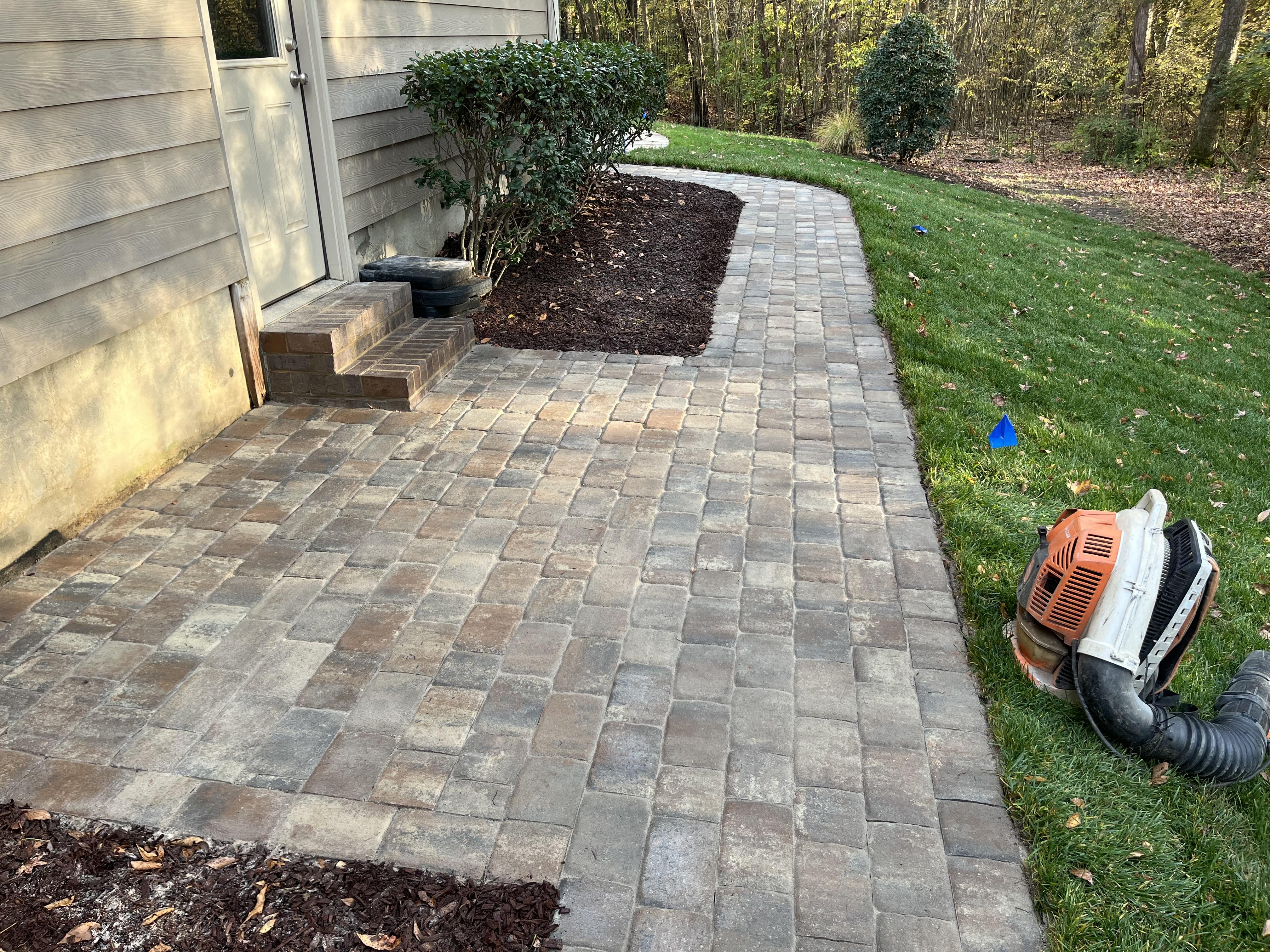
A few weeks after a new paver patio goes in, homeowners sometimes call worried that the stone is fading or staining. In almost every case what they are seeing is efflorescence — a natural, temporary white haze that has nothing to do with workmanship.
What efflorescence is
Concrete pavers are made with cement, and cement contains soluble salts. As moisture moves up through the paver and evaporates at the surface, it carries some of those salts with it and leaves them behind as a fine white or gray film.
It is a chemistry event, not a defect. Nearly every manufacturer addresses it in their literature, and it can appear on one section of a patio and not another simply because that area dries at a different rate.
The haze usually looks worst in cool, damp weather and can seem to come and go with the seasons during the first year.
Why it shows up more on some patios
Moisture supply is the main driver. A patio that stays damp underneath — from a poorly drained base, a downspout discharging nearby, or irrigation spray — pushes more water through the pavers and produces more visible haze.
That is one more reason base work and drainage matter as much as the surface pattern. A properly built base sheds water instead of holding it against the underside of the stone.
Shade is the other factor: a patio that never gets direct sun dries slowly, so deposits build up before rain can rinse them away.
What to do about it
The simplest answer is patience. Ordinary rainfall dissolves and carries away most efflorescence over the first year, and the patio gradually evens out on its own.
If you would rather not wait, the options in order of aggressiveness are:
- Rinse and scrub with plain water and a stiff brush, then let the surface dry completely.
- Use a cleaner labeled specifically for efflorescence on concrete pavers, following the manufacturer's dilution and dwell time.
- Test any cleaner in a hidden corner first — acidic products can dull or etch some paver finishes.
- Address the moisture source if the haze keeps returning: redirect a downspout, adjust irrigation heads, or correct a low spot that holds water.
Sealing and timing
Sealing a patio too early can trap the salts under the sealer, where they look cloudy and are far harder to remove. Most sealer manufacturers ask you to wait until the initial efflorescence has run its course.
If sealing is part of your plan, it is worth reading our overview of keeping joint sand and the surface in good shape before buying product.
Once the patio is past its first year and the haze has cleared, a quality sealer can help keep joint sand in place and make routine cleaning easier.
When it is not efflorescence
A uniform white bloom that rinses lighter when wet is efflorescence. Dark rings, rust stains, or a chalky residue that never changes with moisture are usually something else — organic staining, fertilizer, or a spill.
Persistent green or black patches point to moss and algae rather than salts, which is a drainage and sunlight issue we cover separately.
Southern Style Turf & Design builds paver patios across the Lake Norman area and walks homeowners through what to expect in the first season, including this one.
Frequently asked questions
Does efflorescence mean my pavers were installed wrong?
No. It is a natural reaction between moisture and the cement in the pavers. It appears on well-built patios too, though ongoing moisture from poor drainage can make it worse and longer-lasting.
How long does the white haze last?
Most of it clears within the first year as rain rinses the deposits away. Heavily shaded or persistently damp areas can take longer.
Can I pressure wash it off?
A gentle rinse is fine, but high pressure blasts joint sand out of the seams and can scar the paver face. A stiff brush and a cleaner made for pavers is safer.
Want this looked at on your property?
We give free, no-pressure on-site estimates across Denver, Mooresville, Cornelius, Davidson, Huntersville and Troutman.