A concrete pad is the least glamorous thing we pour and one of the most useful. Sheds, generators, hot tubs, HVAC units, trash bins, grills, basketball goals and boat trailers all last longer sitting on a level, drained slab than on ground.
Common uses and what each one needs
Shed and equipment pads want to be a little larger than the structure so the walls are not right at the edge, and set slightly proud of the surrounding grade so water does not run in.
Hot tub and generator pads are the ones where thickness and base preparation matter most, because the load is concentrated and permanent. Manufacturer requirements govern; those should be handed to whoever pours it.
Trash bin, grill and firewood pads are simple, but they benefit from being sized for how the space is actually used — room to open a lid or step around, not just the footprint of the object.
Play and basketball pads need the most attention to flatness and to what happens at the edges, since balls and feet find every lip.
Sizing
Measure the object, then add working space on the sides you will use. Almost every pad we are asked to extend later was sized to the object rather than to the activity.
For anything with a door, add enough in front for the door swing plus a person standing outside it.
For anything serviced by a technician — generators, pool equipment, HVAC — leave the clearance the manufacturer specifies rather than the minimum that fits.
Base, thickness and reinforcement
The base under a pad does more for its life than the concrete does. Stripped topsoil, compacted stone and a uniform depth prevent the differential settlement that cracks slabs.
Thickness and reinforcement follow the load. A firewood pad and a generator pad are not the same slab, and it is worth saying up front what the pad is for.
Clay subgrade that stays wet is the classic Piedmont failure mode: it softens, the slab bridges, and a crack opens. Getting the water away from the pad is part of building the pad.
Drainage and finish
Slope the pad so water runs off it in a direction that helps — never toward the house, a crawlspace vent or a door.
Broom finish is standard for grip. Smooth finishes are for indoor or covered areas only; outdoors they are slick when wet.
Where the pad sits against a slope, a small swale or a drain line uphill keeps runoff from washing across it.
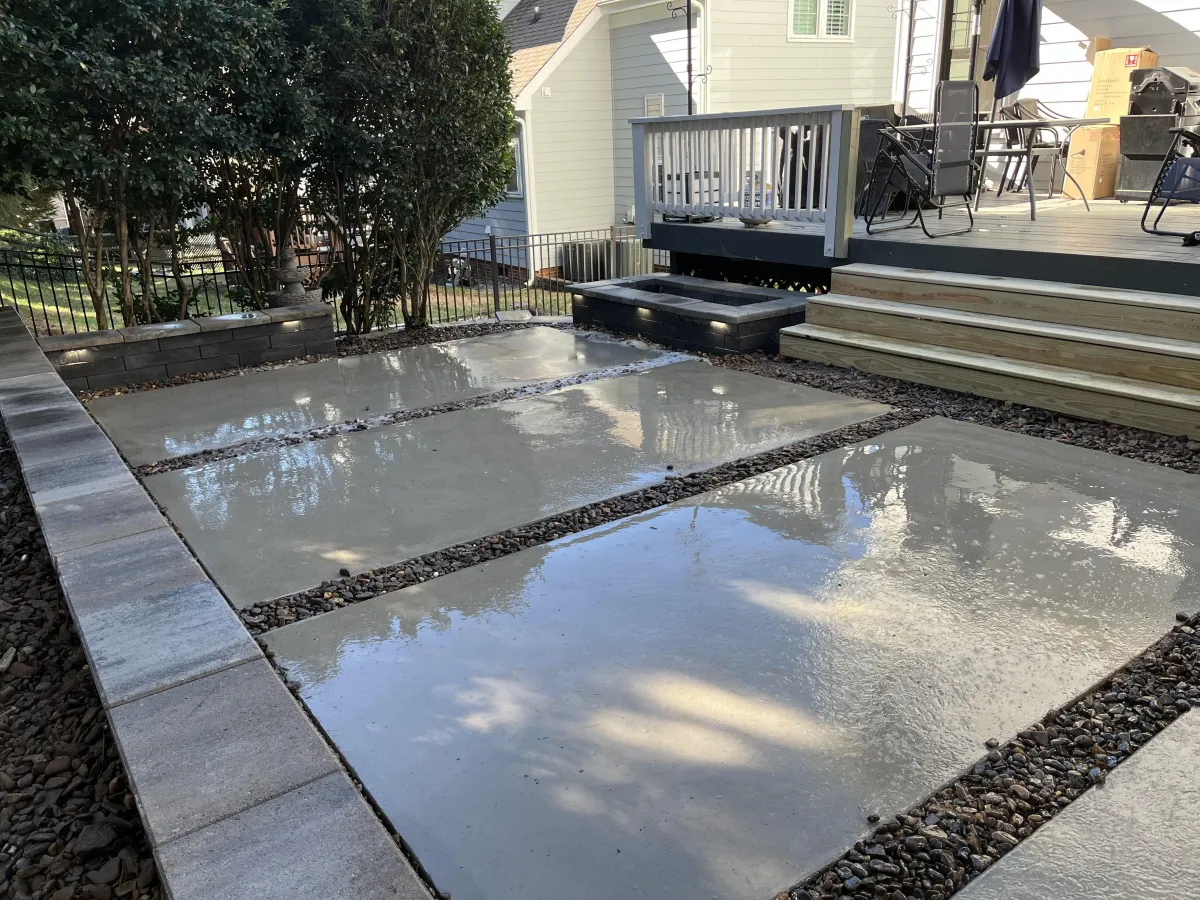
Southern Style Turf & Design pours pads, patios, walkways and steps around Lake Norman and handles the grading around them at the same time. Free on-site estimate.
Frequently asked questions
Does a shed pad need a permit?
That depends on the structure and your jurisdiction, not on the slab alone. Check with your county or town building department, and with your HOA if you have one, before scheduling.
Can a pad be poured over existing gravel?
Sometimes, if the gravel is clean, deep enough and properly compacted. Usually it needs regrading and topping up first.
How soon can I use a new pad?
Light foot traffic comes first, heavy loads considerably later. Your installer will give timings based on the mix and weather.
Want this looked at on your property?
We give free, no-pressure on-site estimates across Denver, Mooresville, Cornelius, Davidson, Huntersville and Troutman.