Most failed drainage was installed by someone who did almost everything right. The failures cluster around a small number of specific mistakes, and nearly all of them share one property: they are invisible once the trench is backfilled, and they only reveal themselves a season or two later when the work has to be dug up again.
1. Gravel with no pipe and no fabric
The classic. A trench filled with stone looks like a French drain and works like one for a while, because the voids between the stones hold water.
Then soil fines migrate into those voids. On clay this happens fast. Within a season or two the gravel is packed with silt, the voids are gone, and the trench is a buried strip of wet mud.
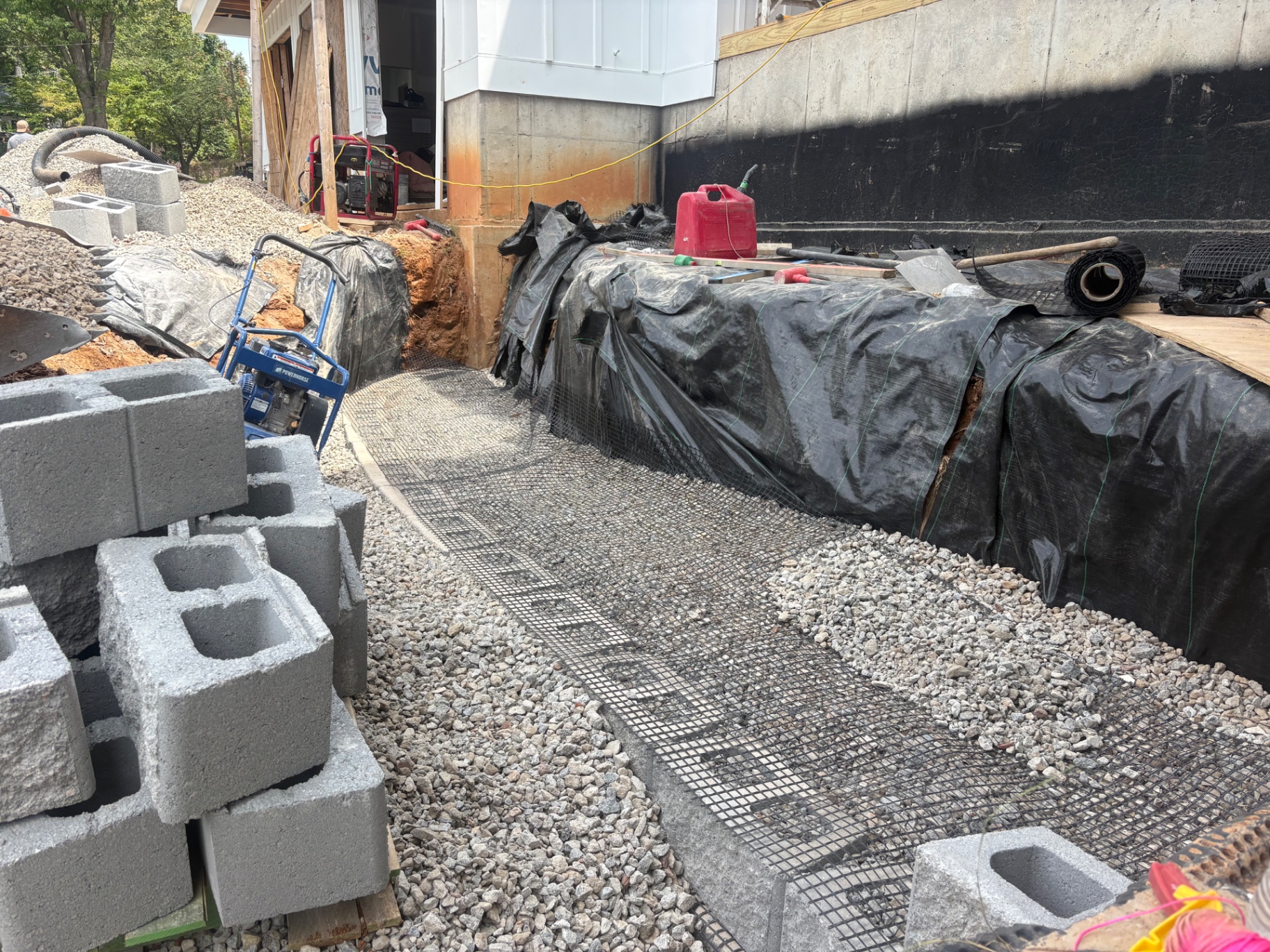
A French drain needs perforated pipe to carry the water, gravel around it to let water reach the pipe, and filter fabric wrapped around the gravel to keep fines out. Remove any one of the three and you have shortened its life to a couple of years.
2. Draining to nowhere, or onto the neighbour
A drain that ends in the middle of the yard has relocated the puddle. A drain that ends at the property line has started an argument.
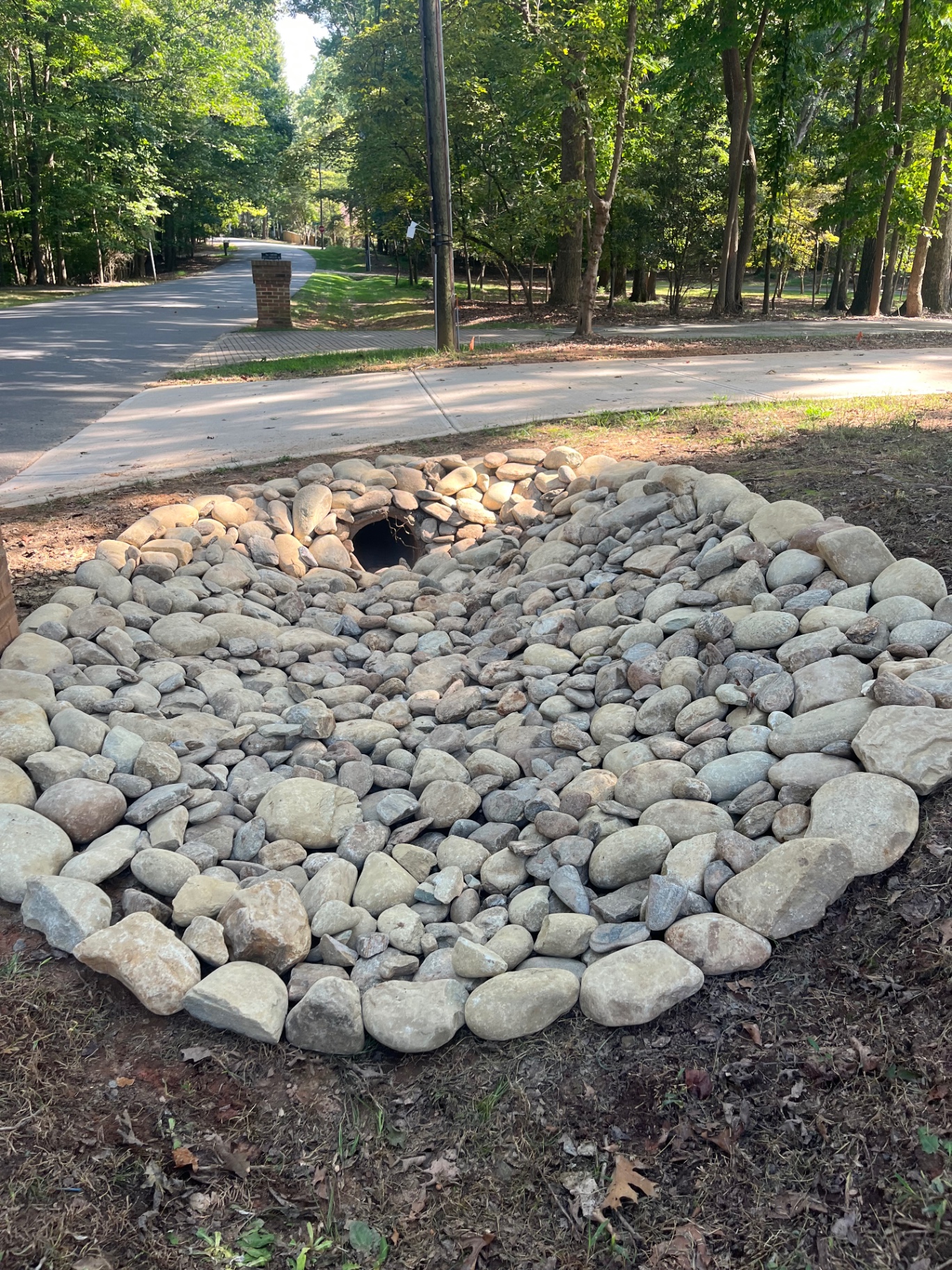
Water has to reach a point lower than where it was collected, on land where it is allowed to be. It cannot go into a sanitary sewer or a septic field, and concentrating flow onto adjoining property in a way that creates a problem there is how neighbours end up in dispute — even when the ground naturally slopes that way.
Establish the outlet before the first shovel goes in the ground. Everything else in the design follows from it.
3. Digging without knowing what's buried
Call 811 before digging. It is free, it is the law in North Carolina, and it locates public utilities.
What it does not locate is the private stuff: irrigation lines, low-voltage lighting cable, invisible fence, gas lines running to a grill or fire pit, septic lines and the drain field. Those are the homeowner's to know about, and drainage trenches cut straight across exactly the depth irrigation lives at.
Mark irrigation heads and zones before starting. Repairing a cut mainline mid-project is annoying; discovering it in April when the system is turned on is worse.
4. No consistent fall
Pipe needs to fall continuously toward the outlet. Not on average — continuously. Any flat or back-pitched section is a place water stops and sediment settles, and that section becomes a blockage that grows.
Eyeballing a trench bottom does not work. The ground surface is not level even where it looks level, and a dip of an inch over a few feet is enough to matter.
5. The wrong pipe in the wrong place
Perforated pipe belongs only in the collection zone, wrapped and surrounded by gravel. Solid pipe carries water the rest of the way. Using perforated pipe for the whole run means the water you collected leaks back into the soil partway along — often right beside the house.
Corrugated pipe is also worth avoiding for long conveyance runs. The ridged interior catches debris and slows flow. Smooth-wall pipe carries sediment through and can be cleared with a hose or a snake if it does block.
6. Sizing for a normal rain
A system that handles routine rainfall and overwhelms in a storm has failed at the only moment anyone cares about. Inlet capacity, pipe diameter and the number of collection points all need to suit the volume the property actually sheds, including roof water arriving at the same time.
Overflow matters too. Where the design capacity is exceeded, the water should have a safe route rather than finding the house.
7. Treating the symptom instead of the source
Installing a French drain across a lawn that is wet because four downspouts discharge onto it is expensive, and it is also unnecessary. Piping the roof water away would have solved it.
The order that saves money: roof water first, surface shape second, collection and piping third, subsurface interception last. Working the other way round means paying for a system sized to handle water you could have removed from the equation.
Southern Style Turf & Design gets called to redo DIY drainage regularly, and the honest advice is that the diagnosis is the part worth getting help with. Free on-site estimate across Lake Norman, written quote before any work.
Frequently asked questions
What is the most common DIY French drain mistake?
Gravel with no perforated pipe and no filter fabric. It works briefly, then soil fines clog the stone and the trench becomes a buried strip of mud.
Do I need to call 811 before digging in my yard?
Yes — it is required in North Carolina and it is free. It marks public utilities only, so you still need to locate irrigation, lighting cable, invisible fence and septic lines yourself.
Should I use corrugated or smooth-wall drainage pipe?
Smooth-wall for conveyance runs. The ridges inside corrugated pipe trap debris and slow flow, and it is much harder to clear if it blocks.
Can a badly installed French drain be repaired?
Sometimes the outlet or a blockage can be corrected, but a trench where the gravel has silted up usually has to be dug out and rebuilt, which is why doing it right the first time is the cheaper route.
Want this looked at on your property?
We give free, no-pressure on-site estimates across Denver, Mooresville, Cornelius, Davidson, Huntersville and Troutman.