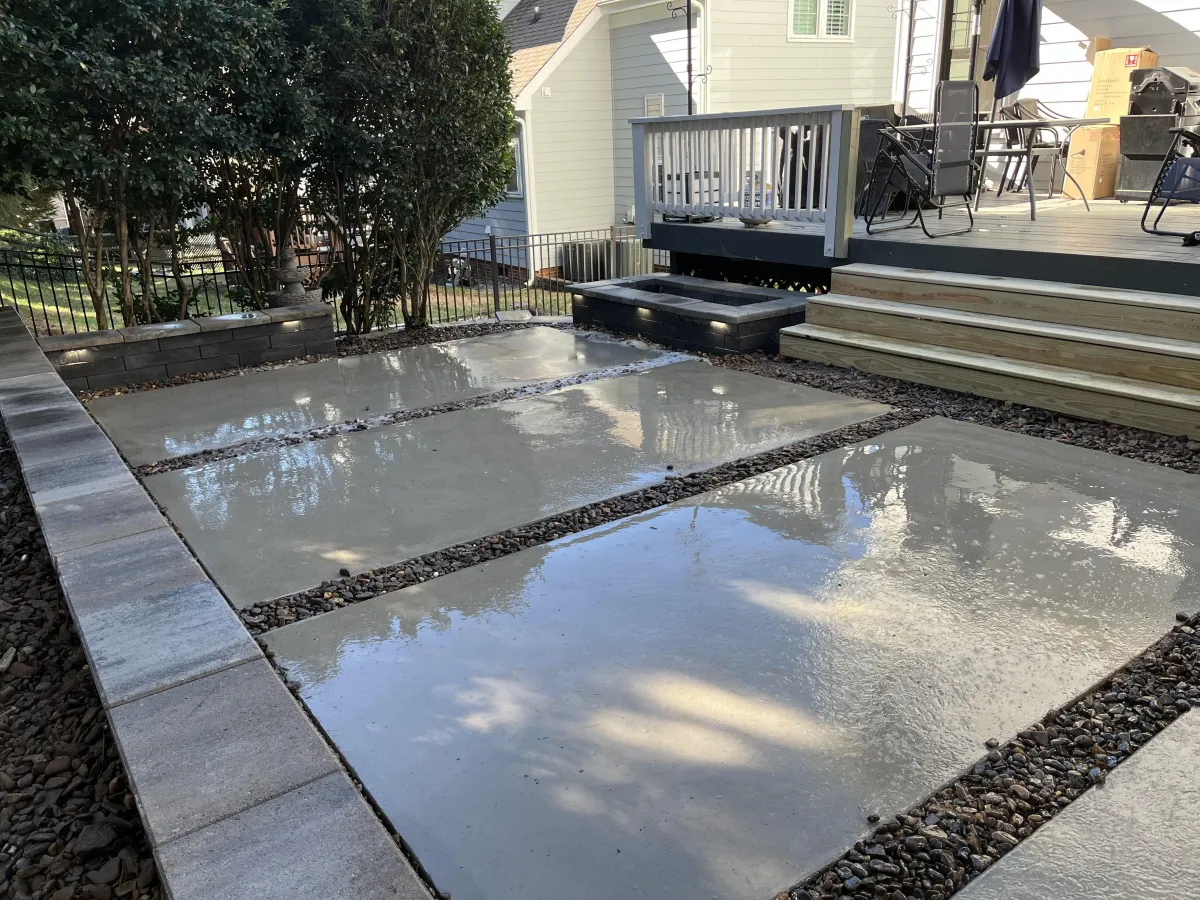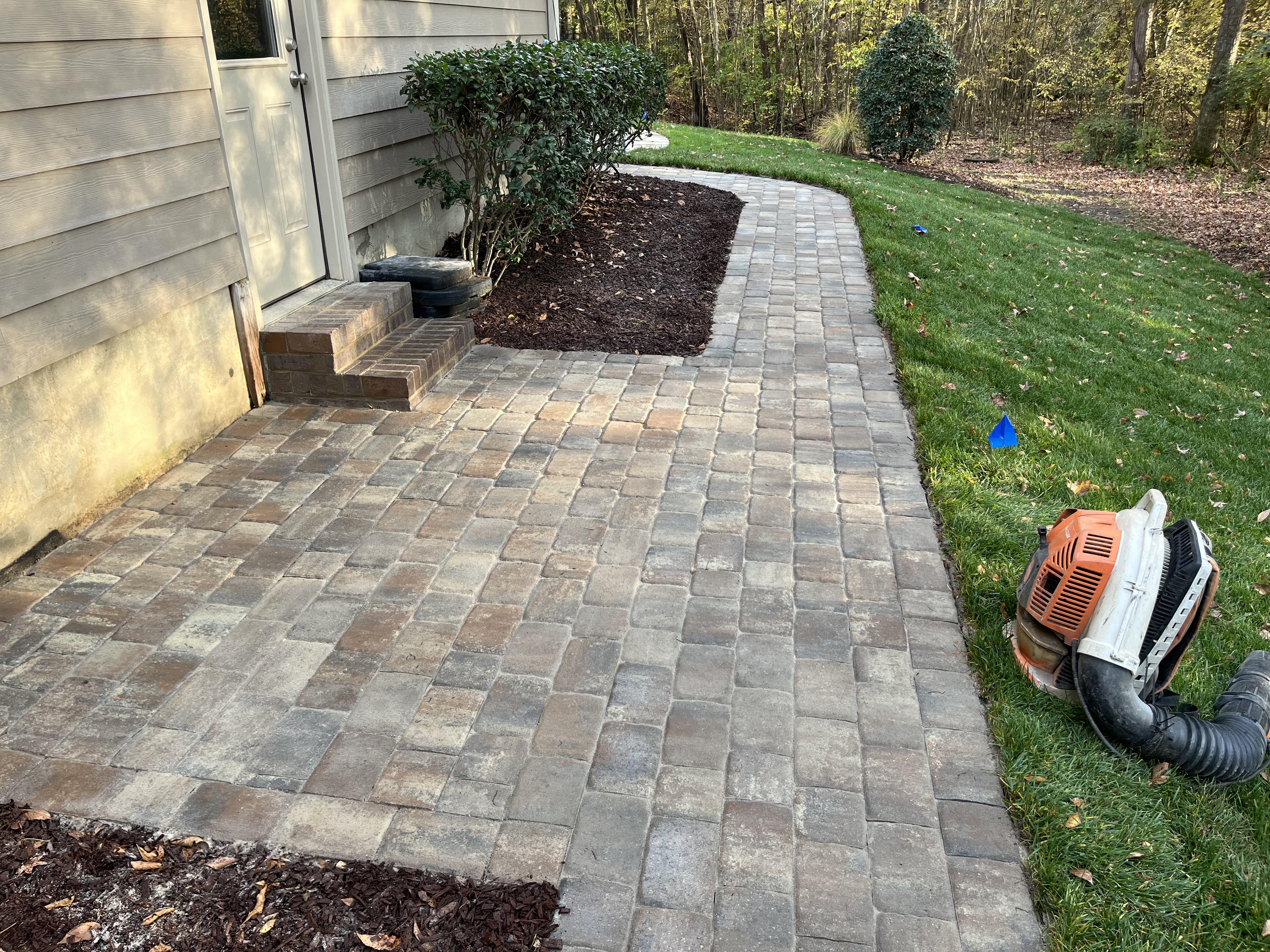
Poured concrete generally costs less up front and gives a clean continuous surface. Pavers cost more initially and can be lifted, repaired and reset individually. On Piedmont clay, where the ground moves seasonally, that repairability is the argument that decides most projects — but not all of them.
Upfront cost against long-term repairability
Concrete is one pour over a prepared subgrade. Pavers are individual units laid on a compacted aggregate base with a bedding layer and edge restraint, which is more material and more labour. That difference is real and it shows in the quote.
What you buy with the difference is repairability. A settled paver is lifted and reset. A damaged one is replaced with a matching unit. A section disturbed by a utility repair is taken up and relaid, and afterward you cannot tell.
Concrete cannot be repaired invisibly. A cracked slab can be patched, sawn and partly replaced, or resurfaced, but the repair will always be visible. A slab that has settled or heaved usually has to be broken out and re-poured.
We do both, and we say the same thing to everyone: the right choice depends on how you weigh those two facts.
How each behaves when the ground moves
Piedmont clay shrinks and swells seasonally, and everything built on it experiences that.
Pavers are a flexible system. Small movements are absorbed across many joints, and the surface can be relaid to correct any that accumulate. Freeze-thaw and settlement produce a paver to reset rather than a failure.
Concrete is rigid. It is designed to crack, and control joints are placed to decide where that happens — a properly placed slab cracks along the joint rather than across the middle. But uneven ground movement produces cracks the joints did not plan for, and once a slab has cracked and settled differentially, the levels no longer match.
This is the core reason pavers dominate residential patios in this region.
Appearance and underfoot
Concrete gives a clean, continuous, modern surface with no joints to maintain, and it suits contemporary architecture particularly well. Finishes vary the look, though we do not offer every decorative finish — worth asking about specifically rather than assuming.
Pavers give texture, colour blending, borders and patterns, and they read as traditional or transitional more easily than as minimal.
Underfoot, pavers are slightly less smooth and considerably less slippery when wet. Large smooth concrete areas can be slick, which matters around a pool or on a shaded patio that stays damp.
Maintenance compared
Pavers: top up joint sand annually, reset the occasional unit, wash as needed. Nothing complicated, but it is a recurring small task.
Concrete: essentially nothing for years, then a crack to live with or address. Sealing is optional for both and helps with staining.
Both grow moss and algae in shade, and both need the water shed off them properly.
Which suits which kind of yard
Choose pavers when the patio is large or shaped, when utilities run beneath it, when the ground is known to move, when appearance in a traditional setting matters, or when you want the option to extend or repair later.
Choose concrete for a clean modern surface, for utility areas, for a simple rectangle where budget matters, for slabs and pads, and where a continuous jointless surface is the point.
Southern Style Turf & Design installs both across Lake Norman — pavers, and poured concrete for patios, walkways, slabs and steps. We do not pour driveways. Free on-site estimate, written quote.
Frequently asked questions
Is a concrete patio or a paver patio better?
Concrete usually costs less up front and gives a clean continuous surface; pavers cost more and can be lifted, repaired and reset individually. On clay that moves seasonally, repairability is why pavers are the more common choice here.
Do concrete patios always crack?
Concrete is designed to crack, which is what control joints are for — they decide where it happens. Cracks outside the joints usually indicate ground movement or subgrade problems.
Which is better around a pool?
Pavers, generally. They are less slippery when wet than a large smooth concrete surface, and individual units can be lifted if plumbing beneath needs attention.
Can a concrete patio be repaired?
It can be patched, sawn and partly replaced, or resurfaced, but never invisibly. Pavers can be repaired so the work does not show.
Want this looked at on your property?
We give free, no-pressure on-site estimates across Denver, Mooresville, Cornelius, Davidson, Huntersville and Troutman.