Most privacy plantings that disappoint around Lake Norman were not bad plants. They were the wrong size for the space, the wrong match for the light, or set into clay that stays wet after every storm. This guide walks through how to choose between trees, shrubs and a mixed screen for yards in Denver, Huntersville, Cornelius, Mooresville and the rest of the lake area.
Trees, shrubs or a mix: start with what you are blocking
Privacy trees such as Green Giant arborvitae, American holly and Eastern red cedar are the answer when you need to block a two-story house, a deck or a view from higher ground. They get tall, but they also get wide, and they need room on both sides of the property line.
Evergreen shrubs fit narrower strips and lower sightlines: a patio, a ground-floor window, a side yard between close homes. They take less space, are easier to keep in bounds, and are a better match for small lots in newer subdivisions.
A mixed planting pairs a few tall trees with shrubs in front or between them. It handles uneven sightlines, looks more natural than a single-species row, and limits the damage if one plant type struggles with pests or disease.
Six questions to answer before you pick a plant
Walk the planting line and answer these honestly. Each one narrows the list:
- Sunlight: how many hours of direct sun does each section of the line get? Arborvitae thins out in heavy shade; hollies handle part shade better.
- Soil drainage: does water sit there after a heavy rain? Many popular evergreens decline in soil that stays wet.
- Available width: measure from the property line or fence to the nearest bed edge, driveway or wall. That number rules out more plants than any other.
- Mature height: how tall does the screen actually need to be, and are there power lines, eaves or views you want to keep?
- Maintenance: will you prune every year, or do you want a plant that holds its shape mostly on its own?
- Budget and timing: how soon do you need privacy, and how does that weigh against the cost of larger nursery stock?
Comparing common Lake Norman privacy plants
The sizes below are typical mature ranges from the NC Extension Gardener Plant Toolbox, except Emerald Green, which comes from published cultivar data. Growth rates are estimates under good conditions. Real growth depends on sun, soil, water and care, and no plant is guaranteed to reach a given size by a given year.
| Plant | Typical mature size | Sun | Growth rate | Maintenance | Practical drawbacks |
|---|---|---|---|---|---|
| Green Giant arborvitae | 40–60 ft tall, 12–18 ft wide | Full sun, light afternoon shade | Fast; up to 3–4 ft/yr in optimal conditions | Low; little pruning needed | Far wider than most people expect; not salt tolerant; root rot risk in poorly drained soil |
| Emerald Green arborvitae | About 10–18 ft tall, 3–4 ft wide | Full sun to part shade | Slow to moderate; roughly 1 ft/yr or less | Low | Not drought tolerant; thins in shade; deer browse American arborvitae |
| Nellie Stevens holly | 15–30 ft tall, 8–25 ft wide | Full sun to part shade; some afternoon protection helps | Fairly quick | Moderate; prune to shape in winter | Spiny leaves; best kept off wet sites |
| American holly | 40–60 ft tall, 10–20 ft wide | Full sun to part shade | Slow | Low to moderate | Slow to screen; not suited to small yards or flooding soil; berries need male and female plants |
| Eastern red cedar | 30–40 ft tall, 10–20 ft wide | Full sun | Moderate to fast | Low | Needs airy space; intolerant of continuously wet soil; host for cedar-apple rust |
What each option does well
Green Giant arborvitae is the common pick for fast, tall screening in full sun. NC State notes that it tolerates a wide range of soils and resists most pests and deer, but its 12 to 18 foot mature width is the detail people miss.
Emerald Green arborvitae stays narrow, which makes it a better fit for tight side yards. It grows much more slowly, tops out far lower, and needs steady water while it establishes.
Nellie Stevens holly makes a dense, prickly screen and tolerates heavy clay better than many hollies, according to the Plant Toolbox. It also handles part shade, which helps along wooded edges.
American holly is a native tree with berries for wildlife, but it grows slowly and gets large. It is a long-term screen for a big yard, not a quick fix for a small one.
Eastern red cedar is native, drought tolerant and tough, and it works as a looser, informal screen on larger, sunny lots. NC State suggests spacing it 12 to 24 feet apart, so it is not a tight hedge plant.
For lower screens, evergreen shrubs such as wax myrtle and inkberry holly are native options worth considering, and both are known for handling moister ground than arborvitae. Check the Plant Toolbox for the size of the specific variety, since cultivars vary widely. Avoid invasive plants such as Chinese privet, even where they are sold as quick screens.
Spacing for mature width, not nursery width
Plants are sold small, so a row looks sparse on planting day. The temptation is to pack them close. Spacing should be set from the mature width and the effect you want: closer for a continuous wall where neighboring plants knit together, wider if you want each plant to keep its own shape.
A common rule of thumb for a solid screen is spacing at roughly half to two-thirds of the plant's mature width. Set the row back from the fence, driveway or house by at least half that width too, or you will be cutting one side flat within a few years.
Staggering plants in two offset rows can close gaps faster than a single row, but only where there is room for both rows at mature size.
Fix soil, grading and drainage before you plant
Lake Norman yards often sit on dense red clay, and new construction lots are frequently compacted and graded so water runs toward property lines. That is exactly where privacy screens get planted.
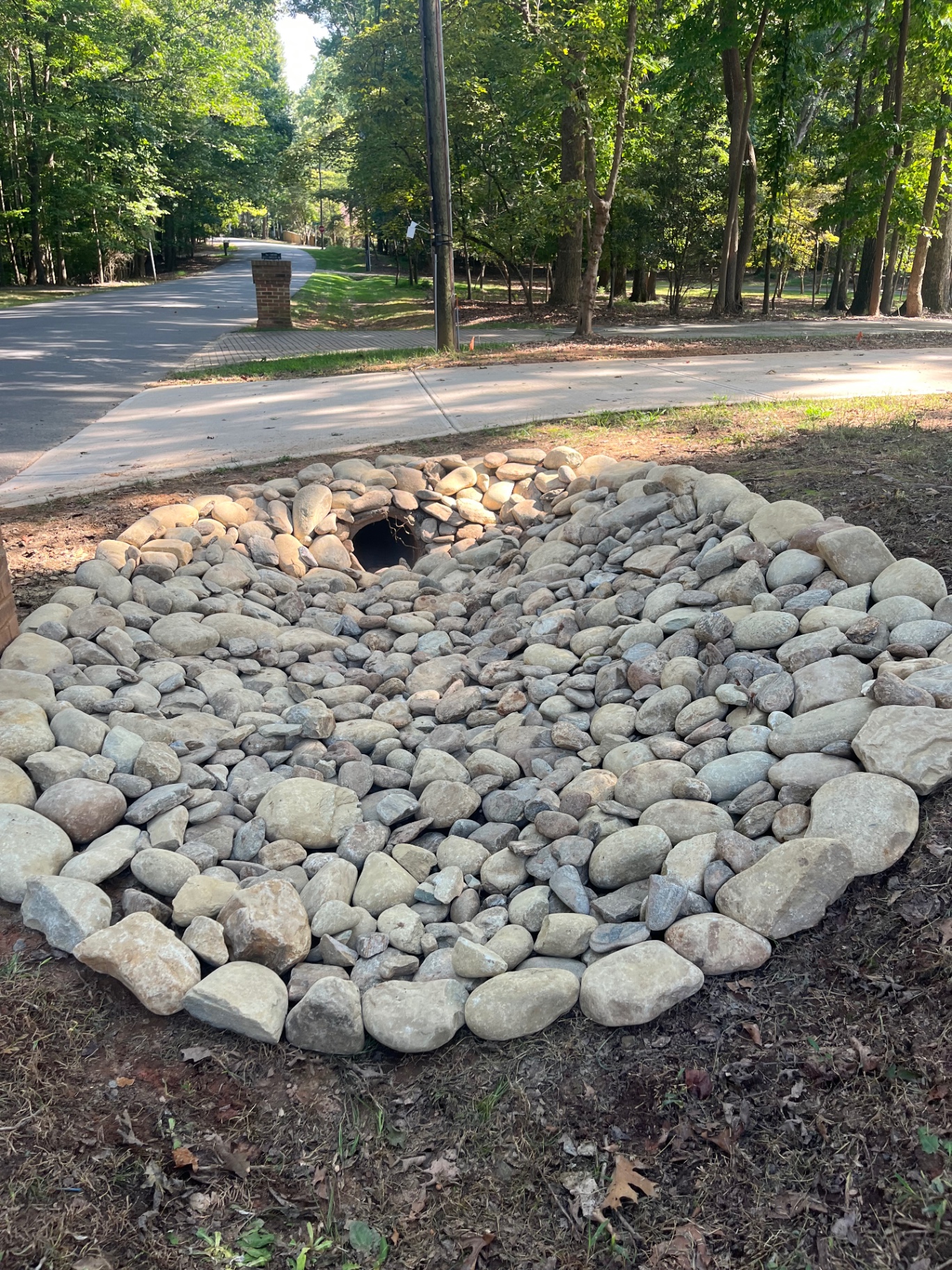
If water stands along the planting line after rain, if the soil is compacted subsoil, or if runoff from a neighbor's yard crosses the spot, deal with it first. That may mean loosening and amending the bed, raising the planting area slightly, regrading, or yard drainage correction to move water away. Planting first and fixing water later usually means digging the plants back up.
When planting, dig wide rather than deep, set the root flare at or slightly above grade, and mulch two to three inches without piling it against the trunk.
Bigger plants: earlier screening, not instant privacy
Larger nursery stock blocks more of the view on day one, and that is worth paying for when timing matters. But bigger plants usually take longer to establish, need more water through their first summers, and can sit still for a season or more while the roots catch up.
Even a tall row will have gaps until neighboring plants grow together. Expect a screen to fill in over several growing seasons, not overnight. Our guide to the privacy screening timeline goes deeper on realistic expectations.
Common privacy planting mistakes
These are the problems we see most often when homeowners ask us to look at a screen that is not working:
- Overcrowding: plants spaced for instant coverage shade each other out, lose lower branches, and become harder to keep healthy.
- Large trees in narrow spaces: a Green Giant or American holly in a six-foot strip will overrun the fence, the driveway or the neighbor's yard.
- Treating every evergreen as wet-soil tolerant: arborvitae, Nellie Stevens holly and red cedar all do poorly in soil that stays wet.
- Ignoring shade: arborvitae planted under tall hardwoods tends to thin out on the shaded side.
- Skipping first-year watering: new plants need deep, regular water through their first summer, and drip irrigation does this better than lawn spray heads.
- Planting a single species in a long row: one pest or disease problem can open gaps along the whole screen.
Choosing what fits your property
If you are weighing plants against a fence, our comparison of privacy fence vs. privacy plants covers that decision. If arborvitae and laurel are on your shortlist, see Skip Laurel vs. Green Giant. When you are ready, our privacy screening service starts with an on-site look at your light, soil and available space.
Helpful outside reference
For step-by-step planting depth and root flare details, see the ISA guide to planting a tree.
Frequently asked questions
What is the fastest privacy tree for a Lake Norman yard?
Green Giant arborvitae is usually the fastest common choice in full sun, with NC State citing up to 3 to 4 feet a year in optimal conditions. Real growth depends on soil, water and sun, so treat that as a best case, not a promise.
What privacy plants handle a narrow side yard?
Emerald Green arborvitae and compact evergreen shrubs fit narrow spaces far better than Green Giant, American holly or red cedar, which can reach 10 to 20 feet wide or more.
What should I plant where the yard stays wet?
First find out why it stays wet. If the drainage can be corrected, more plants become options. Where it cannot, native shrubs known for moist ground, such as inkberry holly and wax myrtle, are usually better choices than arborvitae or Nellie Stevens holly.
Will deer eat my privacy screen?
NC State lists American arborvitae, including Emerald Green, as prone to deer browsing. Green Giant and American holly are described as deer resistant, though hungry deer can still damage almost anything.
Want this looked at on your property?
We give free, no-pressure on-site estimates across Denver, Mooresville, Cornelius, Davidson, Huntersville and Troutman.