Both can hold a slope. They fail differently, they cost differently, and on Piedmont clay that difference matters.
How each system works
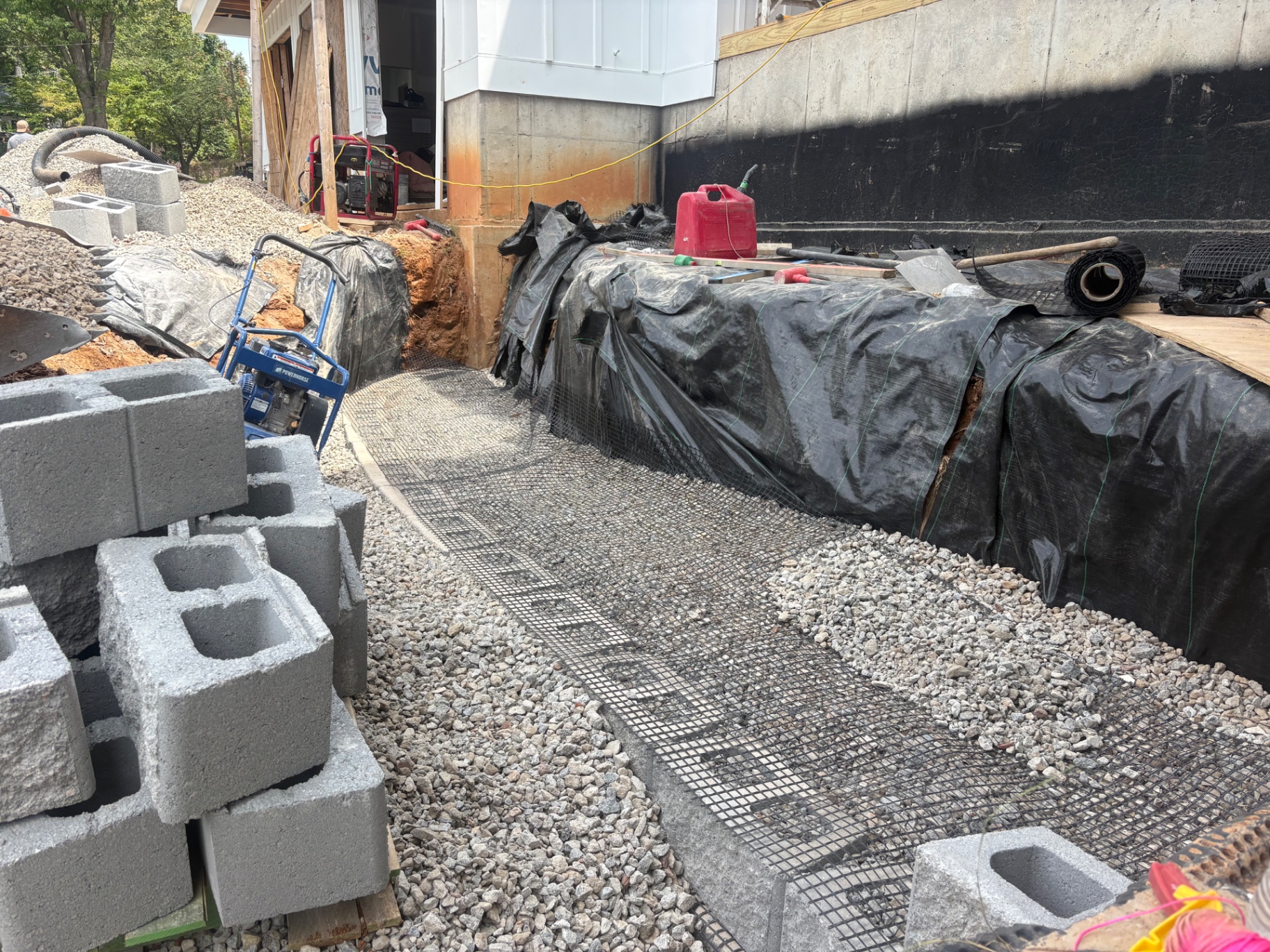
A segmental block wall is a mortarless, gravity-and-friction system: units interlock, drainage stone sits behind, and geogrid ties the wall back into the soil mass on taller builds. A poured concrete wall is a rigid monolithic structure with steel reinforcement and footings.
Movement and cracking
Block walls flex slightly with seasonal soil movement and freeze-thaw without cracking, because there is no continuous rigid face. Concrete resists movement until it does not — then it cracks, and the crack does not close.
Drainage behind the wall
Both need it. Water trapped behind any retaining wall adds hydrostatic pressure, which is the leading cause of failure we see. Block walls handle it with a full column of clean drainage stone and a perforated drain at the base; concrete relies on weep holes and drain tile, which are easier to under-build.
Cost, repairs and appearance
Segmental block is generally faster to install with no formwork or cure time, and it offers a wide range of textures, colors, caps, steps and curves. A damaged section can be rebuilt. Poured concrete suits specific structural situations and can be faced with stone, but repair is patching.
For most residential Lake Norman walls — terracing a slope, leveling a yard, framing a patio — segmental block is the practical choice. Walls carrying structural loads or unusual geometry may call for engineered concrete.
Helpful outside reference
Design and installation guidance for segmental retaining walls comes from the National Concrete Masonry Association.
Frequently asked questions
Which lasts longer?
Both last decades when built right. Longevity comes from base, drainage and reinforcement rather than the material itself.
Do block walls need footings?
They need a compacted aggregate leveling pad, typically with the first course buried — not a poured concrete footing.
Can a block wall be curved?
Yes. Curves, steps and seat-wall returns are much easier in block than in formed concrete.
Want this looked at on your property?
We give free, no-pressure on-site estimates across Denver, Mooresville, Cornelius, Davidson, Huntersville and Troutman.